Faisal Islam: Mandelson, Darling and the conversation I can't forget

 Getty Images
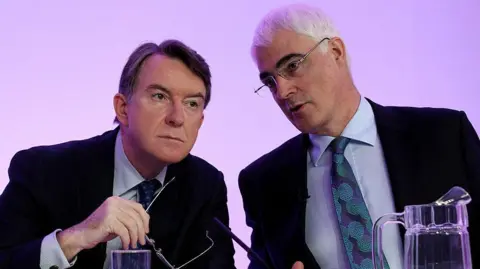
For a decade and a half, I have wondered about a private conversation I had with the late Alistair Darling, Chancellor of the Exchequer under Gordon Brown, about the financial crisis.
Darling told me about a painful and angry telephone conversation he had with Jamie Dimon, chief executive of US banking giant JP Morgan, at the end of 2009 when the UK government announced plans to tax bankers' bonuses.
Some of it had been reported at the time, such as a threat to pull plans for JP Morgan's massive new headquarters in the UK.
But - to my utter astonishment - details of the background and the context to this call appear to be in the Epstein files released on Friday, and appear to have involved the unlikely combination of Peter Mandelson, Jeffrey Epstein and the suggestion of "mild threats" over the bonus tax.
Mandelson, then business secretary, seemingly suggested that Dimon should threaten Darling mildly over the tax.
In 2011, Darling told me something more about the call in a series of private interviews I did with him as part of the preparation work for Back from the Brink: 1000 Days at Number 11, his book about the crisis.
Dimon had raised the fact that JP Morgan was one of the biggest purchasers of UK government debt, leaving the clear suggestion in Darling's mind that America's biggest bank could effectively stop lending to Britain.
While Darling refused to cave, he did recall that a number of bankers rang him up with what seemed like a script to complain about the bonus tax, urging a U-turn.
It occurred with such regularity that Darling started to tell them what they were about to say before they said it, having heard the words repeatedly.
Much, though not all of this, is relayed in Darling's book.
He wrote: "Mr Dimon was very, very angry.. he said that his bank bought a lot of UK debt and he wondered if that was now such a good idea. I pointed out that they bought our debt because it was a good business deal for them. He went on to say they were thinking of building a new office in London but they had to reconsider that now."
While the office got built, the bonus tax remained and JP Morgan did not, in the end, stop buying gilts, this episode is an incredible live example of the relative power of government and financial markets, of the actual dynamics of the "bond vigilantes".
That this may have been orchestrated partly via Epstein, with Mandelson emailing advice, while Britain's business secretary sitting on the financial crisis cabinet of Prime Minister Gordon Brown, is staggering.
The policy meant that bankers' bonuses over £25,000 would be liable for an extra 50% tax rate.
The files indicate that Mandelson wrote to Epstein in December 2009, before the Dimon call saying: "Treasury digging in but I am on [the] case."
An email bearing Epstein's name on 15 December, said: "[A]ny real chance of making the tax only on the cash portion of the bankers bonus."
A subsequent email on 17 December, highlighted by tax expert and Labour Party member Dan Neidle, showed Epstein asking Mandelson if Dimon should call Darling one last time.
Mandelson apparently responds that Dimon should "mildly threaten" Darling.
The Dimon call to Darling that I recount above happened a week later on 23 December, 2009.
Mandelson has told the BBC on Sunday that every UK and international bank was making the same argument about the impact on UK financial services.
"My conversations in government at the time reflected the views of the sector as a whole not a single individual," he said.
Mandelson has been approached for comment.
Correction 2 February: This article was amended to give the full title of Alistair Darling's book: Back from the Brink:1000 Days at Number 11.
