Meet the man turning childhood memories into tiny worlds

 Lee Smithson
Working patiently at his desk, scattered with tools, wood and paint, Lee Smithson brings entire worlds to life in miniature.
The 45-year-old from Sheffield carefully crafts scenes inspired by everyday life, long-forgotten buildings and treasured childhood memories.
"As long as I've got a photo to work from I can usually recreate it," he says.
Lee's passion for miniatures began in childhood, sparked by hours spent building Airfix kits.
His knack for detail later led to a career as a clinical engineer for the NHS, but in 2016 he took the plunge and set up his business, Sheffield Miniatures.
In 2024, he expanded further when fellow miniature maker John Gittens retired and Lee incorporated JG Miniatures into his business.
 Lee Smithson
"He was selling up, so bringing his business into mine, I've managed to make it a full-time job for myself," says Lee.
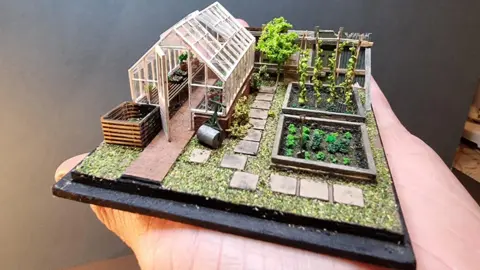
He now makes models of any scale and subject matter, but says by far the most common requests are keepsakes and miniatures for toy soldier collectors.
"I make anything really, I mean I've even made narrowboats, but the main thing I make is people's buildings from the past," he tells BBC Radio Sheffield.
"I've done bakers, butchers, local corner shops, buildings that have been demolished even."
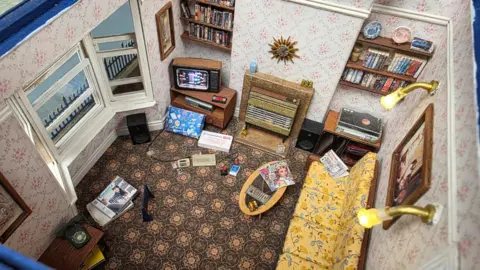
One of his most personal creations is a 1980s living room, inspired by his own childhood, which took three years to complete.
The scene includes a yellow settee with a floral pattern, paintings on the wall, a TV, a glowing gas fire, and magazines alongside games like Connect Four and Monopoly.
"It's just literally everything I remember from my childhood," he says.
"I enjoy the challenge of creating something and making it look as real as possible."
 Lee Smithson
But of course, no challenge is without its frustrations.
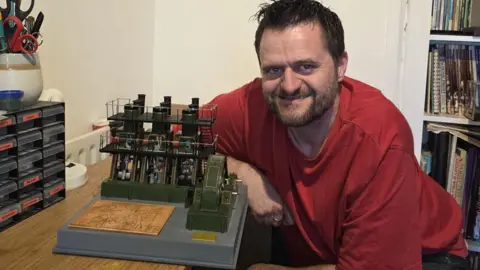
A few years ago, Lee's skills were put to the test when he was asked to create a miniature of the River Don Engine, which is on display at Kelham Island Museum.
According to the museum, it was the most powerful working steam engine in Europe and was built by Davy Brothers of Sheffield in 1905.
Lee says creating the small-scale model included "a lot of trial and error", with pieces being remade and sizes adjusted until everything was just right.
Another miniature inspired by Sheffield's industrial heritage, is a working model of Shepherd Wheel.
Dating back to the 1500s, the water-powered grinding workshop in Porter Valley played an instrumental role in the city's cutlery industry.
Lee's version is currently on display at Weston Park Museum.
Despite the acclaim his work receives, Lee is modest about his skills.
"I've never considered myself an artist but a lot of people do call me that," he says.
"I just enjoy the challenge."
Listen to highlights from South Yorkshire on BBC Sounds, catch up with the latest episode of Look North
