How a farm stay 'put a rocket' under Billy Bragg

 Getty Images
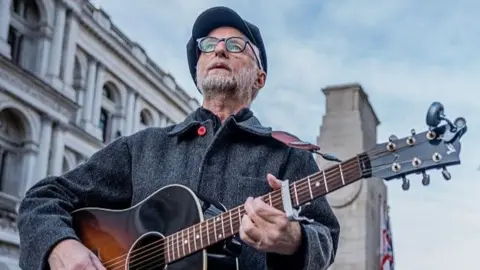
Billy Bragg has told how his career was "transformed" in a converted barn, nearly 50 years ago.
A new book details the singer-songwriter and political activist's salad days in and around Oundle, Northamptonshire, in the late 1970s.
It tells how Bragg, whose hit songs include Sexuality and A New England, a Top 10 hit for Kirsty MacColl in 1985, started recording with a band called Riff Raff in an outbuilding converted into a studio near the town.
Billy Bragg: A People's History describes their early gigs in the county and nearby Peterborough.
 Getty Images
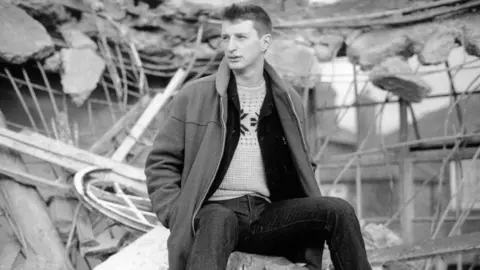
Bragg, 68, has been dubbed the "Bard of Barking" after his hometown, then in Essex but now part of east London.
His teenage band's first gig was at a street party in the town's Beccles Drive to mark Queen Elizabeth II's Silver Jubilee on 7 June 1977.
Later that summer, they headed north.
"An advertisement had been spotted in the Melody Maker, giving details of a farmhouse for rent with a converted barn studio attached," explains Stephen Rice, one of Bragg's teenage friends, in the book.
 Brian Farmer/BBC
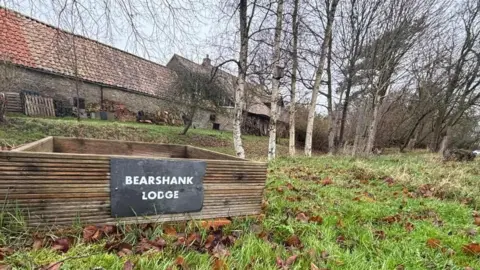
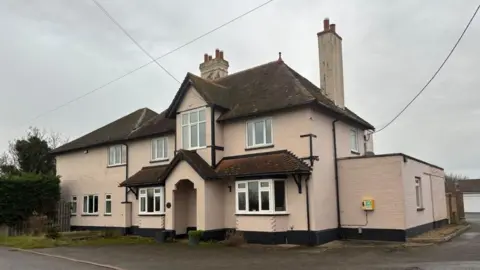
They found Bearshanks Lodge, now known as Bearshank Lodge, in Pilton, near Oundle.
"The deal included bed, board and – most importantly – a demo tape at the end of the week.
"We could only make so much noise in Billy's mum's back room".
He describes how owners, the O Lochlainn family, had "embraced 'The Good Life' and had several chickens and goats that we were invited to join in caring for".
Bragg writes: "My goat-herding abilities were pretty rudimentary but going to Bearshanks put a rocket under my songwriting skills.
"That first week really transformed us from a bunch of teenagers playing instruments into a band."
 Brian Farmer/BBC
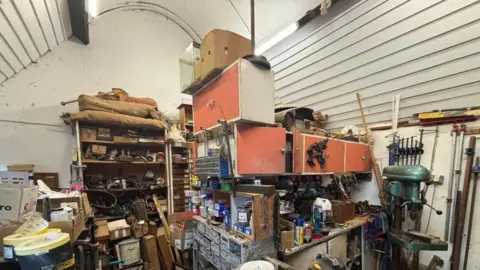
Other bands, including The Stranglers and The Teardrop Explodes, also used the studio.
It now serves as a workshop for Chris Stratford, who has owned it for more than 30 years.
He told the BBC how Bragg visited in the mid-1990s, arriving in "quite a posh car".
"He introduced himself and we walked around the house, and he commented on some changes I had made," Mr Stratford recalled.
He said the singer's half-hour visit ended with him joking that he would send a blue plaque for the house.
"He never did," said Mr Stratford.
 Brian Farmer/BBC
In the book, Bragg explains how the "Bearshanks scene had petered out" by mid-1978.
"So we moved into Oundle, lodging with a friendly family who saved us from the ignominy of having to return to living with our parents.
"They kindly put up with our antics for six months before we found our own place."
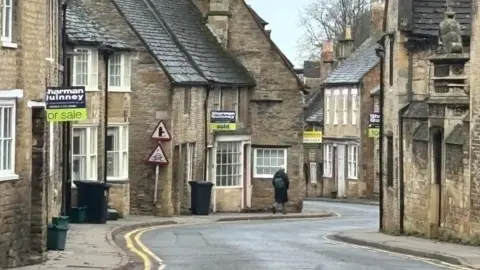
The band signed on the dole before moving into a "rather ramshackle" late 18th-Century mid-terraced house.
"Oundle was a sleepy town but it was also on a main trunk road that linked the A1 and the M1, and North Street was part of that route," he adds.
"At all times of the day and night, massive trucks thundered past, shaking the building, which we christened 'Wobblin' Heights'."
 Brian Farmer/BBC
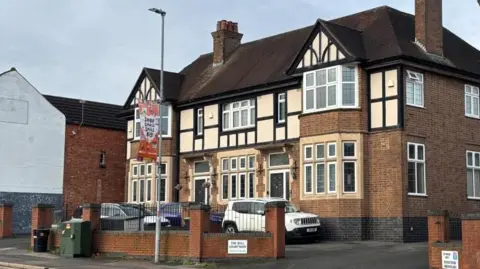
The book tells how Riff Raff "made their debut" at The Bull, in nearby Irthlingborough, in August 1977.
And Bragg also tells of a once-a-month Sunday "residency" at the Lion's Den – a function room in the car park of The Red Lion pub – where they offered the stage to other local new wave groups.
"In stylistic terms, that meant any band that didn't wear flares."
 Brian Farmer/BBC
It records some of Riff Raff's other performances, including on 25 May 1978 at The Bull and Dolphin, Peterborough.
"The band were great and a breath of fresh air - not three-chord thrash punky but with a punky attitude and close enough to rhythm and blues," recalls fan Leo Lyons.
Another fan, David High, tells how, aged 13, he saw Riff Raff support The Stranglers at Wirrina Stadium, Peterborough, on 17 September 1978.
"I wore my taken-in, mildly ripped jeans, dirty white plimsolls, a neon pink shirt that I found in my dad's wardrobe and a black tie with safety pins pinned to it, plus every punk badge I owned at the time (probably about five)," he recalls.
"I then ruined it by putting on my snorkel parka because it was really cold."
The book, published by Spenwood Books, also records how Riff Raff "ran out of steam" by the "tail end" of 1979.
Bragg joined the Army, then made his solo debut in Islington, north London, on 4 March 1982.
Follow Northamptonshire news on BBC Sounds, Facebook, Instagram and X.
