Rare mosaic reveals forgotten Trojan War tale

 University of Leicester Archaeological Services
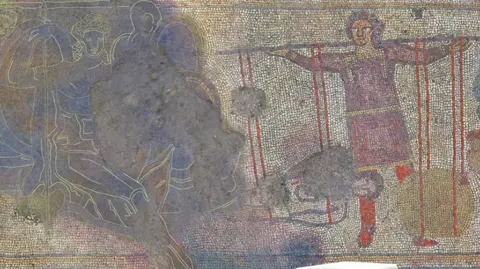
A rare mosaic found beneath a farmer's field actually depicts a different historical tale than researchers previously thought.
It was initially believed the mosaic - which was discovered in Rutland - depicted a scene from Homer's Iliad.
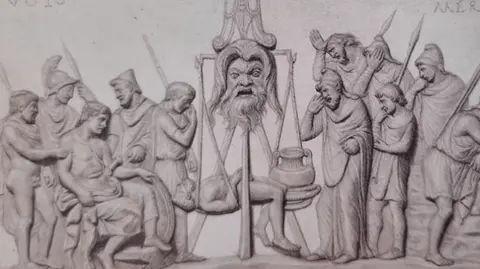
But new research from the University of Leicester has determined the piece presented an alternative version of the Trojan War story, first popularised by the Greek playwright Aeschylus.
The Ketton mosaic has previously been described by Historic England as "one of the most remarkable and significant... ever found in Britain".
It was discovered in 2020, leading to a major excavation funded by Historic England.
The piece and surrounding villa complex have since been protected as a Scheduled Monument by the Department for Digital, Culture, Media and Sport (DCMS) on the advice of Historic England.
 University of Leicester
According to this new research, the piece depicts the Greek hero Achilles and the Trojan prince Hector in three dramatic scenes - their duel, the dragging of Hector's body, and its eventual ransom by King Priam, where Hector's body is weighed for gold.
The images are said to combine artistic patterns and designs that had already been circulating for hundreds of years across the ancient Mediterranean.
This suggests, experts say, that craftsmen in Roman Britain were more closely connected to the wider classical world than has been assumed.
The Trojan War, most famously portrayed in Homer's Iliad, was a mythological 10-year campaign by Greek forces against the city of Troy to reclaim Helen of Sparta.
Dr Jane Masséglia, lead author of this new research and associate professor in ancient history at the University of Leicester, said: "In the Ketton Mosaic, not only have we got scenes telling the Aeschylus version of the story, but the top panel is actually based on a design used on a Greek pot that dates from the time of Aeschylus, 800 years before the mosaic was laid.
"Once I'd noticed the use of standard patterns in one panel, I found other parts of the mosaic were based on designs that we can see in much older silverware, coins and pottery, from Greece, Turkey, and Gaul.
"Romano-British craftspeople weren't isolated from the rest of the ancient world, but were part of this wider network of trades passing their pattern catalogues down the generations. At Ketton, we've got Roman British craftsmanship but a Mediterranean heritage of design."
Jim Irvine, who discovered the mosaic on his family farm, said the new research was a "fascinating development", adding: "Jane's detailed research into the Rutland mosaic imagery reveals a level of cultural integration across the Roman world that we're only just beginning to appreciate.
"The new paper is a suspenseful and thrilling narrative in its own right which deserves recognition."
Follow BBC Leicester on Facebook, on X, or on Instagram. Send your story ideas to eastmidsnews@bbc.co.uk or via WhatsApp on 0808 100 2210.
