Australian businessman found guilty of working for suspected Chinese spies
 ABC News: Adam Griffiths
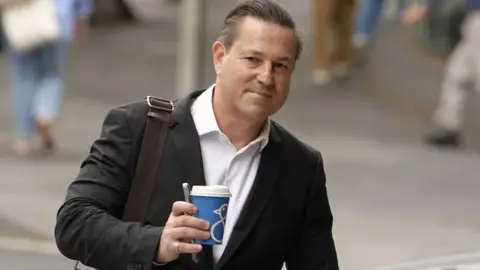
An Australian businessman has been found guilty of reckless foreign interference over his compilation of reports for two people who prosecutors said he should have suspected were Chinese spies.
Alexander Csergo, 59, faces up to 15 years in prison after being convicted in a Sydney court on Friday.
Authorities said two individuals known only as "Ken" and "Evelyn" offered to pay him for national security information while he was working in Shanghai.
Csergo's defence argued he had given them reports containing publicly available information, and that the only deceptions were plagiarism and including fake quotes from people he pretended to have interviewed such as former prime minister Kevin Rudd.
The New South Wales District Court heard that Csergo, who ran a business in Shanghai, was first approached by a woman in 2021 who said she was working for a thinktank, and arranged for him to meet two representatives.
She said her clients were people who had businesses in Australia, New Zealand and Canada.
Csergo later met the pair, known as Ken and Evelyn, to hand over the reports in return for envelopes containing thousands of dollars of cash. The meetings took place in cafes and restaurants that were often completely empty, prosecutors said.
The pair asked for reports on a "shopping list" of subjects including lithium mining, iron ore, the Aukus agreement and the Quad diplomatic partnership, the court heard. The list was found during a search of his Bondi premises in 2023 after his return to Australia, when he was arrested.
Despite the information provided being worthless, prosecutors argued Csergo believed Ken and Evelyn were working for China's Ministry of State Security and he was reckless as to whether it could support China's intelligence activities.
He believed he was being groomed as a potential source, and had a collegiate relationship with Ken, with whom he exchanged 2,800 WeChat messages, prosecutors said.
Csergo did not give evidence during his trial but told police he assumed he was being surveilled during his time in China and that his reports used information available freely on the internet and made-up interviews.
Csergo is only the second Australian to have been charged and convicted under anti-spying laws that were put in place in 2018.
