UK borrowing costs hit highest since 2008 financial crisis

 Getty Images
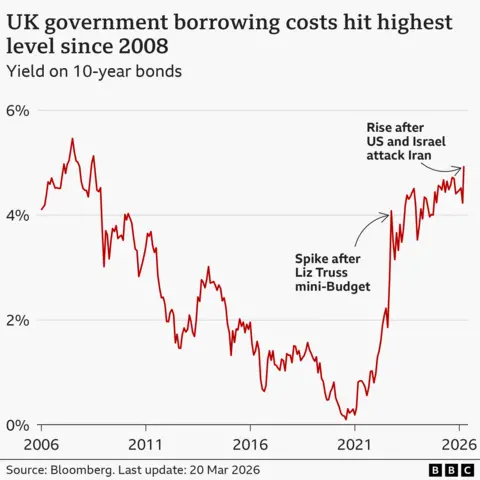
The UK's borrowing costs have hit their highest level since the 2008 financial crisis as the energy price surge sparked by the US-Israel war with Iran has raised fears over the state of the public finances.
The benchmark rate for government's long-term borrowing costs has climbed above 5%.
The government debt sell-off is due to concerns about higher interest rates, sticky inflation, the potential public cost of helping households with energy bills, experts say.
Danni Hewson, AJ Bell's head of financial analysis, said the Treasury was "stuck between a rock and hard place" managing these issues, but the Conservatives said Labour had made "irresponsible choices".
The government's 10-year borrowing rate, known as the yield, reached its 18-year-high on the same day official data revealed UK borrowing rose to £14.3bn in February to the second highest level for that month since records began.
The Office for National Statistics said borrowing was £2.2bn higher than in February last year and much higher than the £8.8bn economists had expected it to be.
An increase in government tax receipts was outweighed by a rise in spending and the timing of government debt interest payments, it added.
However, across the 11 months of the financial year to February, government borrowing was down.
Economists said the unexpected rise in UK borrowing and higher government debt costs means government help with energy bills - which are predicted to rise due to the Iran war - is now less likely.
Ruth Gregory, deputy chief UK economist, at Capital Economics said: "We doubt there is scope for a large-scale fiscal support package like that seen in 2022, even in more extreme scenarios in which the conflict in the Middle East escalates further."
She added that any monetary assistance the government does offer to households and businesses will likely be less than in 2022 because of its "worse fiscal position".
Charlie Bean, former deputy governor of the Bank of England, told the BBC the government "doesn't have the room for manoeuvrability" it had in 2022 after the energy price shock following Russia's invasion of Ukraine.
Danni Hewson, AJ Bell's head of financial analysis, said: "With the chancellor under pressure to act swiftly to protect households from the impact of the latest energy price shock, today's numbers won't make great reading."
Typical annual household energy bills could go up by £332 in July, according to the latest data from consultancy Cornwall Insight, but the figure is likely to change.
Chief Secretary to the Treasury James Murray said the government had the "right economic plan" and added "we are better prepared for a more volatile world".
Shadow chancellor Sir Mel Stride said Labour was "saddling the next generation with the cost of their failure to live within our means".
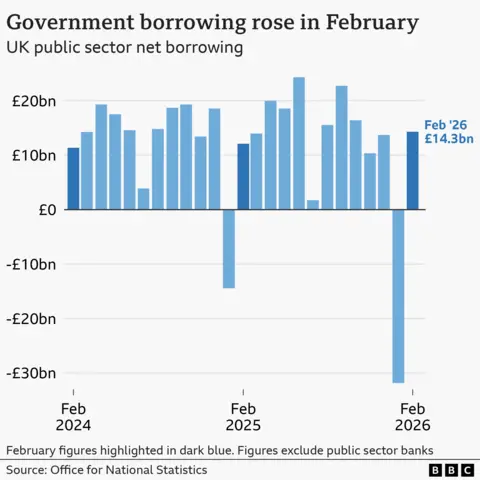
Nabil Taleb, economist at PwC UK, said the increase in government borrowing for February "partly reflects the timing of payments, with some interest due at the end of January falling into February because of the intervening weekend".
The leap to the second highest borrowing for February on record, a number not adjusted for inflation, is a sharp change from the record surplus in January.
Lindsay James, investment strategist at Quilter, said there were some "glimmers of hope that government borrowing was beginning to be reined in as tax rises helped to create the largest January surplus on record".
"The latest data out this morning, however, has put a swift end to that picture," she added.
James said the about-turn in public sector finances was "largely due to record levels of interest payable, highlighting the sheer scale of debt interest the government is now facing".
Around £1 in every £10 is still currently spent on debt interest, which ministers said needed to be addressed so more could be spent on policing, schools and the NHS.
The ONS provisionally estimated the amount of government debt to be at 93.1% of the size of the UK economy at the end of February 2026, which means it remains at levels last seen in the early 1960s.

Sign up for our Politics Essential newsletter to keep up with the inner workings of Westminster and beyond.
