Iran's new leader has never been tested. He now faces an existential battle

 AFP via Getty Images
A leader who has never been fully tested takes the helm in Iran when its theocracy faces its greatest test in five decades.
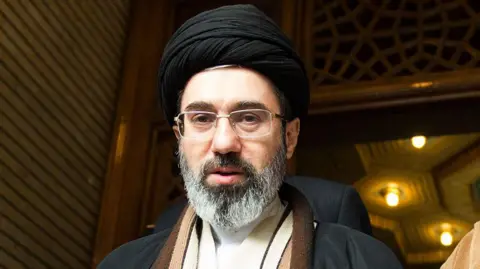
Continuity and connections have pulled Mojtaba Khamenei, 56, to the top after the assassination of his father, Ayatollah Ali Khamenei, in the first salvos of this war.
But Iran's third supreme leader since its 1979 revolution takes charge as the Islamic Republic confronts an existential battle.
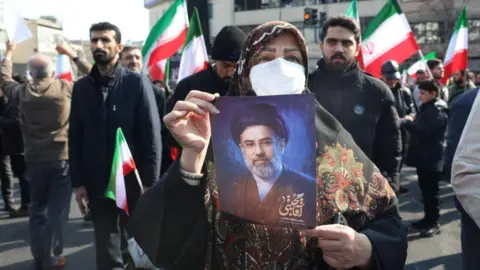
Large crowds, the foot soldiers of the revolution, took to the streets immediately to shout "Allahu Akbar" - "God is greatest" - to celebrate his selection by the Assembly of Experts, a body of 88 Shia Muslim clerics.
All security forces pledged to serve their new commander-in-chief until their "last drop of blood".
State TV showed pictures of the first missiles fired in his name with a message scrawled on its side - "At your service, Seyyed Mojtaba."
Yet - from the safety of their apartments - some of the many protesters who filled the streets in January denouncing his father as a "dictator" and calling for his death were last night heard shouting "Death to Mojtaba!"
For those who still mourn the loss of the many thousands killed in that crackdown on those protests, a harsh, hardline regime seems set to become even harsher.
They still dare to hope that Khamenei's days, and his system, are numbered.
The second, most prominent, son of the late ayatollah is in his father's ultraconservative mould.
Mojtaba Khamenei worked for decades in his shadow; he knows all the details about how the deep state works when it confronts external threats and internal upheaval.
He is also at one with the powerful Islamic Revolutionary Guard Corps (IRGC), which he first joined as a teenager straight out of high school before heading to study in Qom, the city known as the preeminent centre for Shia Islamic study.
The IRGC, established in 1979 to protect and preserve the revolution, now holds sway over a multi-layered security system and an enormous economic empire. Its commanders are now calling the shots.
The younger Khamenei was said to be their candidate.
And this war is no longer just a political fight; it's intensely personal.
It's also about revenge.
Mojtaba Khamenei lost not just his father in the Israeli strike on the supreme leader's compound, but also his mother, Mansoureh Khojasteh Bagherzadeh, his wife Zahra Haddad-Adel, as well as a son, on that fateful Saturday morning.
 EPA/Shutterstock
He was also reported to be injured but there have been no details, nor even any sign of him since.
And it's deeply personal for US President Donald Trump, who keeps making it clear he doesn't take kindly to those who take issue with his orders.
As speculation swirled over the successor, Trump declared more than once that Ali Khamenei's hardline son was "unacceptable".
Now he's warning that Mojtaba Khamenei "won't last long". He is in Israel's sights too, with Defence Minister Israel Katz calling him "an unequivocal target".
So Khamenei may still remain in the shadows for a while.
It will deepen the mystery around this reclusive cleric.
There's no record of any public speeches, he's rarely appeared in public, and he's never held any formal government jobs. His photograph never appeared alongside the ubiquitous portraits of his father.
The late ayatollah was reported to have ruled him out of the succession, wanting to avoid the hereditary system of the monarchy ousted in the 1979 revolution.
Most Iranians have never even heard his voice.
But there have been some signs of his views.
A pivotal moment being mentioned now is the 2005 electoral success of the conservative presidential candidate Mahmoud Ahmadinejad. His reformist rivals accused the younger Khamenei of conspiring behind the scenes to secure his victory.
Ahmedinejad's disputed re-election in 2009 sparked an unprecedented wave of protest now remembered as "the Green Revolution". Prominent reformist politicians were put under house arrest where they remain to this day.
One of the other contenders for Iran's new supreme leader had been a candidate with different revolutionary credentials. Hassan Khomeini, grandson of the first supreme leader Ayatollah Ruhollah Khomeini, was in the ilk of the reformists.
Khamenei's ascent seems to signal that the reformists - the relative moderates in Iran's fractious political spectrum, who include the current President Masoud Pezeshkian - are now pushed even further to the sidelines.
Politically, Khamenei is close to two leading figures, also linked to the revolutionary guards, who now play pivotal roles - the veteran politician Ali Larijani, who heads the decisive Supreme National Security Council, and Mohammad Baqer Qalibaf, a former military officer and politician who's now the speaker of parliament.
Friends and allies of the late Ayatollah, they were chosen to take on greater responsibilities in the high stakes planning of recent months which had included engaging in talks with Trump's envoys mediated by Qatar, and preparing for an all-out confrontation with the military and intelligence might of their greatest enemies.
Larijani was described as a pragmatist by a western official who met him during last month's aborted negotiations to secure a nuclear deal between Iran and America.
In this moment where hardliners - who call themselves Principlists in defence of their system - are taking centre stage, there are still voices who say this could still take a different turn.
A politician close to Khamenei - Abdolreza Davari - described him in public statements and a recent interview with the New York Times as "extremely progressive" and someone who would "move to sideline the hardliners".
He cast him as an Iranian version of the Saudi Crown Prince, Mohammad bin Salman, who significantly expanded social freedoms in the kingdom while keeping a tight grip on power.
There's no sign of that kind of seismic shift now, especially not in these perilous unpredictable days.
Iran is now trapped in the vice of an escalating war rocking the entire Middle East wrecking relations with its neighbours and causing economic shocks far beyond.
Mojtaba Khamenei's rise was cited by Trump as a worst-case scenario. The forces fighting against America and Israel see him as their best chance to see this through.
