Why pothole repairs made this winter will not last

 Mike Stevenson
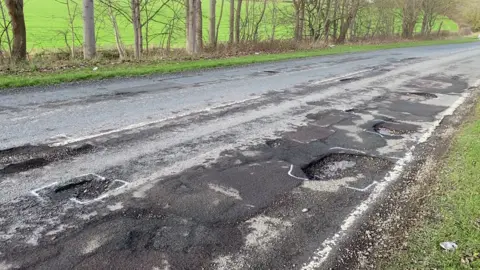
The state of roads and potholes has been a hot topic of conversation across many communities in Nottinghamshire.
Hundreds of people in the villages of Kinoulton and Hickling have put their names to a petition demanding higher quality repairs to roads, with some questioning why "substandard temporary repairs" appear to fall apart so quickly.
An expert explained that temporary repairs are often made in the winter as if hot mix asphalt - a more permanent and secure repair - was used, it "won't work as well".
Mick Barton, leader of Reform UK-led Nottinghamshire County Council, added: "If you put proper tarmac into any of these [potholes] and do a proper repair now, it'll go off within minutes."
 Peter Hortor
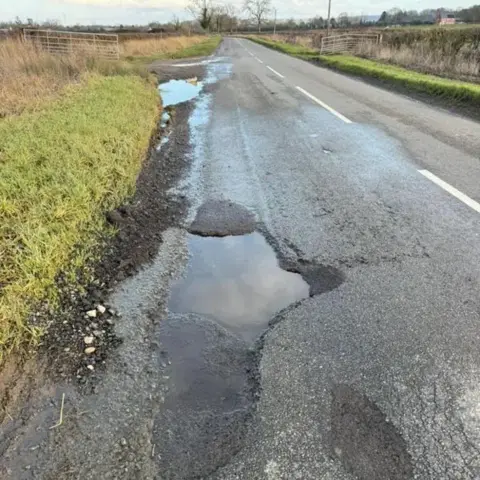
Peter Hortor, 44, who helped start the petition in Kinoulton, said the roads in their current state were an "obstacle course".
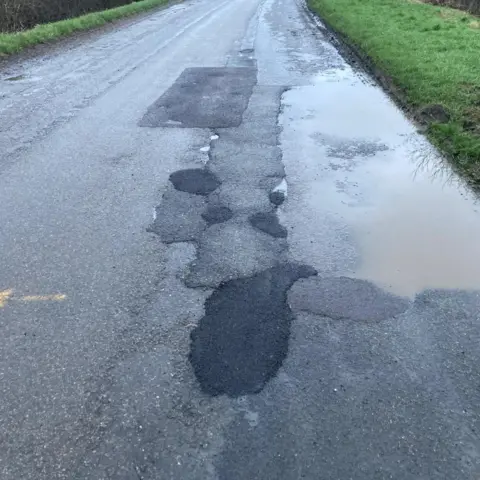
He said drivers not only had to contend with dodging potholes, but also tackling lumps and bumps caused by temporary repairs.
"People are tipping a bit of tarmac in, whacking it with a shovel, and leaving it," he said.
"It makes it worse in the immediate because there's then a lump in the road. In the medium term, when the tarmac falls back out again, it leaves a bigger hole than we started with.
"Nobody is expecting the pothole issue to be fixed overnight, but we need a proper plan to work through the backlog rather than lots of temporary fixes."
 Peter Hortor
Motorist Keaten Leatherland, 31, from Mansfield, also criticised the quality of temporary pothole repairs.
He said debris kicked up by another car cracked his windscreen on the A614. He claimed this debris was a dislodged chunk of a temporary repair.
"I don't know if it's underfunding or poor workmanship, but you pay your road tax, you pay your council tax, it's not great. It is getting unsafe," he said.
Nicholas Thom, a University of Nottingham assistant professor who specialises in the behaviour of asphalt, explained the material being used was not as strong as in permanent repairs.
Asphalt is a mixture of stone and bitumen, and the strength of the final product depends on the strength of bonds between the stone and bitumen, Thom said.
He said potholes are formed when water enters cracks in the road surface, which weakens the bond. If it freezes into ice, it will expand and make cracks worse.
Subsequently, when vehicles add stress and weight on to the weakened asphalt, it will break bits off which will develop into a pothole.
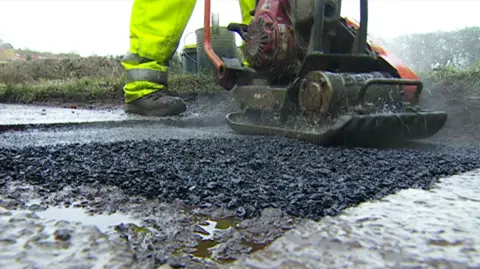
For temporary repairs, a "cold-mix asphalt" is used, which is inherently weaker than the "hot-mix asphalt" used for permanent fixes.
This makes it more susceptible to further damage from the weather.
"The problem with a cold mix is it's never as good as a hot mix," Thom said.
"There's a lot of water about and so the bonds do not form as well as in a conventional hot mix asphalt where there's virtually no water there.
"The councils know perfectly well that these materials are short-term repairs and it's deliberate.
"There's no point trying to do a hot mix repair in the sort of weather conditions that we have in winter - it just won't work as well."

That view is shared by Nottinghamshire County Council, which said it did not carry out permanent repairs during the winter, and said permanent repairs would be looked at in the spring.
Leader Mick Barton said: "This time last year, council workers used approximately 4,500 bags of Viafix [a cold mix asphalt]. This year we've used over 10,000 and we're not out of winter yet."
On the standard of the repairs, he added: "It's not always down to the staff, we're asking them to fix these potholes, and some do need permanent fixes rather than quick fixes.
"Although they're putting in plenty of Viafix, it's not always ideal."
He added that the authority was looking into different products for next winter, although it had not been determined which yet.
"It is an emergency, and we are reacting to it. We're not just sitting back."
Additional reporting by Mel Duffy
Follow BBC Nottingham on Facebook, on X, or on Instagram. Send your story ideas to eastmidsnews@bbc.co.uk or via WhatsApp on 0808 100 2210.
