'I nearly died on the streets - then found a new family'

 Cianna McNally
"I thought I was going to die in the street on this day."
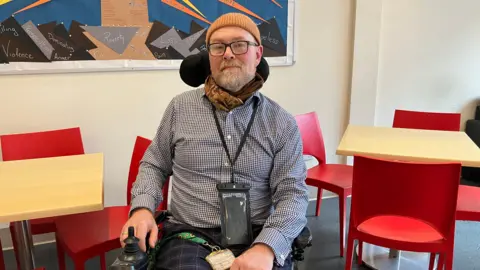
Moses describes the moment his health deteriorated to the point where he collapsed outside Victoria Station, having lived on the streets for several months.
"I was there for maybe one hour on my knees with my suitcase, and crying in a lot of pain. I was broken."
Moses now says he has found a "new family" at the Salvation Army church in Chalk Farm but is still trying to find a permanent home.
His experience comes as rough sleeping rates continue to rise in London with one charity Crisis calling for more social housing to curb the issue.
'I was very scared'
Moses left France 20 years ago with his young son to work at a department store in central London.
"I had an amazing job, an amazing life, an amazing flat on the border with the river," he said.
He later lost his job due to his health, including kidney issues, and fell behind on his rent.
"I don't know the system of benefits, I don't know the system of job centres, it wasn't my world," he said.
He and his son were eventually evicted, sleeping rough for four months from November 2023 until February 2024.
"I was in the street with a suitcase and my teenage son, I remember the shame in the eyes of my son," Moses says, adding: "It's difficult to talk about this if you don't live this experience."
His son was given a place to sleep at a church by a charity providing emergency accommodation for young people.
"It was the first time in my life I was separated from my son... I was very scared."
'Normalised emergency'
He collapsed due to a hernia and needed an operation. When he was discharged, Southwark Council granted him temporary accommodation, plus the use of a wheelchair.
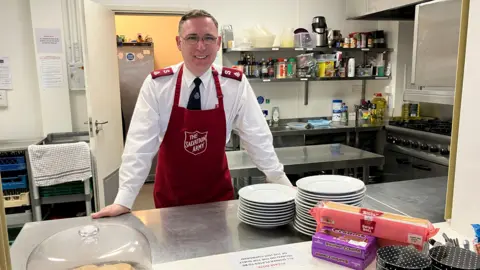
He started attending a twice weekly drop-in service at a Salvation Army church in Chalk Farm which offers showers, hot meals and fresh clothes for people sleeping rough.
It was here that Moses met Major Michael Kinnear, lead support worker at Chalk Farm since 2018.
Kinnear says they support "whoever comes through our doors, no matter who they are, in a non-judgmental way", adding: "It's that human face of help and support that people miss."
"To actually be treated and served and cared for, it has a massive impact."
 Cianna McNally
While Moses has found some stability thanks to Chalk Farm, statistics show rough sleeping is worsening in London.
Recent data compiled by the Combined Homelessness and Information Network (CHAIN) from October to December 2025, shows the number of people termed as "living on the streets" has increased by 18% from 704 to 830, compared to the same period in 2024.
Overall rough sleeping in London is also up over the same period by 5%, from 4,612 to 4,841 - a record high for the city.
This number includes 135 new rough sleepers, a 6% increase over the same period.
CEO of the homelessness charity Crisis, Matt Downie, told BBC London the statistics are a "normalised emergency".
"People get used to seeing statistics, they might go up 10, 20, 30%, but it doesn't generate any additional political activity or public outrage, or anything that shifts the dial," he said.
He also highlighted worsening life expectancy rates for people sleeping rough - research done by Crisis in 2012 found the average age of death for a man was 47 and 43 for a woman.
More recent figures from the Office for National Statistics (ONS) for 2021 have shown this has fallen to 45.4 and 43.2 for men and women respectively.
Mayor of London Sir Sadiq Khan has pledged to end rough sleeping in the city by 2030, having secured £17m from central government last year.
It will be used for a new Ending Homelessness Hub and to expand its Homes off the Streets programme where up to 500 empty homes will be refurbished.
The mayor is also spending an additional £1m on new "floating hubs" to help rough sleepers find accommodation.
Downie has welcomed the mayor's efforts but said there needs to be a change in approach.
"The problem on homelessness isn't money, the problem is will and access to housing.
"Councils in London are spending £5m a day on temporary accommodation and forms of emergency assistance for people.
"Imagine if that money was spent on mainstream housing, on social housing, on helping people avoid homelessness in the first place?"
The mayor's office said Sir Sadiq "remained committed to ending rough sleeping in London by 2030 but clearly there is still more to do.
"He will continue working closely with partners, the government, councils, and experts to build a safer, fairer London for everyone."
A Ministry of Housing spokesperson said Moses's case "underlines why it is so important that action is taken to end the unacceptable homelessness crisis we inherited in London and across the country.
"We have taken decisive action by launching our £3.6 billion National Plan to End Homelessness. We are also investing over £759 million to support local London authorities to protect rough sleepers, tackle homelessness and support people into secure housing."
Listen to the best of BBC Radio London on Sounds and follow BBC London on Facebook, X and Instagram. Send your story ideas to hello.bbclondon@bbc.co.uk
