Estate attracted Rihanna and Justin Bieber - but area's Grade II-listed gem was forgotten

 Matt Kent/Getty Images
At a beauty spot where thousands of music fans have watched global superstars perform, just out of sight, an architectural gem has been left to slowly decay.
In 2010, tens of thousands of people saw Rihanna, Justin Bieber and Biffy Clyro at the Faenol Estate in Bangor, Gwynedd.
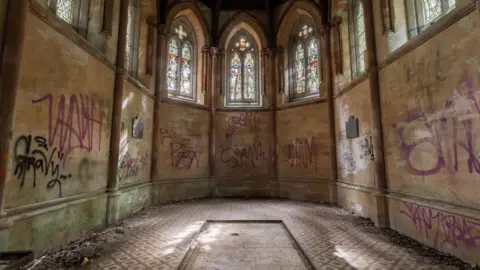
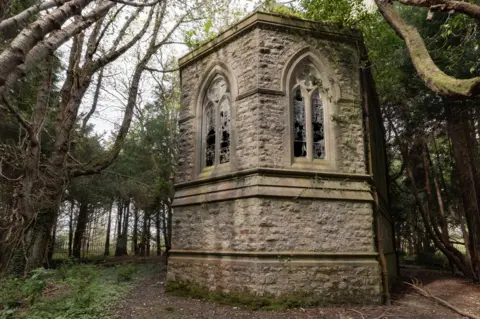
A few hundred metres away is a Grade II-listed mausoleum that has been described as an architecturally-significant part of Wales' history, but is covered in graffiti and has just been placed on the Victorian Society's most endangered list.
Its state was blamed on "fragmented ownership", while actor Griff Rhys Jones called it an "extraordinary find" for walkers who stumble upon it from the nearby Wales Coast Path.
"This is such a familiar story," Victorian Society president Jones added.
"The tangle of ownership needs to be cut aside by a latter-day perfect gentle knight, so this sleeping beauty, this unique monument, can come back to life."
The Faenol Estate hosted 40,000 people with millions of others listening to music from the venue when Radio 1's Big Weekend was held there in 2010.
Five years earlier, hundreds of thousands visited over the week as the site hosted the National Eisteddfod in 2005.
The Faenol Festival, which ran between 2000 and 2009, and was organised by singer Bryn Terfel, also attracted more than 30,000 music fans every year.
While these events have taken the limelight, the Faenol Mausoleum, described as "a cosy and romantic folly" has almost been forgotten, hidden away in woods some way from the main stage.
Now covered in graffiti, it is a significant part of the history of an estate that once consisted of 36,000 acres, stretching from the Llŷn Peninsula to Eryri, or Snowdonia.
Various parts are now owned by different groups and individuals, including the National Trust, but it's unclear who exactly is now responsible for the mausoleum, according to the Victorian Society.
 Dan Weatherley
It was built in the late 19th Century for the Assheton-Smith family who owned the estate.
Their family wealth was tied to the Dinorwig quarry, which was a major producer of slate in the area.
It was built as a burial place for the powerful local dynasty and many of the Assheton-Smith family are buried there.
The romantic-looking building was designed by Henry Kennedy, a north-west Wales architect, and has French Gothic elements, a bell tower and striking interior that includes a hammerbeam roof.
 Andy Sheppard/Getty Images
It is surrounded by an octagonal enclosure and cornered off by iron railings.
Cadw described it as "grandeur of design", but years of disregard have taken a toll.
As well as being covered in graffiti, the windows have been smashed.
However there is hope, with the Wales Coast Path meaning thousands of walkers each year pass close by.
"The mausoleum has clear potential to be appreciated once again as part of the historic environment," the Victorian Society added.
By making it one of its top ten most endangered buildings, it is hoping to address its condition and to try and secure a future.
 Dan Weatherley
The list is drawn up each year by the Victorian Society, selected from nominations made by the public, to raise the profile of the buildings in Wales and England it believes are most in need of rescue.
This year's list also features the long-empty former Oakes Board School in Huddersfield and St Michael's RC Cemetery Chapel in Sheffield.
Victorian Society director James Hughes said: "This is a rare and evocative building that forms part of the historic fabric of the wider landscape.
"Its current condition is a direct result of fragmented ownership and a lack of co-ordinated care.
"With the right intervention, it could once again become a valued and accessible heritage asset."
