In this US county, measles starts to feel like next pandemic

 Colin McCawley SCETV
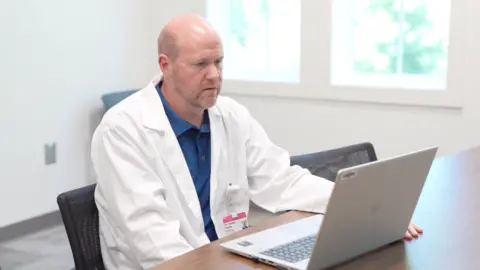
Before last year, pediatrician Stuart Simko had only seen historical case studies of measles - with its signature blotchy red rash - once infecting millions of children each year, before a vaccine was invented.
But in the past two months, he has seen six cases - in person, for the first time.
The children were "very sick", the South Carolina doctor said, with a high fever that was difficult to bring down.
"It's a terrible, terrible disease that can cause mortality, and we don't say that to scare people, but people need to know the risks," said Simko, who works for Prisma Health. "It is hard to see a sick child knowing that it could be prevented."
Simko's six patients are among 847 people infected in South Carolina over the past few months, the vast majority unvaccinated children. It marks the largest measles outbreak since the US declared the disease eliminated in 2000. The US, with outbreaks in several states, is now on the verge of losing that status - following in the United Kingdom and Canada's footsteps. Two school-aged children died in a Texas outbreak last year.
Public health experts worry that the disruption caused by measles and other dangerous, preventable illnesses could become the new normal for many US towns with declining vaccination rates.
This time, the disease has taken hold in north-western South Carolina in Spartanburg County, made up of several neighbouring former mill towns and home to about 370,000.
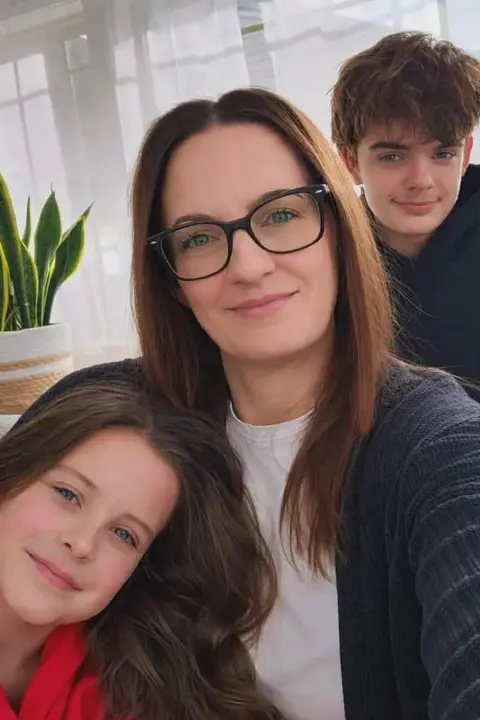
Kate Martin, whose vaccinated children had measles cases at their schools, said it reminds her of the pandemic.
"It is a lot like Covid where every day it's at another school," she said. Dozens of unvaccinated students at their schools ended up quarantined for 21 days.
The measles vaccination rate for school-aged children is about 90% in Spartanburg County, though some schools have much lower rates because of religious exemptions.
The US recommends two shots of the measles, mumps and rubella (MMR) vaccine to children between ages one and six, which is 97% effective in protecting against the illness. To achieve herd immunity, which limits its spread and protects the unvaccinated, around 95% of the population must have the shots.
In local grocery stores and restaurants, Spartanburg community members acknowledged "that measles thing" infecting hundreds of children in town. Most knew someone who had encountered it, but many said no one wanted to talk about it, or seemed to care.
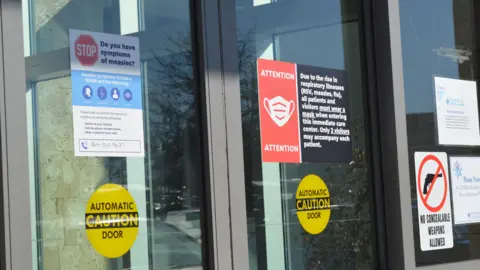
Unlike the Texas measles outbreak - where billboards warning of the disease lined highways and people queued for tests - the only measles warning in the county was an urgent care office sign asking symptomatic people to wait in their cars.
"It's really bad here," Martin said. "But the average person just doesn't think it's a big deal."
 Kate Martin
A 'public health threat' against the town
For weeks, state Senator Josh Kimbrell avoided wading into the public discourse about the measles outbreak. A Republican critical of the US government's handling of the pandemic, including Covid vaccine mandates, Kimbrell said he hoped the situation would "self correct".
But in December, he got a call from a man whose wife was in hospital with measles. An elementary-school teacher in her 50s, she was vaccinated as a child, but caught the illness from a student, sending her to the intensive care unit for two weeks, Kimbrell said.
"I thought that was real close to being our first death," Kimbrell said. "It's really unfortunate for people who did choose to be vaccinated who now have a serious public health threat against them."
Kimbrell took to social media with a statement he hoped would strike a "balance" - supporting "personal choice" while stressing that the outbreak now required public health action, including, he told the BBC, limiting where unvaccinated people can go.
He was met with praise - and also vitriol from vaccine-hesitant parents accusing him of violating their rights. But Kimbrell felt he had no choice.
"The numbers are high enough now that I'm going to have to attend a funeral for either a teacher or a kid, and it's preventable," he said. "I'm going to be really pissed off about that."
'We're more worried about the vaccine'
Local officials and doctors say the recent outbreak has primarily affected Russian and Ukrainian immigrants in South Carolina, though others have been infected, too. The state has resettled hundreds of Ukrainian refugees, while thousands of Slavic immigrants have moved to the area in recent years, according to population estimates.
Slavic churches had several measles exposures, with Kimbrell adding that some took a religious stance against vaccines. Some schools in the community have vaccination rates as low as 20%.
Kimbrell said misinformation spread that the MMR vaccine contains fetal cells, a common conspiracy theory that he tried to combat by reiterating the safety and mechanisms of the MMR shot.
Inna, a member of the Ukrainian immigrant community in Spartanburg who declined to share her last name for privacy reasons, has not vaccinated her children against measles.
So far the family has avoided the illness, but she knows many who haven't.
Asked if she is worried about whether her children would get infected, Inna shrugged.
"We're more worried about what's in the vaccine," she said, adding she'd heard concerns about autism - which have been debunked.
"They got chicken pox and they were fine," she said of her children. The measles carries a much higher risk of life-threatening complications than chicken pox.
Some parents are more concerned about the risks of a vaccine than the once low risk of catching measles, said Jennifer Grier, associate professor of immunology at University of South Carolina School of Medicine Greenville.
"Unfortunately, now that situation of getting measles is not low risk anymore," she said.
Miles across the country, another sprawling measles outbreak has sickened hundreds along the Utah-Arizona border.
Lorna White, a 23-year-old mother of four who lives in the small town of Kanebed, Arizona, chose not to get her children measles shots, saying she worried it was "a lot to put on a little body".
"Say I went and got my kids the MMR and they had an adverse side effect, I did that to them," she said.
She and her children all got measles over Christmas.
"Either we all got lucky with mild cases or measles isn't as bad as they say," she said in January.
But some may not see the effects until years later. Measles can lead to long-term complications including encephalitis and immune amnesia, which resets the immune system, leaving it with only limited ability to respond to new infections.
These are the type of risks Simko brings up when he talks to vaccine-hesitant patients. He also tries to acknowledge that there are small, rare risks with vaccines - but that those risks pale in comparison to the threat of measles.
"Some will still continue to choose not to do it," he added. "It's not ideal, but I can't force someone to do things."
A 'real-world' test for the unvaccinated
 South Carolina Department of Public Health
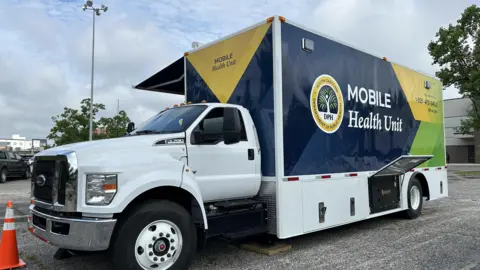
The South Carolina Department of Public Health (DHS) has seen some small wins, including vaccinating 62 people at mobile clinics, 42 adults and 20 children since October.
But public health experts say the federal government, and in particular, Health Secretary Robert F Kennedy Jr's remaking of US vaccine policy, has hampered efforts.
Under Kennedy's leadership, the US Centers for Disease Control and Prevention slashed the number of recommended childhood vaccines - although not the MMR shot.
Kennedy has offered mixed thoughts on the MMR vaccine, at times saying it's the best way to protect against the disease, while other times casting doubt on its safety.
His words, and his scepticism, have weight in Spartanburg, residents said.
"He's widely respected here," said Martin. "I do think that definitely has something to do with [vaccine hesitancy]."
In recent weeks, Kennedy, a longtime vaccine sceptic, has remained silent about the outbreak in South Carolina. In a statement to the BBC, the Department of Health and Human Services said vaccination is "the most effective way to prevent measles, and the Secretary has been clear and consistent on this point".
Some of Kennedy's allies have downplayed concerns over the cases. Asked last week whether the country's impending loss of measles elimination status was significant, Ralph Abraham, the CDC's deputy director replied: "Not really".
The same week, Kirk Milhoan, Kennedy's pick to lead an independent vaccine advisory panel, said that polio and measles immunisations should be optional. He suggested that would allow better data collection about the dangers of measles.
"What we're going to have is a real-world experience of when unvaccinated people get measles, what is the new incidence of hospitalization? What's the incidence of death?" he told the podcast "Why Should I Trust you?"

To medical experts, it's not a mystery.
The disease will run through communities with low vaccination rates, infecting many, before it moves on to the next large group of unvaccinated individuals, said Chris Lombardozzi, chief medical officer for acute care hospitals in the Spartanburg Regional Healthcare System.
"Ultimately, I worry about all the things that we vaccinate for that used to be common," he said, citing polio, mumps and rubella.
Such an experiment, and the loss of the US measles elimination status, will likely have deadly consequences for American children, medical experts said.
"It would just be sort of a failure of public health in our nation," Grier said. "Because we have the means to stop the infections, we know the risk of the infections, and it still was able to come back to our community."
