Londoner is one of country's 10 'super donors'

 BBC
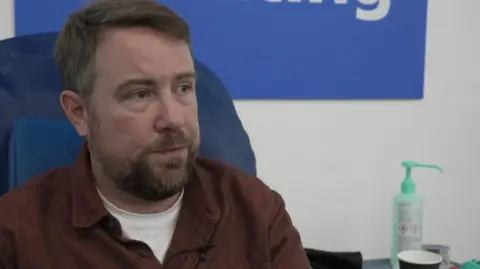
BBCA man from London has been named as one of 10 "super donors" in England - who are now being celebrated by NHS Blood and Transplant (NHSBT).
James Allen, 44, started donating in his late 20s and has clocked up more than 90 sessions.
He said he could not remember why he started, but he follows in the footsteps of his father, who managed at least 50 donations.
Mr Allen, and the other nine super donors, have given blood, plasma, platelets and stem cells in the past 20 years.
He said he donated plasma during Covid and found he was also a match for somebody in need of stem cells, which he also signed up for.
Mr Allen said he donated because it "is the right thing to do", although his status as a super donor does make him feel "quite proud".
"I just think it's not particularly difficult - it is quite quick, quite easy, so it doesn't really take a lot of my time. It just seems to me an important thing to do," he said.
He added that the fact not everyone could donate puts "more of an onus on the people who can".
"The vast majority of us would expect there to be blood available if we needed it so we must make sure there's some ready for everyone," he said.
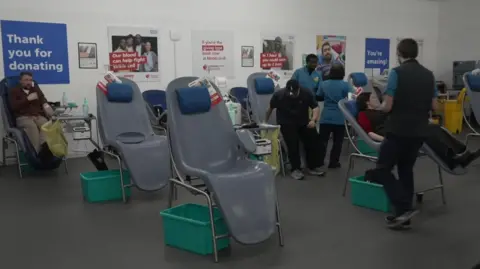
The 10 super donors, aged between 31 and 64, are also on the NHS Organ Donor Register. They are:
- James Allen, 44, from London
- Adam Murchington, 61, from Birmingham
- Andrew Bruce, 58, from County Durham
- Andy Stowe, 64, from Birmingham
- Anthony Robson, 33, from Stockton-on-Tees
- Christopher Black, 31, from Leicester
- Henry Care, 33, from Manchester
- Robert Clay, 64, from Solihull
- Stuart Reader, 62, from Essex
- Tim Sargeant, 58, from Essex
Men can give blood every 12 weeks while women can donate every 16 weeks because men generally have higher iron levels than women.
Plasma and platelets can be donated more frequently while stem cells can only be donated when matched, according to NHSBT.
Mark Chambers, director of donor experience at NHSBT, said it was a "very rare thing" for somebody to have directly donated every blood component.
"To donate solely with the desire to help others shows a real altruistic nature and we cannot thank every donor enough for all they do to help the many people who need treatment from blood, plasma, platelets or stem cells.
"Their donations are improving and saving lives every day.
"As ever, we always need more people to donate and we hope that by sharing these stories, we might encourage others to take the step."
NHSBT was established in October 2005 when the National Blood Authority, UK Transplant and Bio Products Laboratory merged to create one organisation.
Since then just 10 people have been dubbed "super donors" – having been asked to donate individual blood components and stem cells.
Earlier this year NHSBT said the number of regular donors needed to rise from around 800,000 to more than one million to maintain a safe and reliable supply.
Listen to the best of BBC Radio London on Sounds and follow BBC London on Facebook, X and Instagram. Send your story ideas to hello.bbclondon@bbc.co.uk
