No blame on council over parade attack, report finds

 Merseyside Police
An independent report commissioned after Paul Doyle drove into crowds at Liverpool FC's Premier League victory has attributed no blame to the city council, the authority has said.
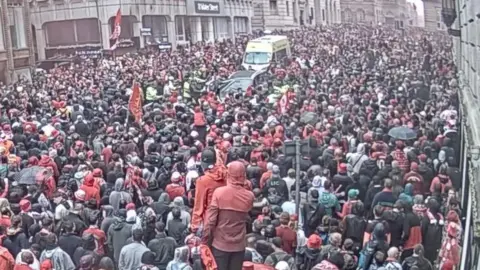
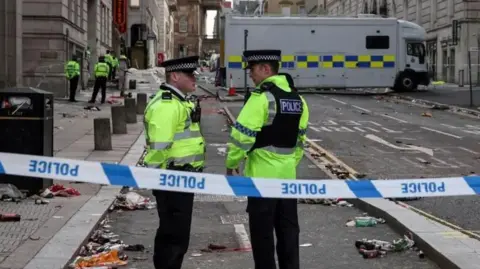
Questions had been raised about how Doyle was able to drive on to Water Street on the day of the parade, when hundreds of thousands of fans were celebrating, before the incident unfolded.
Some eyewitnesses said they felt more could have been done to stop drivers travelling along crowded streets adjoining the parade route.
Liverpool City Council said initial findings from the evaluation indicated the council and its partners "applied sound planning principles" to managing the event, and no blame was attributed to them.
Partners who had signed off and been involved in planning for the parade include emergency services, council departments, Merseytravel and Merseyside police.
The report, which was carried out by event management expert Eric Stuart, will be released in full next year.
The council said in a statement: "Paul Doyle has pleaded guilty to all charges. The only person responsible for this crime is Paul Doyle."
Carl Cashman, leader of the city's opposition Liberal Democrats, urged the authority to release the report in full as soon as possible.
He said now that "justice was done", people's "minds will be focused on this issue, and they will now want to know why the people were coming down that road."
 Reuters
He added: "They are right in the sense that this crime was committed by one person and one person only.
"But we have to look at all elements of what has happened on that day. And it's quite clear to me that there were cars, not only his, that were going down that road that never should have been there.
"And that for me is inadequacy of the council's monitoring system."
Mike Blair, a Liverpool supporter who helped rescue people who had become trapped under Doyle's car, said: "The council should have done more, there should be barriers in place, cars should not have been allowed to drive through that."
The authority said that, as with all major events, it commissioned an evaluation to "ensure best practice and continuous improvement in the management of public events".
It said that given the seriousness of this incident, it had enhanced the process and engaged a world-leading expert.
The council said: "There was a complex traffic management plan signed off by multi agencies, which addressed the difficult balance of pedestrian safety and vehicle movement within a large city centre.
"The cornerstone of the plans is the lawful compliance of motorists."
 Reuters
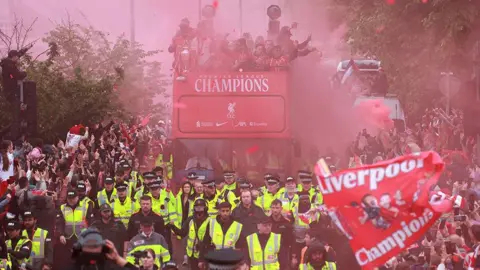
A council spokesman said the parade route measured 9 miles (15 km) from the start at Mather Avenue to its end on Wapping, at its junction with Blundell Street.
The traffic and crowd management plan was in place, including what is known as "hostile vehicle mitigation measures".
The council added: "The traffic management plan comprised a sequence of hard and soft road closures and traffic diversions, as well as road closure signage, traffic cones, traffic stewards, traffic personnel, and traffic management vehicles, which were further supported by police vehicles at some key junctions.
"This was continually monitored and supported in the joint control centre through the use of specialist drone footage, CCTV footage, body-worn cameras and helicopter footage to provide real-time information."
Dale Street was not on the parade route and the council said it had needed to remain open as a key arterial route for public transport.
Water Street itself was identified as a "red route" for emergency vehicles but was closed with hard and soft road closures and traffic diversions.
Feeder roads into Water Street were also closed to traffic and staffed by stewards.
The council said: "It is thanks to that planning process that emergency services were on the scene rapidly."
Listen to the best of BBC Radio Merseyside on Sounds and follow BBC Merseyside on Facebook, X, and Instagram. You can also send story ideas via Whatsapp to 0808 100 2230.
