Racist violence by paramilitaries deeply worrying - report

 Getty Images
The involvement of paramilitaries in immigration-linked racist violence in Northern Ireland is "a deeply worrying development", a report for the British and Irish governments has stated.
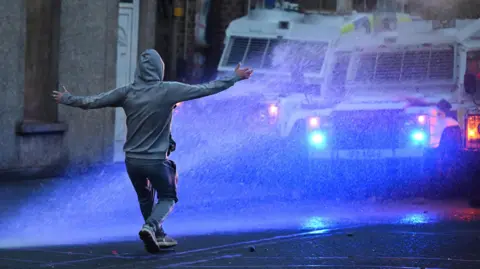
The worst disorder was witnessed in Belfast in August 2024 and in Ballymena in June.
Police intelligence pointed to the participation of individual loyalist paramilitary members, but groups were not "orchestrating" the trouble.
The Independent Reporting Commission (IRC) said paramilitarism "continues to pose a threat" in Northern Ireland. Its eighth annual report was published on Tuesday.
'A pressing need'
The IRC was established by London and Dublin in 2017 and monitors efforts to tackle paramilitarism.
Its four commissioners include the former Women's Coalition leader Monica McWilliams and ex-US special envoy Mitchell Reiss.
The report notes a decline in violent crime linked to paramilitarism – but warned it remains "a live and serious issue".
It states: "A particularly serious manifestation of that reality over the last two years has been the link between paramilitarism and racist violence connected to the issue of immigration.
"We note that involvement does not have to be organised.
"The very fact of the continued existence of paramilitary structures and paramilitarism itself heightens the likelihood and danger of expansion by members into activities of this kind.
"This, in our view, is another reason why there remains a pressing need to maintain the focus on bringing paramilitarism to an end."
The IRC welcomed the recent appointment of an expert to explore the merits of disbandment talks.
Conflict resolution expert Fleur Ravensbergen is based at the University of Amsterdam.
She could meet representatives of loyalist and republican organisations over the coming months and will deliver a report to the British and Irish governments next August.
Justice Minister Naomi Long has described the move as inappropriate.
"Twenty-eight years after the Good Friday Agreement, the route to ending paramilitarism has to be through more robust law enforcement, coupled with more targeted community relations work to tackle vulnerability and the harms they cause," Long said in September.
"There can be no negotiation or sweeteners involved."
