Scottish energy firms invest £5.4bn as part of UK grid upgrade

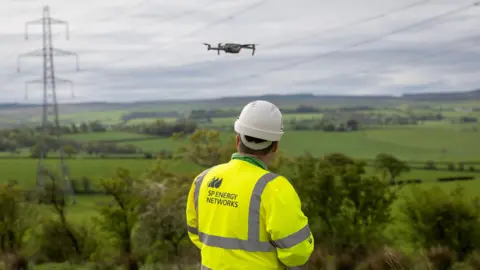 Scottish Power
The energy regulator has given the go-ahead for £5.4bn to be spent upgrading the electricity transmission network in Scotland.
It is part of a £28bn investment approved by Ofgem to improve the UK's electricity and gas grids over the next five years.
Scottish Power, which runs the network in central and southern Scotland, will invest about £2bn while SSE, which has the northern network, will spend £3.4bn.
Ofgem said home energy bills would rise to fund the upgrade, but in the long-term it would help lower the reliance on imported gas and make wholesale energy cheaper.
Scottish Power said its investment was part of a larger £12bn package that would double the workforce within its SP Energy Networks business, with 1,400 new roles.
SSE said it planned to inject an even bigger sum, about £22bn, over the same period.
SP Energy Networks is one of several companies that run energy networks - including power lines, cables and gas pipes.
These have monopolies in different parts of the UK and are separate from suppliers.
Scottish Power's chief executive Keith Anderson said the UK was building a grid that was "fit for purpose for the 21st Century".
He told the BBC's Radio Scotland Breakfast programme: "If we want to build houses, if we want to build data centres, if we want to get investment into the country, we need the electricity infrastructure to allow all of that.
"Without it, there would be no economic growth in the United Kingdom."
How much will it add to bills?
 Getty Images
Ofgem's plan sets the framework for the cost controls energy firms face over the next five years. It estimates that £108 will be added to energy bills by 2031.
But Ofgem also says that people would end up saving about £80 more than they otherwise would, as the investment will help lower the reliance on imported gas and make wholesale energy cheaper, leading to a net energy bill rise of about £30.
Scottish Power predicts that it would add about £12 per year for its customers.
It says the network upgrade is expected to reduce constraint costs – the costs to turn off generators when there is no way of transporting their electricity – by around £5bn per year.
Keith Anderson said: "If you look at that price cap, right now by the time we get to April the chancellor is already taking £150 off that price.
"As we start to build this grid out, we'll bring the price down even further.
"We'll open up the grid to more investment in renewable and remove the volatility of gas prices on the system.
"Overall, we'll end up with a cheaper system."
How many jobs will it bring?
 Getty Images
Scottish Power said the investment would bring jobs across the country, in particular in the south of Scotland where it is upgrading the network.
"Because the infrastructure goes into local communities, into Dumfries and Galloway into South Ayrshire, these jobs are in those local areas," Mr Anderson said.
"We want people to be employed directly from schools, from colleges in all of those communities."
He said it would provide opportunities for apprenticeships and graduates across Scotland.
He told BBC Scotland News: "This year I'm still looking for another 300 people to join our company, then another 1,000 people next year, and by 2027 another 2,000 on the back of delivering all this work.
"This is fantastic news for the country, for jobs."
Where will new pylons be built?
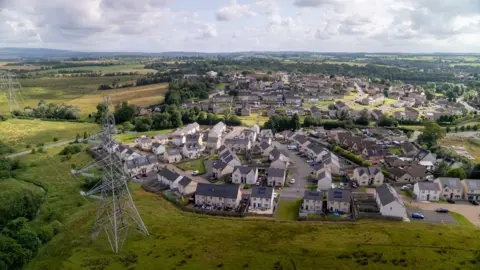
An extra 310 miles (500km) of lines is needed over the next five years in central and southern Scotland.
As part of its investment, SP Energy Networks will begin work to build 12 new substations, upgrade 450km of existing circuits and 87km of overhead lines and replace 35km of underground cable by 2031.
The investment also includes two new subsea electrical superhighways off the east coast of Scotland.
A growth in renewable generation in Scotland is expected to far exceed the amount that can be consumed, and so much of it will have to be exported to England.
Mr Anderson said: "We need to get the electricity moving around the country if we want the whole of the country to benefit from this.
"Some of this will be strengthening existing lines, putting more capacity through them, then there are also new lines.
"For any community being impacted there will be a engagement process, looking at what we're doing, how we're doing it, when we're doing it and where the line goes, and where the substation goes.
"All the local communities will be involved in that debate to get this done in a way that is a beneficial to everybody."
