'You can't wipe out Whitby's whaling past with replica arch'

 Steve Jones/BBC
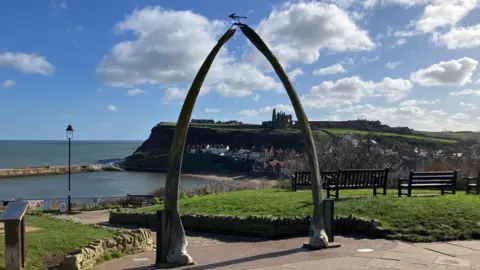
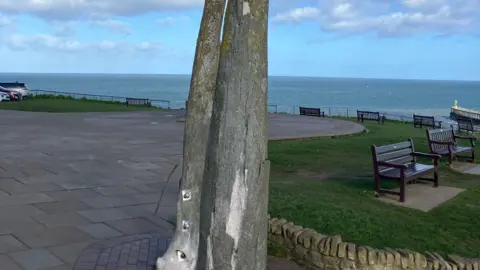
Described as one of Whitby's "most recognisable and significant landmarks", the Whale Bone Arch is a symbol of the picturesque coastal town's maritime history. But behind the photo opportunities, the clifftop structure also tells a somewhat darker tale of the whaling industry upon which Whitby's wealth was built.
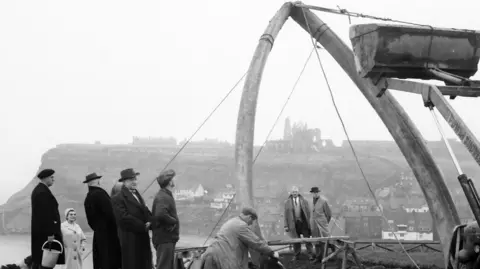
According to local newspaper reports, real jawbones of dead whales were first raised on top of West Cliff in 1964, when they were gifted to the town's council by a Norwegian whaling firm.
After nearly 40 years exposed to the elements the original structure was substituted for another genuine pair, sourced from Alaska, in 2002.
Now, with the bones deteriorating once again, the question of how to replace them has become a source of much discussion.
From the ethical and logistical concerns around replacing it with real whale bones to how best to create a replica of the structure, the answer is not simple.
As attitudes change, the BBC spoke to visitors and locals to hear their views on how Whitby's heritage should be remembered moving forward.
 Whitby Museum Collection
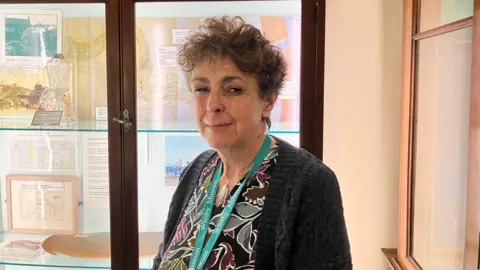
Whitby Museum's natural history curator Elaine Hoyle says the town's association with whaling goes back to the 18th Century, when it became "one of the major whaling ports" in Britain, thanks to local figures like William Scoresby and, later, his son of the same name.
"This was concurrent with the start of the Industrial Revolution in Northern Europe," she explains.
"They needed lubricants, they needed lighting fuel, they needed strong materials that could support things like bed frames. The whale was used for all these kinds of things."
Whitby began to prosper off the back of this thriving new practice, Hoyle says, which helped the town to develop.
"The Georgian mansions that you see around you were built on the back of shipping and whaling," she adds.
Hoyle, a native of the area, says the general feeling among local people about the town's history is one of "pride".
However, she admits there is a "more modern" school of thought about Whitby's association with whaling which isn't as positive.
 Steve Jones/BBC
"Having sat up there and listened to people chatting about it - 'It's disgusting, it shouldn't be there' - that's what I hear," she says.
North Yorkshire Council has said there are "ethical and legal challenges" to securing a new set of real whale bones, with Elaine admitting "attitudes have changed" in the 24 years since the last set of real bones were raised.
'Good educational opportunity'
Over at the arch, which is used heavily to market Whitby to visitors, a steady stream of people stop to take photos.
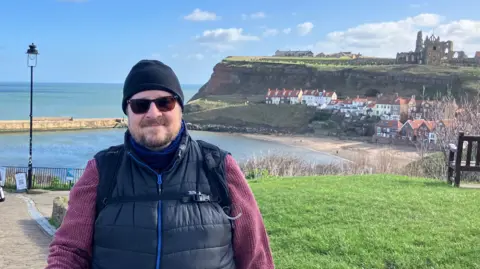
Among them is Neil Orford, a retired historian from Orangeville, in the Canadian state of Ontario.
He loves Whitby so much he visits three times a year to take in some of North Yorkshire's best scenery.
"I'm OK with it because it's historical," he says, looking up at the roughly 19ft (5.8m) tall arch.
"It tells the narrative history of this place. The more important issue is to have the discussion about it."
He suggests putting up a plaque to explain the potential controversy of the landmark.
"It's a good educational opportunity, but I don't think you necessarily throw out the original just for the sake of the controversy."
 Steve Jones/BBC
At a meeting earlier this week, Whitby Town Council endorsed an option to replace the bones with replicas cast in bronze, similar to the Captain Cooke statue which stands just a few feet away.
Costed at £60,000, it is the most expensive option available to the local authority, but would have an "indefinite lifespan".
West Cliff councillor Robert Dalrymple was part of the decision to endorse the bronze replica option, which will be put forward to North Yorkshire Council for the final ruling.
"We thought it would fit better within the surroundings and that it would be quite fitting if it was similar to Captain Cook," he explains.
"We had no issue going with the most expensive one because North Yorkshire Council have said they have got funding.
"A lot of tourists come here so we wanted to ensure whatever replaced the whale bones was suitable and continued to be appropriate for the area."
A spokesperson for North Yorkshire Council said they did not yet have a date for a decision on the future of the sculpture, although Whitby's mayor Sandra Turner previously said she hoped a replacement set could be secured by "the summer at the latest".
'It's part of Whitby'
Meanwhile, Peter and Elaine Mills, from Wakefield, are also regular visitors to Whitby. They would like to see the arch maintained in its original form.
"I don't have a problem with it being replaced with a natural whale bone as long as the whale has died naturally and they are not slaughtered for profit or gain," says Peter.
"It's part of the history of Whitby and that's what people like to see," adds Elaine.
"You can't wipe that out, whatever has happened."
Peter says the bronze replica "will cost an awful lot of money", adding: "There's things that need updating in Whitby and the money could be better spent elsewhere."
Turner, however, said all options to source genuine replacement bones have been "exhausted", including conversations with the mayor's office in Anchorage, Alaska, over the possibility of procuring a new set.
According to a report presented to Whitby Town Council, assessments suggest the current structure is "unlikely to remain in a safe condition beyond the next five years".
 Steve Jones/BBC
Sylvia Borness was also visiting the landmark during an overnight stay in Whitby with her mother.
"It's quite sad because they have been there such a long time and they are genuine," she says.
"It does seem a bit of a pity to replace a genuine article with a replica, but I can see they are crumbling at the top and I don't think there's another alternative."
Taking in the view from West Cliff, John McCormack has made the most of the spring sunshine with "a run out in the car" to Whitby.
"I have been coming here since I was a kid," explains the 77-year-old.
"I like these things," he says of the bones towering overhead.
"It's part of my childhood."
But he has something else on his mind when asked what he thinks of the possibility of them being replaced by a replica.
"I would rather they reduced the parking charges."
Listen to highlights from North Yorkshire on BBC Sounds, catch up with the latest episode of Look North.
