Sark Asian hornet sightings are 'earliest ever'

 Getty Images
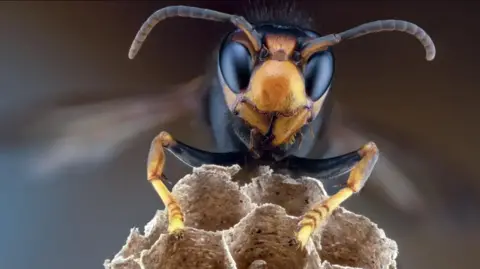
A Channel Islands group tracking Asian hornets has reported trapping 14 queens already - a record for this early in the year.
The Sark Asian Hornet Team said its tracking and trapping project continued to be a success amid growing numbers of hornets flying in from France and Jersey.
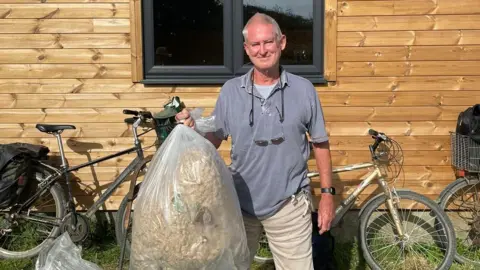
Coordinator Peter Cunneen added: "This is early in the season to be catching them already, the conditions must be warm for them to be emerging from hibernation.
"You're always learning and they keep taking us by surprise."
 Peter Cunneen
Up to 2023, about 10 queens were caught each year, said Cunneen, rising to 24 in 2024 and 135 in 2025, with the increase attributed to warmer weather and improved trapping resources.
In 2025, there had been just four queens caught by this stage in the year, he added.
Guernsey has also reported earlier sightings, with islanders asked to "remain vigilant and report any sightings".
Cunneen said they also relied on the "power of inhabitants" in Sark to work together to combat Asian hornets.
"We rely on people helping with spring queening from March to June through to monitoring bait stations and tracking and reporting later in the summer and that works to our advantage.
"We have a very tight community and everyone gets involved," he said.
"Without them we couldn't do it.
"There will be 80 people putting out about 85 traps this year,."
'Safety and security'
The project aims to intercept queen Asian hornets as they "emerge in the spring from hibernation and forage for nectar".
It is thought queens do not hibernate over the winter on Sark because nests are destroyed, he said.
Cunneen said the hornets were thought to be flying the 12 miles from Jersey and 20 miles from France, with nests mostly spotted near the coastlines.
The traps handed out to volunteers are designed to attract and capture the queens.
Cunneen said they used to catch 10 to 12 queens in the spring, before encountering six to eight nests during the course of the season, since the first nest was spotted in 2019.
Sark now has its own destruction kit, meaning it will rely less on resources from Guernsey, while it has also taken delivery of a new tracker to be used for the first time in the summer.
It comes with a "handgun" which helps users locate the sites.
Cunneen said jurisdictions in the Channel Islands saw combatting the problem as "essential for the safety and security of the eco-system and for public health".
Recalling being stung 10 times while tracking a nest in 2023, he added: "I had steroids and antihistamine injections but it was very very painful.
"If you can catch the queen hornets before they have a chance to make a nest it saves us a lot of bother in the summer.
"We feel like we are on top of it," he added.
Follow BBC Guernsey on X and Facebook and Instagram. Send your story ideas to channel.islands@bbc.co.uk.
