Is home 'Britain's oldest constantly lived-in'?

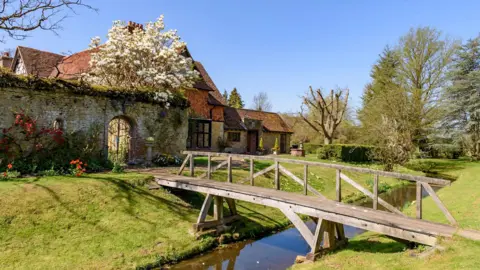 Great Tangley Manor
The residents of a property believed to be the oldest continuously inhabited house in Britain are planning to move out.
Anne Powell-Evans has lived at Great Tangley Manor for 30 years but says the site needs a "younger family who can do more and keep it in the way it deserves".
The property in Wonersh, Surrey, has seen royal residents and visitors across its 1,000-year history, ranging from Henry I to George VI.
Ms Powell-Evans said she and her husband "both love history, so uncovering what's happened in this house has been really very interesting".
The property's claim to be the country's oldest continuously inhabited house stems from Ms Powell-Evans's possession of records showing "everybody who's lived here since 1016".
"I don't think anybody else can make that claim," she said.
According to Ms Powell-Evans, Roman coins were previously found at the site.
She added: "It belonged to the youngest son of William the Conqueror, it belonged to Henry I, it belonged to Odo, Bishop of Bayeux."
The top floor and Tudor frontage were added in 1584, as well as the Great Tangley Manor's current windows, according to Ms Powell-Evans.
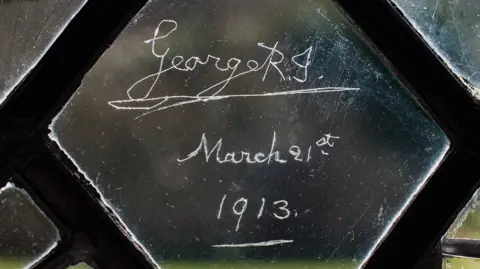 Great Tangley Manor
Previous residents and high-profile visitors - including George V and George VI - have etched marks into the windows, with the earliest engraving dating from 1672.
The windows were taken out and stored during World War One and World War Two before being refitted, according to Ms Powell-Evans.
Features also include a priest hiding place that suggests the property was a Catholic household at times following the English Reformation and dining room panels "purported to come from the Spanish Armada".
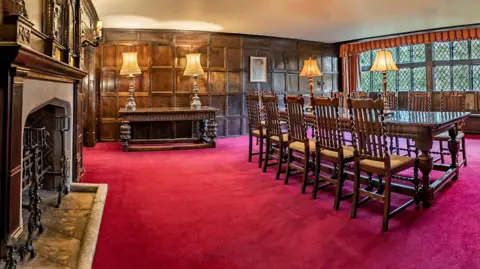 Great Tangley Manor
The current resident also claims the Grade I listed manor has been visited by "very benign presences".
She said: "I've sat in my study and watched the door open, and I know there's been nobody else in the house.
"It's lovely. They're all very nice, whoever they are."
Despite the history of the house, which members of the public can book to stay at, Ms Powell-Evans said the thing she would miss most was her "real love", the garden.
"We just look back on it with such joy really and feel very privileged to have had the opportunity to live here," she added.
The manor was listed for sale with an asking price of £4.95m.
Follow BBC Surrey on Facebook, on X, and on Instagram. Send your story ideas to southeasttoday@bbc.co.uk or WhatsApp us on 08081 002250.
