Legal challenge to Galloway power line project fails

 Getty Images
A legal challenge to plans for new overhead power lines across the south of Scotland has failed.
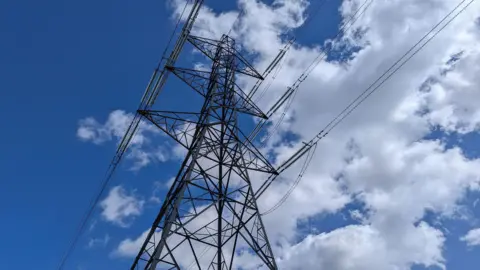
The Scottish government approved the plans to replace about 27 miles (43km) between Kendoon and Tongland last year.
That decision was described as "kick in the teeth" by campaigners and the case was taken to the Court of Session by Galloway Without Pylons (GWP).
However, a judge has now ruled that it failed to identify any evidence or representations which it claimed had been "overlooked" and therefore the bid for a judicial review had failed.
Approval for the project was confirmed in February last year after a very lengthy planning process.
The network in the area was constructed in the 1930s and SP Energy Networks (SPEN) said it was at the end of its life.
A public inquiry was held into the scheme and reporters ultimately recommended refusal.
However, ministers decided that protecting energy supplies for about 30,000 residents meant the project should proceed.
Opponents described that decision as "disgraceful" after the local community had fought for seven years to get the lines put underground or rerouted.
 Getty Images
The case was taken to the Court of Session which has now published its judgement.
It said GWP's principal contention was that the ministers decision letter did not give adequate reasons for going against the reporter's recommendation.
"The critical decision here concerned the weight to be attached to the need for the development," said Lord Lake in a written judgement.
"The decision was that this should not be reduced as the reporters had suggested.
"It was as a result of the effect of that on the overall balancing exercise that the ministers came to the decision that they did."
'Extremely disappointed'
He added that GWP had failed to identify any evidence or representations which it claimed had been overlooked.
"This makes it impossible to consider whether it was so obviously material that it required to the be the subject of express consideration," he said and ruled the legal challenge had failed.
Paul Swift of GWP told the BBC he was "extremely disappointed" for himself, people living and working in the area and visitors.
"It's also a blow for the environment and the wildlife especially when SPEN could have chosen the existing route - with a very short stretch of undergrounding - which would have caused far less damage," he added.
A statement from SPEN welcomed the decision of the court.
"Our Kendoon to Tongland project will replace a line that's over 80 years old, improving the security of supply to thousands of homes and businesses, including hospitals and schools, in the region," it said.
"Scotland's energy security will also be boosted by the project, helping to create more space on the network for new, green homegrown electricity to connect into the grid."
