Couple discovers Lebanon home destroyed by Israel from satellite image
"It's a catastrophe... for all of us, not only my family, but every single family that lives in that town."
Joe Elias and his wife Diana have not been able to return to their home in Qouzah, a predominantly Christian village in southern Lebanon, since renewed fighting between Hezbollah and Israel began in early March.
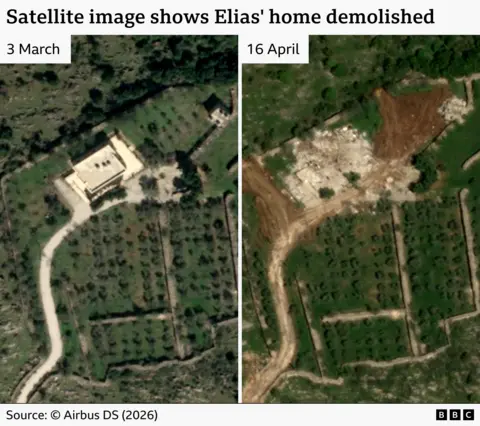
When BBC Verify reported that Qouzah was among several villages in southern Lebanon where buildings had been demolished after Israeli forces invaded, the Elias family got in touch. Satellite imagery later obtained independently by both BBC Verify and the family showed the house they had built had been flattened and several of their olive trees destroyed.
The Israel Defense Forces (IDF) said "five anti-tank missiles were launched towards troops" from the co-ordinates of the Elias house on 6 March, injuring four soldiers. It did not provide any evidence or details when asked, but said it had "struck several military targets" - including Elias' home - "to prevent further attacks against IDF troops".

The renewed fighting began after Hezbollah fired rockets into Israel, in retaliation for the killing of Iran's supreme leader. Since then, Israel's forces have levelled buildings and homes across southern Lebanon as part of its campaign against the armed group - which international law experts say may amount to a war crime.
Visual evidence analysed by BBC Verify shows controlled demolitions have taken place in at least 12 border villages and towns since the beginning of March. The IDF says that Hezbollah is embedded in civilian areas in the region and that it operates in accordance with the Law of Armed Conflict.
"[The village] is strategically located 750 metres above the ocean" on the top of a mountain, Elias said. "You can see 360 degrees all the way to Haifa in Israel."
Elias and his wife have been staying in their main home east of Beirut since February, but their neighbours in Qouzah told them they fled after Hezbollah entered the village.
"They just left with nothing, no food, no support. The ones that have cars, they went with the cars. The ones that do not have cars, they went walking," he said.
More than 1.2 million people are estimated to have been displaced across Lebanon since 2 March, according to figures by the UN Office for the Coordination of Humanitarian Affairs (OCHA).
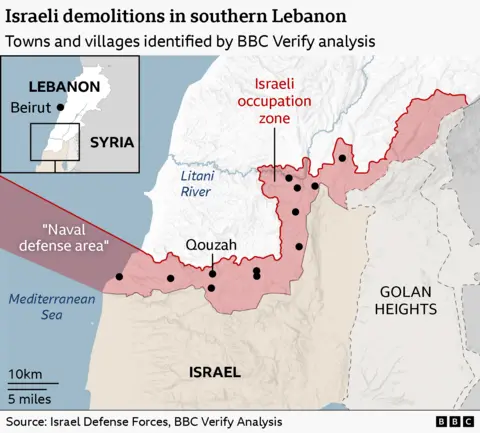
BBC Verify analysis of satellite imagery shows the IDF destroyed nearly a third of buildings in the main residential area of Qouzah between 3 March and 16 April.
Both Hezbollah and the IDF say buildings in the village have been used by each other's forces.
The IDF published a video which it says shows Hezbollah fighters climbing into the grounds of a building, which BBC Verify located to the centre of Qouzah. While other verified videos shared on a Hezbollah military Telegram channel showed what it described as Hezbollah drone attacks on Israeli positions both inside the village and in neighbouring towns.
"I understand there is a world [with] two parties shooting at each other, firing missiles and all of this. But at the end, in reality, the Lebanese civilian is the one who pays the price," Elias said.
Even before the renewed fighting between Hezbollah and Israel, Elias' house was severely damaged during the war triggered by the Hamas-led attack on Israel on 7 October 2023.
The previous fighting between Israel and Hezbollah shattered the windows and left cracks in the walls, which the couple spent months repairing.
Elias said that Hezbollah fighters might operate from villages but that the "Israelis respond excessively".
"No need to destroy the entire infrastructure - not the roads, the water pipes, the electricity," he added.
BBC Verify has also confirmed the presence of the Israeli military in the area. Analysis of satellite imagery by intelligence firm MAIAR shows three armoured vehicles just 200 metres from Elias' house on 16 April, while seven armoured vehicles, four tanks, an excavator and a bulldozer can also be seen in the village.
Elias built the house in his ancestral village nearly 20 years ago, after spending six years saving up. He and his wife had spent 26 years in the US, where he worked as an engineer and eventually became citizens, before deciding they wanted their six children to have a chance to experience the area where his family grew up.

They planted olive, fig and pomegranate trees in their garden and brought furniture back from the US from the Amish community in Pennsylvania: "That's something we cannot replace," he said.
Before the recent conflict, his family produced around 1,000 litres of organic olive oil a year from their groves. But satellite imagery shows several olive trees around the house razed to the ground.
Elias became a mayor in the village for more than a decade, and his family members are buried in its cemetery.
"My wife and I are trying to hold on to what's left… to memories that are slipping away from us like the falling rubble," he wrote in a post online sharing footage of the olive groves around his home.
"Every corner of that home held a story, and every piece of furniture carried a heartbeat of our lives - a laugh, a tear, a dream that was once real," he added.
"We don't know if we want to go back and build a house in the absence of a permanent, lasting peace."
A 10-day ceasefire was announced on 16 April after six weeks of conflict and remains in place, but Israel continues to occupy towns and villages up to 10km (6 miles) beyond the border.

