It was once part of Scotland's landscape - now it's been sold for £26m

 Alamy
AlamyThey were once familiar figures in the landscape of southern Scotland.
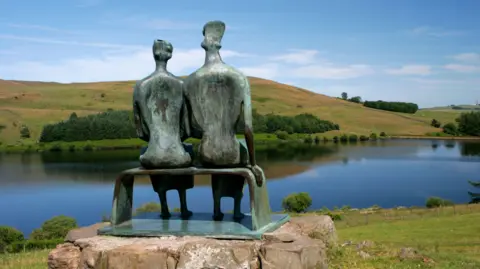
A series of sculptures by Henry Moore and others stood around Glenkiln in Dumfries and Galloway as a bold example of artwork in the countryside.
However, one of them - King and Queen - was vandalised in 1995, when it was decapitated.
The heads were later found and meticulously reattached but the sculpture was permanently removed from public display several years later.
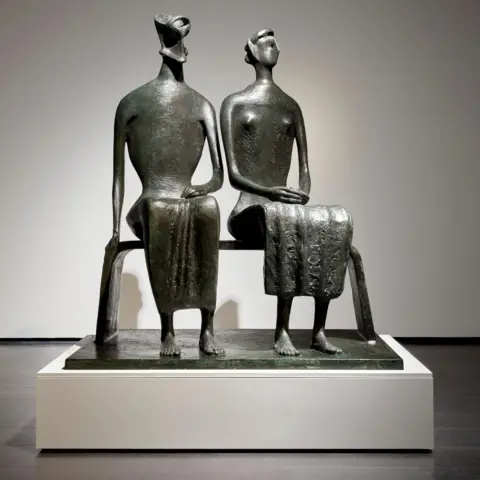
It has now sold at auction for £26m.
 Christie's
The Glenkiln sculpture park was created by local landowner Sir William Keswick between 1951 and 1976.
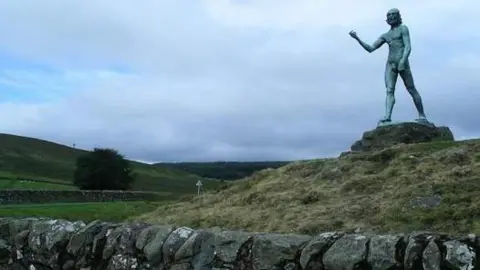
Alongside four works by Moore were two others by Auguste Rodin and Jacob Epstein.
The idea behind the park was to display modern sculptures in natural outdoor settings rather than traditional galleries. It proved a popular attraction for walkers, who could take a tour around them when visiting the region.
"Set within a wild, windswept moorland, King and Queen took on a new life," said Alice Murray of auctioneers Christie's.
"Against vast skies, rolling hills and shifting weather the pair seemed to come alive - timeless guardians of the landscape."
 Getty Images
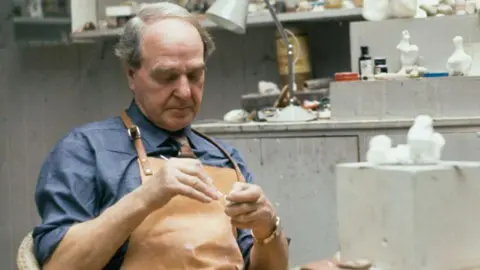
Henry Moore is regarded as one of the greatest British artists of the 20th century. He was born in Castleford in West Yorkshire and studied at Leeds School of Art alongside Wakefield sculptor Barbara Hepworth.
He specialised in semi-abstract bronze sculptures which were displayed in public places.
King and Queen was inspired by an Egyptian sculpture in the British Museum of a court official and his wife, and evolved from Moore playing with a small piece of modelling wax.
Moore said he later realised that more inspiration might also have come from years of reading stories about "kings and queens and princesses" to his daughter Mary.
The sculpture became known as one of his landmark pieces, described by one critic as "Moore's finest achievement since the war, and probably the most graceful of all his works."
 Alamy
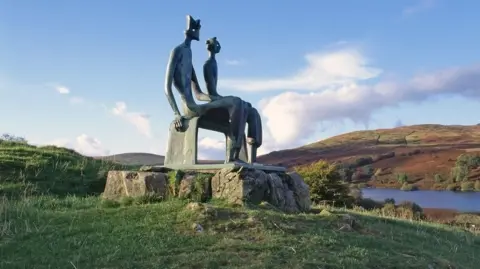
AlamyIt was a major attraction at Glenkiln, though it became a target for vandals and thieves.
In 1995, King and Queen was beheaded, but the original heads were eventually retrieved and meticulously restored.
And in 2013, the theft of another artwork - Standing Figure - signalled the end for the public exhibition space.
The 7ft (2.1m) tall artwork was taken and a £50,000 reward offered for information leading to its return but it has never been recovered.
The remaining pieces were moved into secure storage, bringing to an end one of the south of Scotland's most unusual attractions.
Memories of King and Queen looking out across the Glenkiln Reservoir were revived last week.
The figures went up for auction and were expected to fetch up to £15m but in the end sold for £11m more to an undisclosed bidder.
Christie's said it was remarkable price for a piece with a colourful history.
The bronze is one of four editions of the sculpture but is the only remaining example still in private hands. The others are in Japan, the Netherlands and the USA.
Two subsequent casts were produced for the Tate Collection in 1957 and The Henry Moore Foundation in 1985.
 Lynne Kirton
"Henry Moore's King and Queen stirs a strong response in those who view it," said a Christie's spokesperson.
"Housed in major museum collections worldwide including Tate, the present cast is the very last to remain in private hands.
"In the spring of 1995, the work was dramatically beheaded while installed in the wild beauty of its moorland setting.
"Though the gesture was striking, the original heads were retrieved and carefully restored under the guidance of The Henry Moore Foundation adding a powerful footnote to the history of this majestic sculpture."
The Glenkiln sculpture park is now just a distant memory, but the "loop" around the reservoir remains a popular draw for cyclists.
Although nowadays, it comes without the accompaniment of multi-million pound artworks.
