'It's vital to celebrate how far we've come, but also how far there is to go'

 Johan Persson
The forgotten story of the women from Sheffield who played football in front of crowds of tens of thousands during World War One is to be told in a new play being performed in the city.
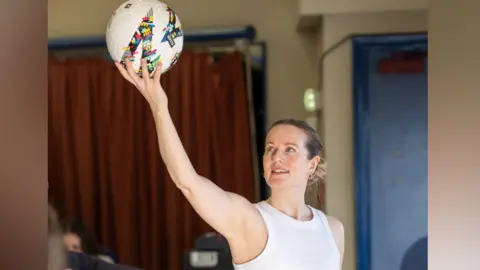
Written by Stefano Massini, who wrote the Lehman Trilogy, and adapted by Calendar Girls' Tim Firth, The Ladies Football Club follows 11 women who, with men away fighting in the trenches, step in to work in Sheffield's munitions factories and who relax by kicking a ball about during their lunch break.
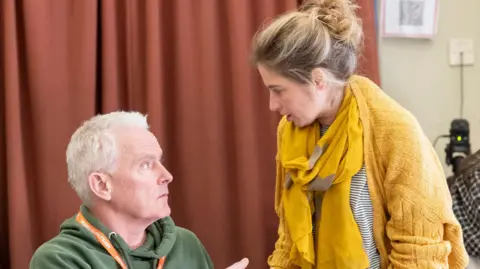
Elizabeth Newman, director of the play, which is due to start its run at Sheffield's Crucible Theatre, says she hopes the play will educate audiences about the role of women in sport, but also wider society.
"It speaks to all the battles women are facing: their working conditions, the politics of the day, what it means to be women playing football," she says.
 Johan Persson
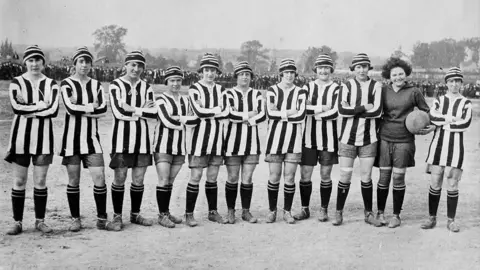
Huge numbers of women were brought in to Britain's workforce during World War One, becoming known as the "munitionettes".
Many were encouraged to play organised sports and women from across the workforce started teams and competed with each other, culminating in an event called The Munitionettes' Cup.
But when men returned to workplaces after the war, the sport was judged to be inappropriate for women and in 1921 the Football Association (FA) imposed a ban on women playing at professional grounds and on pitches of clubs affiliated to the FA.
However, according to Cara Theobold, who plays midfielder and Sheffield Wednesday fan Violet, the show is not a political or social lecture - and, despite its serious themes, is full of laughter.
"Also, it's not very often that a play ends, 'and it's better today'. It's really nice to be part of a story where it ends and goes, 'look, we have actually made major progress'," she says.
Theobold adds that England's Lionesses have inevitably been an inspiration for the cast, but they have also been reminded of the hardships women faced in the last century.
"Watching the Lionesses win in the Euros last summer was the only time I've seen an England team win a championship or a competition in the final in my whole life," she explains.
"And the fact it's in the consciousness, not because it's, like, give them a go. It's, like, no, because they are world champions.
"I think it's important to see the parallels, to celebrate how far we've come, but then also think how far there is still to go."
 Getty Images
Leah Brotherhead, who stars as Hayley, is another of the 11 actors in the play, which, like a real match, is 90 minutes long with 45 minutes each side.
She says finding out women's football had been banned - a rule that was not lifted until 1971 - was certainly an education.
"I just kind of assumed people had been doing it really low level and then it had come back into its own in the 1980s or something. So, filling in those gaps is really important," she says.
"It's quite moving when I think about my friend's daughter who is five and has already been scouted and is amazing at football - and thinking about the shoulders she's standing on.
"She's aware of the rhetoric that girls don't play football still, even though she's fully grown up in the resurgence of it and the mainstream of the women winning all those competitions.
"And so it feels very pertinent to be doing it now and to kind of actually be going, this didn't happen in a vacuum, this has real history and it's about women and it permeates into everything about women's lives and having our own autonomy, having our strength and the ability to do what we want to do."
 Johan Persson
Massini says he was inspired to write the play during the pandemic, when a woman was murdered near his home.
He says he wanted to write about the struggles women face and decided to use football as a vehicle.
Newman explains that Massini "started doing his research about the founding of women's football, the fact the FA banned women from playing - all of this important stuff - and he picked Sheffield because we're on the site of the home of the rules of football".
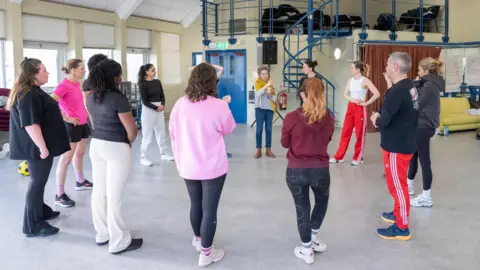
All the cast have had to learn how to play for the show, which has come easier for some than others.
Theobold says she played at school and runs a community five-a-side kickabout at home in London, but Brotherhead says learning to play football for the show was a whole new experience.
Meanwhile, she says being in an all-female cast made her feel more comfortable.
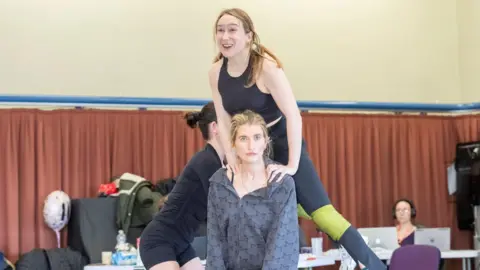
"Lots of the girls play football, but I was coming into it feeling like a free space to be be crap with my body. No-one's going to come in and be like, 'oh I can do this lift because I'm stronger than you'," Brotherhead says.
"You have the freedom to carry your own weight and be the strong person in the room.
"I have had absolutely fantastic times in mixed gender rooms and working with men but I think when you're being so physical, there is something quite freeing."
 Johan Persson
Director Newman agrees that working in all-female cast allows "everyone to be themselves" and is frustrated at the lack of all-women shows.
"For a very long time it has not been uncommon for there to be companies of men, to the point it's not mentioned," she says.
"Whereas the fact it's still a rarity that you'd have a play that only happens to have women in it, I think is a bit sad.
"No-one thinks when somebody puts on [World War One-based drama] Journey's End that they need to comment that there's only men in it," she says.
"I would love to get to a place as not just a director of a play, but as an artistic director, where it's almost not noteworthy.
"I think we're a fair way off, but that's why it's important to just keep doing it."
The Ladies Football Club is at Sheffield Crucible from 28 February to 28 March.
Listen to highlights from South Yorkshire on BBC Sounds, catch up with the latest episode of Look North
