Mandelson scandal is 'serious' for Starmer but PM is 'man of integrity', Brown says
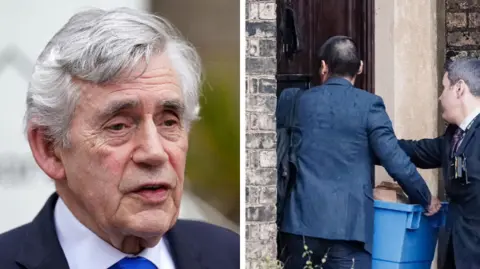
Former Prime Minister Gordon Brown has told the BBC the situation facing Sir Keir Starmer was "serious" and suggested he may have been "too slow to do the right things" concerning Lord Mandelson.
The prime minister is under mounting pressure from Labour MPs over his decision to appoint Lord Mandelson as the UK's US ambassador in 2024 - despite Mandelson's relationship with convicted sex offender Jeffrey Epstein being a matter of public record at the time.
Brown said the appointment had been a "mistake", saying he had also made a mistake by bringing Lord Mandelson into his own cabinet in 2008.
But he told BBC Radio 4's Today Programme he backed Sir Keir as a "man of integrity" who had been "betrayed" by Lord Mandelson, adding the prime minister was the right man to "clean up the system".
Brown's remarks came as police concluded a search of two homes linked to Lord Mandelson, after email exchanges released in the latest Epstein files suggested he passed on market-sensitive government information to Epstein.
They indicate Lord Mandelson gave Epstein notice of an impending EU bailout in 2010, after sending him internal government information about the state of the UK's struggling economy and lobbying the Treasury on banking policy at Epstein's suggestion while in Brown's cabinet in 2009.
Sir Keir said earlier this week that Lord Mandelson had lied to him about the extent of his relationship with Epstein during the vetting process for US ambassador, adding: "None of us knew the depths and the darkness of that relationship."
But Labour backbenchers are increasingly questioning the PM's judgement.
Asked if Sir Keir was the right man to take the country forward, Brown said: "Well, this is obviously serious. I mean, there's always speculation. It happened to me, it happened to Tony Blair, it happens to everybody about how their future should be gauged.
"But this is serious and the task is very clear. We've got to clean up the system... and end the corruption and unethical behaviour. And if we don't do it, we'll pay a heavy price."
The last Labour PM added that Sir Keir was "a man of integrity" who "wants to do the right things".
He said: "Perhaps he's been too slow to do the right things, but he must do the right things now. And let's judge what he does on what happens in the next few months, when he tries - and I believe [he] will try - to clean up the system."

 Getty Images
Mandelson 'betrayed' his country
Brown said he believed Lord Mandelson "betrayed" his country by leaking the information.
He said Lord Mandelson's communications with Epstein "meant Britain was at risk because of that, the currency was at risk, some of the trading that would happen would be speculative as a result of that - and there's no doubt that huge commercial damage could have been done and perhaps was done".
Brown said he felt "shocked, sad, angry, betrayed, let down" by the messages.
He said they indicated Lord Mandelson - who Brown made a peer to give him a cabinet position - was planning for a career outside government while he was business secretary during its response to the global financial crisis.
"The emails show that," he said. "They show that he was talking about writing a book while he was supposed to be a government minister. He was talking about how he would get a job after the government was over and talking about what banks would employ him.
"All these things were happening at one and the same time, so it was a complete betrayal of his colleagues and of the job that he was carrying out and, of course, it was a betrayal of the country."
 United States District Court Southern District of New York
Emails shared information on bailout
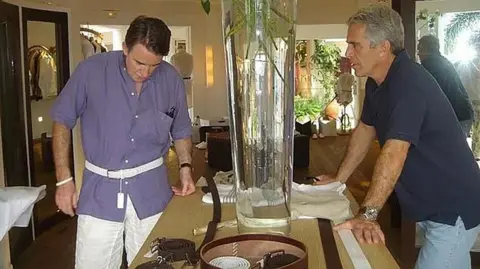
Among the email exchanges is one that indicates Lord Mandelson gave Epstein advance notice of a €500bn bailout by the EU to save the ailing Euro in 2010.
Another included a 2009 memo in which Brown's policy adviser Nick Butler wrote about the UK's struggling economy and recommended selling off government-held assets to raise public funds.
Brown said this was "market-sensitive" information as people can make money from changes in the values of currencies.
He said: "I see it as a financial crime, and there's no doubt that that was very dangerous.
"And look, all the information he passed on, the papers by other advisors were commercially sensitive. This was financially secret information. It meant that Britain was at risk because of that."
On Saturday, the Metropolitan Police said it had concluded a search at two properties linked to Lord Mandelson in Wiltshire and north London following allegations of misconduct in public office.
Deputy Assistant Commissioner Hayley Sewart said the 72-year-old had not been arrested and that enquiries were ongoing.
"This will be a complex investigation requiring a significant amount of further evidence gathering and analysis. It will take some time to do this work comprehensively and we will not be providing a running commentary."
Andrew Mountbatten-Windsor, who also appeared in photographs in the recent Epstein file release, has faced called to testify before the US Congress on his dealings with Epstein - including from Sir Keir.
There have been reports this week that Lord Mandelson could be issued with a similar request, though he has no legal obligation to appear while in the UK.
Asked whether Lord Mandelson should go if he is called to give evidence in Washington, Brown said Lord Mandelson, Andrew and "anybody who knows anything about this has got to give the information to the authorities that will allow us to see what we can do to root out what is the most egregious abuse of power".
He added: "We're dealing with a global network of very powerful people who believed that they could break the law, they believed they could do anything because nobody would prosecute them."
Brown renewed his calls for "comprehensive" reform of the British political system as "we don't do well enough in imposing standards on members of parliament, on ambassadors but also on government ministers".
He said the government needed to introduce an "anti-corruption commission" with "powers to seize assets", among a raft of other measures to clear up public life.
Brown said the government needed to act quickly to bring in the recommendations relating to standards in public life that he laid out in his report "A New Britain: Renewing our Democracy and Rebuilding our Economy".
He suggested there should be US-style confirmation hearings for ministers and senior government appointments as there had been "a systemic failure to do proper vetting".
Had there have been a public confirmation for Lord Mandelson's appointment as US ambassador, "people could ask the questions of Mandelson and see whether he was indeed the liar that he is now been seen to be", Brown said.
 Getty Images
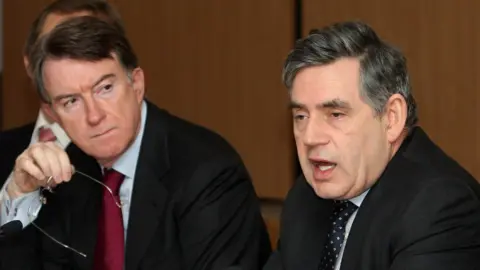
He said Sir Keir "was misled and he was betrayed" by Lord Mandelson during the vetting process for US ambassador, but that this was "not a sufficient explanation for what happened".
The prime minister earlier this week acknowledged it had been publicly known for some time that Lord Mandelson knew Epstein, but contended that he would not have appointed the peer to the ambassadorship had he known what he did now.
Sir Keir said Lord Mandelson had been asked directly about the nature of his relationship with Epstein during the vetting process, and had portrayed the disgraced financier "as someone he barely knew".
Brown said an ethics commission should be given statutory powers to check the bank accounts of people being appointed to senior government positions, and there needed to be a crackdown on "the systematic abuse of power by lobbyists".
He also said there should be a ban on MPs' second jobs except in the case of doctors.
"This is an issue of trust, and trust once dented is difficult to recover, and that's why we need a comprehensive set of actions on corruption, ethics, lobbying, and indeed on openness."
