Severe flooding expected as Tropical Cyclone Narelle hits Queensland

 Bureau of Meteorology
A cyclone in Australia which authorities said could be among "the worst in living memory" appears to have been less damaging than feared - but concerns remain about severe flooding.
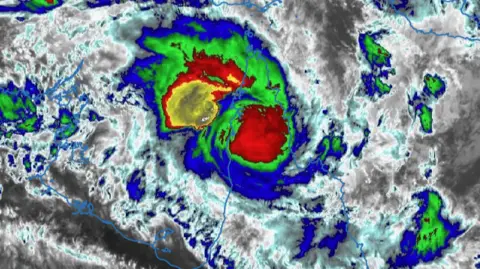
Tropical Cyclone Narelle crossed the east coast of Cape York in Far North Queensland with powerful wind gusts of 220 km/h (137mph), but has since weakened from a category four system to a three, the weather bureau said.
Authorities praised residents who had followed orders to shelter in place.
Preparations are now being made for the cyclone when it reaches the Northern Territory – expected on Saturday – while up to 500mm of rain is expected in parts of far north Queensland, and is predicted to cause severe flooding.
Australia's Bureau of Meteorology said Narelle was still packing wind gusts of around 140 km/h as a category three cyclone.
The town of Coen, which has a population of around 350 people, had been expected to face the brunt of the storm, but police say there are no reports of injuries or serious infrastructure damage.
However, Debbie Jackson, who lives 50km (31 miles) north of Coen, told the ABC that they were "losing roofs everywhere".
"Lots of trees down. We have lost a few roofs. It's not real great," she said. "We just have to ride it out."
Thousands of homes are without power, and telephone signal has also been lost in parts of the western coast of Cape York, including the predominantly Indigenous town of Aurukun.
State Premier David Crisafulli said that although these were areas with relatively small populations, residents were "still Queenslanders, and we care about them".
"In many cases it will be the strongest wind people have experienced in this part of the state for a long, long time," he added.
And although this is known as the wet season in Far North Queensland, he said there was "a lot of rain" in the system.
"As it moves it will be hard and fast and we're dealing with an area where there are already very saturated catchments," Crisafulli said.
"As a result, the prospect of flash flooding is real."
Queensland's State Disaster Coordinator Chris Stream said that locals needed to remain wary.
"Do not be lulled or get into any false sense of security or safety as the eye passes over," he said at a news conference in Brisbane.
The tourist town of Port Douglas, a gateway to the famous Great Barrier Reef and the Daintree Rainforest, has felt the impacts of the weather system with the town's beach washing out - despite being some 400km south of where Narelle made landfall.
In Cairns, a further 100km south, some beaches to the north of city were badly eroded while others saw sand levels build up because of winds and tides.
Tropical Cyclone Narelle is moving across Cape York peninsula with small, predominantly Indigenous communities likely to be affected later on Friday.
It is then expected to move across the Gulf of Carpentaria where storm experts say the warm waters could cause the cyclone to intensify once again, as it moves towards the Northern Territory.
Hundreds of people from the remote community of Numbulwar have been evacuated to Darwin as a precaution.
And in the town of Katherine, where flooding is expected, a field hospital is being set up to supplement existing health services.
