Welcome to Australia's hottest beach event - nowhere near the sea
Like many wild and wacky ideas, it all started down at the pub.
"I was literally looking out the window at that intersection and thought, 'What if we put in a beach volleyball court and play a competition?'
"On a tar road. In the middle of a town 400km from the nearest beach," Simon Sutherland, 51, says.
He wanted to bring the party vibe of Bali's Kuta – a popular island holiday spot for many Australians – to his hometown of Cootamundra.
And so that night he went home and drew up plans for Australia's own "Coota Beach" and its now famous annual volleyball tournament.
Twenty-five years on, it's grown from a single day of play into a three-day festival – a cultural and sporting highlight in the town's calendar, delighting locals, attracting thousands of tourists and bringing in an estimated $2m in revenue.
"In a way, I think it's bigger than Christmas," 86-year-old grandmother Pat Roberts, who tells the BBC she has made cheering on her children and grandchildren a summer tradition.
"I've loved it every year, I've never missed one."
From one court to ten
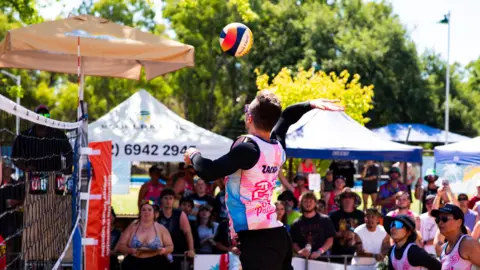
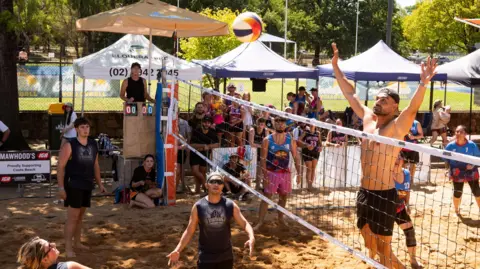
It's Saturday afternoon and the tournament resembles a beach bash in full swing, costumed bodies heaving under the blazing sun.
"Mine!" calls out one singlet-clad player to her teammates, making it to a volleyball just in time. Loud pop and rock music blares down the entire block, punctuated by the odd cheer and whoop from spectators.
Over on one court, a team of minions – complete with yellow-painted faces, oversized googles and beach-styled overalls – are jumping excitedly much like their animated namesake.


Elsewhere, teams like Holy Blockamole and Itsy Bitsy Spiker are dropping shots like it's hot, diving to make saves and drinking like it's the last days of summer.
There's plenty of laughs as teams of six serve, spike and block during the 20-minute matches, with rules that are a mix of indoor and beach volleyball.
Suncream's being slathered on, high-fives are flowing as freely as the cold drinks. In between matches, hard-working staff are hosing down the courts to cool the sand.
It's a stark contrast to the first Coota Beach event in 2001 – when 16 teams played a couple dozen matches on a single court in one day. This year's event had almost 200 teams playing over three days. Demand was so high, 40 teams were turned away.
Sutherland remembers the early years clearly.
"We used to get up at 1am and start setting up on the Saturday morning, ready to go for games at 8am," he recalls, shaking his head in mild disbelief as he glances over the ten courts at this year's event.
 Kaktus Scot
These days, transforming the asphalt landscape into a sandy oasis takes about a week, with almost 900 tonnes of sand – that's about six blue whales or 70 double-decker buses – trucked in.
James Graham, owner of the quarry where the sand is sourced from, says the town's order is the strangest request he's ever had: "Who am I to tell people what to do with it?," he jokes.
Council workers then flatten the huge mounds of sand to create an inland beach, ready for the first games on Friday.
Hours after the finals wrap up on Sunday and all the eskies have been packed away, workers and volunteers try to scoop up every last grain of sand, which is either sold or donated to the community, turning up in local parks, sporting grounds or construction sites.
Within two days, the road – buffed and cleaned - returns to its usual form, lined with parked cars and locals going about their daily errands.
Costumes and camaraderie
 Kaktus Scot
Organiser Lee-Anne Hogan estimates the town's usual population of 7,000 swells by about 3,000 over the weekend. "It's enormous - the town actually books out in every way".
While, in the early days, there were fears from some businesses that closing a street might mean fewer customers, those worries have disappeared.
A No Vacancy sign out the front of his Southern Comfort Motor Inn, Dylan O'Neill says: "It's clear that every hospitality business in town benefits significantly from the event."
Among those who have flocked to Cootamundra for the weekend are British couple Guy Wilkinson and Lizzie Ellison, both 30, who moved to Sydney two years ago and have driven four hours to compete.
It's a "true rural experience," that feels "uniquely Australian", Ellison says.
"It's a super fun, friendly vibe," Wilkinson adds.
Their team – all dressed in tasselled cowboy outfits – have nabbed the prize for best-dressed, tying with another team decked out in pink nighties and platinum blonde wigs.
 Kaktus Scot
 Kaktus Scot
"We've had people come here from Manly in Sydney saying that these are better courts to play on than the ones at the beaches there," Sutherland brags, "I don't think we can get a better wrap than that."
Whether you're a long-time local or new to Coota, the weekend is an opportunity to cultivate a sense of community.
Sia Lesa speaks to the BBC as she is about to step onto court eight for her third and final match of the day.
She recently moved to town from her native Samoa as part of a visa scheme that has seen hundreds of Pacific Islanders relocate to Australia for jobs.
"I arrived in 2024, right on the day of the tournament," she says. "I arrived in the early morning and I played in the afternoon, no kidding."
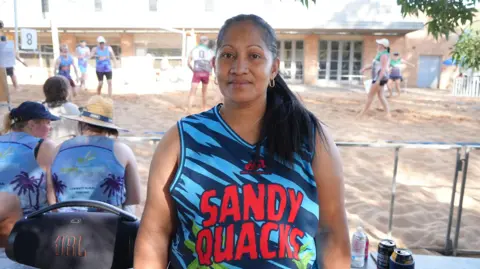
For Lesa, the social aspect of the weekend is a rare chance to feel part of a community that often feels closed off to her.
"Coota is very small and [this is] something different for us, because normally we work at the abattoir and straight after we finish work, we go home and stay there."
It's certainly a homely affair for James Dunk, who has played every year for about a decade and always enters a team made up of three sets of neighbours.
Last year, his son joined the team as he had just turned 14 – the minimum age to participate. "It's almost a rite of passage before they ditch you and go and have more fun with their friends," he jokes.

That's exactly the case for Sutherland's son Eamon, 14, who finally had a chance to join in, after years of watching from the sidelines.
"It's so exciting to get to play," he smiles, his team's name – Spiked and Served – emblazoned on his singlet.
As the sun sets and players dust off their sandy feet, Sutherland says he has big plans to expand the shoreline of Coota Beach.
"I want it to be as big as the Elvis Festival in Parkes," he says, referring to the week-long celebrations in another regional Australian town that draws tens of thousands of fans every January to celebrate the King of Rock.
"The more people we can bring into the Coota sphere, the better - people that would rarely go to a country town. Come and see what we've got to offer."
