Elon Musk's Starlink blocked from operating in Namibia

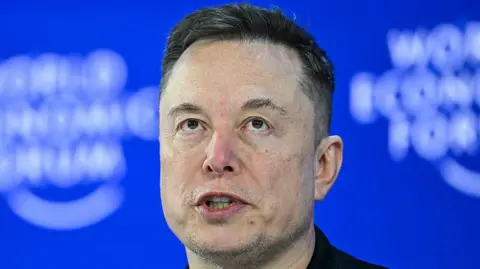 AFP via Getty Images
Namibia has rejected an application by Elon Musk-owned Starlink for a licence to provide satellite internet services in the country, dealing the company a second setback in southern Africa.
The Communications Regulatory Authority of Namibia (Cran) announced the decision without giving reasons for its refusal, but noted that Starlink's Namibian subsidiary did not have local ownership.
Starlink has not yet commented on the decision.
It operates in about 25 African countries but has faced regulatory challenges in others, including South Africa, where ownership rules have also blocked its entry.
Namibian law requires that at least 51% shares in any telecommunications company must be owned by citizens or local entities.
Namibia is a former colony of Germany, and was under the rule of South Africa's white-minority regime until it gained independence in 1990.
It then adopted policies aimed at increasing local ownership in businesses and tackling racial inequality.
On its website, Starlink says it has established a local company that will partner with Namibian firms and create employment opportunities.
Cran said it could reconsider its decision either "on its own motion or on a petition filed by an aggrieved party" within 90 days.
In 2024, the regulator issued an order against Starlink, accusing it of operating without a licence and instructing it to immediately cease all operations in Namibia.
It also advised the public not to purchase Starlink terminal equipment or subscribe to its services, as doing so would be illegal.
Musk, who was born in South Africa in 1971 before moving to Canada in the late 1980s and then to the US where he became the world's richest man, has blamed "racist ownership laws" for his company's failure to launch in South Africa.
In a post on X last year, he claimed that his satellite internet service provider was "not allowed to operate in South Africa simply because I'm not black".
He has strongly criticised the country's black economic empowerment policies, alleging that they act as a barrier to foreign investment.
The government challenged this view, saying Starlink was welcome to operate in South Africa "provided there's compliance with local laws".
It also noted that more than 600 US companies, including computing giant Microsoft, were operating in South Africa in compliance with its laws - and "thriving".
The black empowerment policies were introduced after white-minority rule ended in 1994, in an attempt to tackle the racial injustices of the past.
This has included adopting legislation requiring investors to give local black firms a 30% stake in businesses in South Africa.
Starlink provides internet services via a huge network of satellites. It is aimed at people who live in remote areas who cannot get high-speed internet.
You may also be interested in:
 Getty Images/BBC
Go to BBCAfrica.com for more news from the African continent.
Follow us on Twitter @BBCAfrica, on Facebook at BBC Africa or on Instagram at bbcafrica
