New study to track childhood blood disorders

 Getty Images
A major study in Leeds is going to track the long‑term effects of childhood blood disorders, such as sickle cell disease, beta thalassemia and acute leukaemias.
Researchers will compare NHS, education and social care records as well as carrying out a survey with patients about their lived experience.
The aim is to understand how these conditions affect health, life expectancy, education and employment as people grow up.
Prof Richard Feltbower from the University of Leeds said the study would "shine a light on the experiences of people living with these conditions".
The Haematology Lived Experience and Outcomes (HALO) study is the first of its kind in the UK.
It will look at conditions that can cause chronic fatigue, severe pain and other serious complications, and which often require lifelong treatment.
Sickle cell disease and beta thalassemia affect red blood cells and are inherited conditions while acute leukaemias are aggressive blood cancers of the white blood cells, usually treated with chemotherapy or bone marrow transplants.
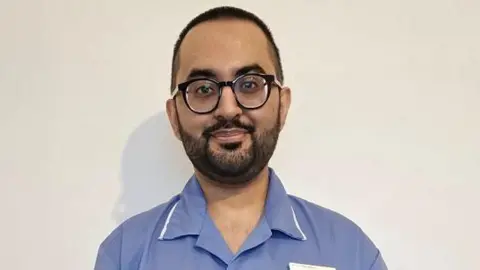
For Kabir Hussain, 28, from Leeds, these conditions shaped much of his early life.
He was diagnosed with beta thalassemia at eight months old and spent long periods in hospital.
Aged 10, he had a bone marrow transplant from his father.
To prepare for the operation he had chemotherapy to kill some of his unhelpful bone marrow that was producing the unhealthy blood cells.
Hussain said: "Every single month between the ages of about four till at least 11, once a month for all those years, going into hospital, having a blood transfusion.
"I don't remember not having needles and I don't remember not having pain."
He said he did not fully understand the illness as a child.
"I don't remember anybody saying to me what the problem was, why it was," he added.
There was little emotional support available at the time for Hussain.
"I don't remember there being any counselling, any psychological support," he said.
 University of Leeds
Now working as a registered nurse at the Mid Yorkshire Teaching NHS Trust, Hussain said he was grateful for the support he received growing up from family and friends.
"I feel as if my story now is quite positive, but I want to emphasise that I'm a minority in this, because the majority of people are still suffering and feel forgotten. So that's what this study is all about," he said.
Hussain believes the HALO study could help highlight inequalities.
"These conditions, they affect minorities mainly, and we consistently see health inequalities. It's 2026, why are we still seeing health inequalities in England?" he said.
Prof Feltbower, who specialises in paediatric epidemiology at the University of Leeds and is deputy director of Child Health Outcomes Research at Leeds (CHORAL), said the research would help the NHS understand how best to support children diagnosed with these conditions as they move into adulthood.
The £680,000 study is funded by Leeds Hospitals Charity and delivered through CHORAL, a partnership between the University of Leeds and Leeds Teaching Hospitals NHS Trust.
It is being run with Haemoglobinopathy Co‑ordinating Centres across the North of England, with the patient survey now under way.
Listen to highlights from West Yorkshire on BBC Sounds, catch up with the latest episode of Look North.
