Assisted dying campaigners request extra time for peers to scrutinise bill

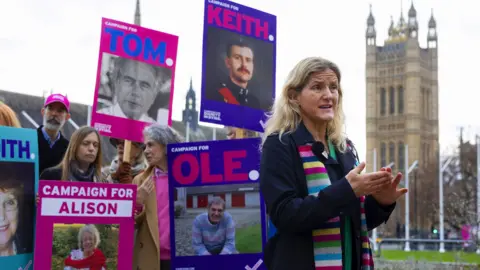 PA Media
Campaigners for assisted dying will ask the House of Lords to sit late or start early in order to pass the legislation in time.
Concern is growing among supporters of the bill that it won't pass all its parliamentary hurdles in the allotted days.
A motion in the Lords asks peers to agree that "further time should be provided for consideration of the bill".
Extending the usual Friday debates is one likely option but that would anger some Jewish peers because the weekly religious Shabbat ceremony begins at sunset.
Lord Shinkwin, who is disabled, has also previously said that because of his travel arrangements, sitting later on a Friday would be a "a feeble fig leaf for discrimination against me".
If the House of Lords agrees to the motion, private negotiations between peers would then begin over when and how much extra time would be granted.
Any decision would require agreement from the different sides in the Lords.
Sources close to those opposed to the bill have suggested they would not agree to extra time.
Members of the House of Lords have proposed more than 1,000 amendments to the bill – which experts believe is a record number for a bill proposed by a backbench MP.
Supporters believe this is a delaying tactic. They argue peers, who are not elected, should respect the will of the House of Commons which passed the bill last year.
Critics deny they are deliberately stalling the bill. They believe the bill does not protect vulnerable people and needs significant changes before becoming law.
It must complete all its parliamentary stages before the next King's Speech, which the BBC revealed is expected in early May.
If it does not pass all its hurdles before then, the bill will fall.
However those behind the bill believe rarely used powers to limit the Lords' ability to block legislation could bring the bill back for a second time.
The Parliament Acts mean that a bill can become law without the approval of peers, if it is rejected by the House of Lords in two consecutive parliamentary sessions.
However, this would rely on either the government offering its own parliamentary time for the bill, or an MP willing to bring an identical bill being drawn near the top of a ballot for Private Members Bills at the start of the new session.
The effect would be to delay the bill's passage into law until 2027.
A source close to Kim Leadbeater – the backbench MP who introduced the bill – said: "This issue has to be resolved. The time has come for Parliament to decide its view. It is far better for that to be now than we have to go through it all again."
Thursday's motion, tabled by the bill's lead backer Lord Charlie Falconer, says that "in order to allow the House to complete its scrutiny of the Terminally Ill Adults (End of Life) Bill and return it to the Commons in reasonable time before the end of the current parliamentary session, further time should be provided for consideration of the Bill."
Supporters believe it will put pressure on peers to speed up their debates. But many, including the incoming Archbishop of Canterbury, remain implacably opposed.

Sign up for our Politics Essential newsletter to read top political analysis, gain insight from across the UK and stay up to speed with the big moments. It'll be delivered straight to your inbox every weekday.
