Why Leicestershire is flooding more often - and what could be done

 Getty Images
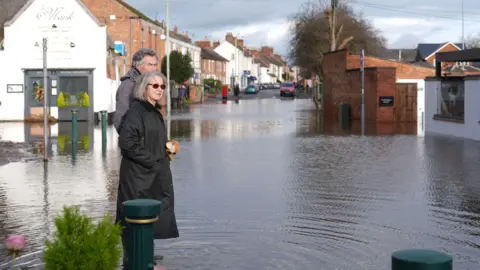
Two consecutive Januarys left Leicestershire residents reeling from severe floods - and for many, the fear has not faded.
Among them is marketing director Simel Kara, who watched his parents' home in Rushey Mead fill with a metre of water on the evening of 2 January 2024.
Their story became familiar to many in the wake of Storm Henk. Having been widowed within a fortnight of the flooding, Kara's 75-year-old mother spent a year sofa surfing before she could return home.
Despite spending more than £30,000 of their own money making the house more flood-ready, the family worry about winter.
"Properties here are still at risk," Kara said. "Each time it rains, we are just hoping we don't get flooded again."

A year later, in January 2025, an unnamed storm brought rapidly thawing snow and more flooding to the county.
In total, 883 properties were damaged and more than 100 businesses disrupted. Three rest centres were opened and nearly 90 people were rescued by boat.
It was the second time some had been flooded in 12 months and despite a major incident being declared, no government grants were available for those affected by the unnamed storm.
January has, for the past two years, seen rain and river levels in the county reach record annual peaks. Damage to properties has been over and above that of its East Midlands neighbours.
While the weather itself is beyond control, is enough being done to reduce other flood-risk factors and better protect communities?
Urban development

"Leicestershire is typical of a lot of East Midlands areas," said Ruth Needham, head of landscape and partnerships at the Trent Rivers Trust.
Her organisation has mapped the River Soar's catchment area since 2013. In short, almost every drop of rain in a 500 sq m radius eventually flows into the Soar, which winds through the county.
About 80% of Leicestershire is farmland, she explained. Drainage systems were built into those fields to help crops grow, but such systems are designed to stop waterlogging and increase the speed of water entering rivers.
When you factored in the extra roads, car parks and housing that came with new developments, Needham said it created the perfect storm.
Flat surfaces like tarmac and concrete do not absorb water. Instead, rain rushes into rivers and brooks, sometimes overwhelming drains.
And parts of Leicestershire are seeing rapid housing growth along the River Soar.
Between 2019 and 2022, official data shows 13% of new homes in the Charnwood Borough Council area - north of the county - were built in flood-prone zones, much higher than the national average.
Parts of Loughborough, Barrow-upon-Soar and Sileby - all in the Charnwood area - bore much of the 2025 floods, though their low-lying nature also makes them vulnerable.
It is a similar picture in the south of the county.
Whetstone sits in the Blaby district, an area currently behind on its five-year housing supply. It needs to build more and the village is being seen as fertile land to make up the deficit.
But on 6 January 2025, the banks of the Soar burst and poured into Whetstone Brook. Drainage systems put in place when new estates had been built over the past decade could not cope.
Homes near the brook were inundated, a primary school closed for months and an award-winning pub would not reopen until May.
Mike Jelfs, a retired architect and environmental campaigner, has lived in Elliott Close in Whetstone since 1997.
"Houses were four or five feet deep in water," he said. "It was the second time in two years - something that had never happened before."
Locally, Jelfs said, there was a feeling a decade of rapid development had increased the flood risk.
Residents want developers to take more responsibility and David Wilson Homes, which wants to build more houses there, has recently responded by strengthening the banks of the brook among other measures.
Meanwhile, London-based Tritax Big Box Developments is preparing plans for 4,500 homes and commercial buildings that would straddle Whetstone Brook less than a mile away from the recently flooded homes.
The company said a "comprehensive" flood and drainage modelling would be carried out as part of the planning process for the so-called garden village.
Who maintains defences?

Over the last two years, many defences were overwhelmed. Strengthening them to match the realities of climate change will be complicated, costly and time-consuming.
The Environment Agency is the public body with broad responsibillity for flood management in England. It inspects nearly 100,000 flood defences nationally, rating their condition to identify urgent repairs.
But it only maintains about half. Responsibility for the rest falls to councils, water companies, charities and, in many cases, private individuals.
Leicestershire's defences rank among the best nationally as far as inspections go. Just 3% were below target condition at the most recent inspection, compared to a 9% average in England.
Data analysis by the BBC suggests defences are 45% more likely to fall short when they are not maintained by the Environment Agency.
The defences in Quorn, in the Charnwood borough, are maintained by a patchwork of organisations.
Flooding here is nothing new but the last two years had been the worst in living memory, said parish councillor Carolyn Thornborrow.
In January 2025, much of the village was submerged, damaging homes and businesses.
"It was apocalyptic," said Duncan Jack, a village flood warden. "You could see water levels rising, but there was very little you could do."
He believes the village's ageing flood walls - maintained by the Environment Agency - leaked, contributing to the damage.
A report published by Quorn Parish Council reached the same conclusion and suggested nearby Swithland Reservoir, owned by the water company Severn Trent, had overflowed.
It also said drains owned by Leicestershire County Council could not cope with the standing water.
The Environment Agency confirmed water did seep through the village's flood walls during Storm Henk and the following unnamed storm and more work is needed to restore them to "pre-storm" conditions.
"The flooding experienced in Quorn during Storm Henk and January 2025 was the result of multiple sources acting simultaneously, rather than one single cause," a spokesperson said.
Severn Trent said the reservoir operated as intended, adding it had met residents and hosted site visits to show this.
It said it was committed to working with the Quorn community and would continue to support any ongoing flood investigations.
The results of two such investigations are due this year, with a Section 19 report examining the January 2024 floods expected this month. Another on the 2025 floods will follow in July.
These reports, produced by the county council as Leicestershire's lead flood authority, aim to find out what went wrong and recommend improvements.
They are legal obligation for councils when four or more properties are flooded in a single incident and examine the role played by various public bodies.
The council said the Section 19 reports were large pieces of work that took time. It is instead prioritising the publication of flooding "action plans" for high-risk areas like Quorn, ahead of the formal reports.
The plans will outline a schedule of improvements and how different agencies in flood-prone areas should respond when river levels start to rise.
Slowing the Soar

While many residents feel let down by flood authorities, experts say the impact of climate change cannot be overlooked.
The last two winters have seen record levels of rain in Leicestershire. The Soar hit its highest recorded level in January 2025.
But longer-term solutions go beyond building higher walls alongside rivers. The Trent Rivers Trust wants better catchment management, which means slowing the flow of water upstream through ditches, bogs and soft ground.
Its scheme at Beacon Hill Country Park is one example. Runways, dips and retention ponds there prevent water from rushing from one of the county's highest points and into nearby Loughborough.
The trust said similar management across half the county could save £19m per flood event. Road closures alone can leave businesses facing huge losses, even if a premises is not directly flooded.
The Environment Agency and county council agree it could make a big difference, but the trust said it faced challenges. Much of the land needed is farmland and, in a competitive market, developers can often offer landowners far more money.
"The financial appeal of housing is huge," said the trust's Needham. "It makes it very difficult to have conversations about flood management."
In the short-term, residents in flood-prone areas are being urged to protect their homes.
The county council has redirected £2m from a previously agreed carbon reduction reserve into flood resilience this winter, including a community fund for flood sacks administered by parish and district councils, increased drain maintenance and extra staff to respond to flood events.
In January 2025, it wrote a letter to the floods minister Emma Hardy, signed by all district council leaders in Leicestershire.
It asked for more powers to force co-operation between agencies where flood defences needed improving and for stronger planning powers to set rules for developers wishing to build on floodplains.
No national policy announcements have been made since.
Councillor Adam Tilbury, cabinet member for the environment, said: "If you are living in a flood-risk area, it's important to make your home more resilient, make sure your reporting documents are not on the ground floor, make sure your plug sockets are higher up if you can."
He acknowledged many homeowners would need to invest in protections, such as flood gates and flood doors, in higher risk areas.
Meanwhile, the Environment Agency said it had largely repaired flood defences damaged during the last two harsh winters.
It has introduced new flood warnings for Syston, Rearsby and Sileby and aims to provide a flood warning service for Quorn and communities along the Gaddesby Brook.
The Wood Brook Flood Alleviation Scheme, due for completion in early 2028, is designed to protect 160 properties in Loughborough by using Napanton Reservoir for further rain storage.
Leicestershire flood support
- Residents can sign up for flood advice newsletters via Leicestershire County Council's website.
- Leicester City Council area provides flood advice on its website.
- The Environment Agency's flooding infomation tool details who manages the flood risk in Leicester city centre.
- Anyone can sign up to the agency's flood alert service and incidents can be reported to its floodline on 0345 988 1188.
- Local district and parish councils have a limited suppy of sandbags. In Charnwood, applications for sandbags can be made by calling 01509 634666.
- If the flooding in your area poses a danger to life, call 999.
