Blood scandal victim says memorial 'means so much'

 BBC
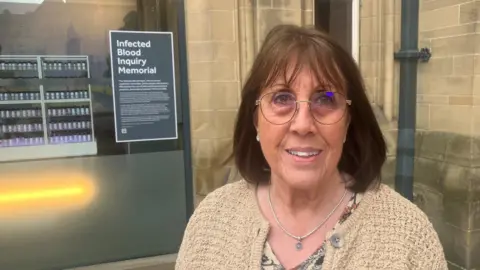
BBCA woman who was infected with hepatitis C after having a blood transfusion has said a memorial remembering the victims of the NHS blood scandal "means so much to so many people".
More than 30,000 people were infected with conditions including HIV, hepatitis and Variant Creutzfeldt-Jakob Disease (vCJD) after they received contaminated blood products in the 1970s and 1980s.
Nicola Leahey, from Chorley, said she hoped the Infected Blood Inquiry Memorial, sited at the University of Manchester, would "be a reminder for medical staff".
The 74-year-old, who took early retirement at 55 due to constant health problems before being diagnosed in 2009, said she wanted to see "lessons learned".
Christine Burney, whose husband Peter died of liver cancer in 2019 after he was was given hepatitis C through contaminated blood, said: "The inquiry memorial holds deep personal significance."
"It serves as a vital, permanent reminder of this tragedy for the medical professionals of tomorrow," she added.
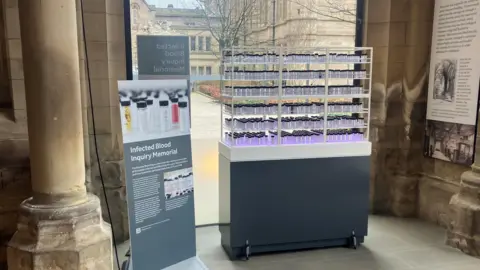
The memorial has been sited in the Whitworth Building on the University of Manchester campus.
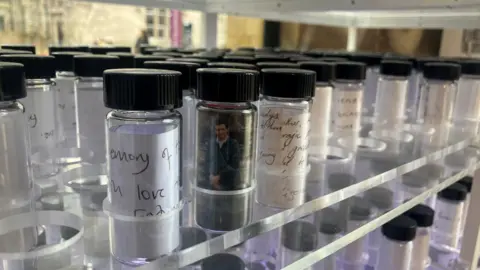
It consists of a display case with blood vials containing personal messages from victims and the relatives of those who were given contaminated blood products.
John McAuliffe, associate vice president, said: "Humility and listening is what this memorial is here to remind us of.
"Some of the messages inside the vials are very clear, while some of them are wrapped up and there is a sense that there are so many hidden stories that this public memorial is trying to surface."
Two main groups of patients were affected by what has been called the biggest treatment disaster in the history of the NHS.
One group were haemophiliacs - and those with similar disorders - who have a rare genetic condition that means their blood does not clot properly.
After being given the infected treatments, about 1,250 people in the UK with bleeding disorders went on to develop both HIV and hepatitis C, including 380 children.
A second group of patients was given contaminated blood transfusions after childbirth, surgery, or other medical treatment between 1970 and 1991.
In total, it is thought about 2,900 people have died.
The Infected Blood Inquiry, which began its work in 2018 and published its final report into the scandal in May 2024, concluded it "could largely have been avoided" and there was a "pervasive" cover-up to hide the truth.
A compensation scheme was announced, but a follow-up report last year highlighted compensation delays.
The government said it and the IBCA were "committed to providing fair compensation to the victims of the infected blood scandal" and had paid out more than £1.9bn in final payments.
Listen to the best of BBC Radio Manchester on Sounds and follow BBC Manchester on Facebook, X, and Instagram. You can also send story ideas via Whatsapp to 0808 100 2230.
