Canterbury deal 'changed everything' for Tunnel

 Getty Images
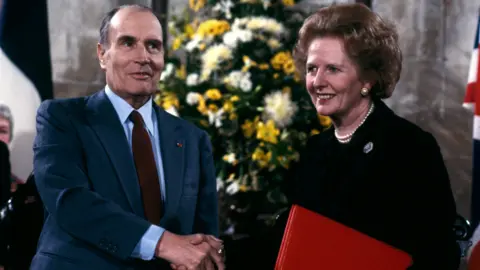
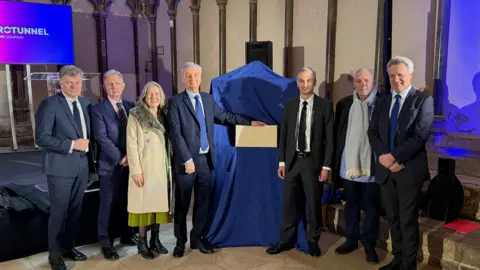
A flagstone will be installed at Canterbury Cathedral to mark 40 years since the deal to build the Channel Tunnel was agreed between the UK and France.
The Treaty of Canterbury was signed at the cathedral on 12 February, 1986, enabling the undersea railway tunnels to be built.
Construction of the tunnels started the following year, with rail services beginning in 1994.
Anthony Coulls, senior curator at the National Railway Museum, said: "What happened 40 years ago changed everything and made the project possible."
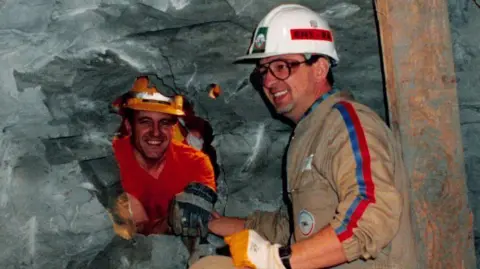
To construct the project, two tunnelling teams began from their respective countries and eventually met underneath the English Channel on 1 December 1990.
 Gamma-Rapho via Getty Images
There are two tunnels for railway lines and a connected service tunnel.
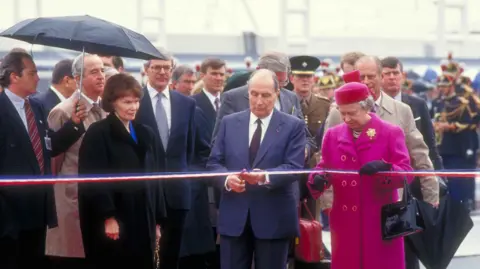
The project eventually opened to Eurostar and Le Shuttle services in 1994.
French ambassador Hélène Duchêne said the ceremony to mark the anniversary and unveil the flagstone was "a very important moment".
The project saw trade developing and brought Paris closer to London, she said, so was "an important milestone in the bilateral relation".
 Keir Mackenzie/BBC
Jacques Gounon, chairman of Channel Tunnel operator Getlink Group, said the project changed "definitively and in a dramatic and positive way the relationship, sometimes conflictual, between the UK and France".
"It has been a real boost for various exchanges between the two countries, and I think it has been a way for the two countries to have a better, joint understanding of what could be the future," he said.
"We know that Brexit changed the rules but it works like Brexit does not exist because it's a real, vital link."
According to Coulls, the scheme was "the greatest civil engineering feat of the 20th Century, certainly in western Europe".
The Treaty of Canterbury was a "a real ground-breaker" for agreeing the boundary between the two countries under the sea, he said.
 Eurotunnel
"If you look through history a number of the Channel Tunnel ideas failed, due to either political or economical challenges," the curator told the BBC.
"This is in essence the building block, the foundations, on which the Channel Tunnel project was able to be created."
Coulls said the project still felt "so modern and so new as a concept".
"When I was a kid in the 70s it was always that thing, it was something that was a vision, something that you never thought would happen, and here it is now."
Gounon said the scheme was a "successful investment" and that "something which was quite new 40 years ago is now a great achievement".
Duchêne says the Channel Tunnel remains "really important" today.
"So many lorries, so many passengers go through Le Shuttle, go to the Eurostar," she says.
Follow BBC Kent on Facebook, on X, and on Instagram. Send your story ideas to southeasttoday@bbc.co.uk or WhatsApp us on 08081 002250.
