The new treatment giving people their voices back

 BBC
BBC"I've never been able to sing, I've never been able to shout - I've just been limited in so many ways."
The words of David Metherell - and words are important to him - particularly the spoken ones, because he's struggled with speaking since he was a small boy.
At just nine months old he caught a rare strain of the human papillomavirus (HPV) - it led to damage to his vocal cords and 21 operations before he turned six. They've left him with scarred vocal cords, a croaky voice and difficulty speaking for any length of time.
"The amount of times that I've sat round the table and really had to think - I have something to add to this conversation but the importance of it isn't enough to warrant me putting that much effort in to talk to someone at the far end of the table. Everyone else can just project their voice but I've never been able to do that."
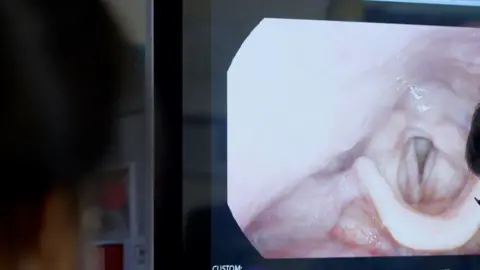
David, 45, is a critical care nurse and noticed he struggled to project his voice, particularly during covid when he was wearing full face masks and protective equipment.
"When I was speaking my voice would suddenly stop, like someone had put their hand over my mouth."
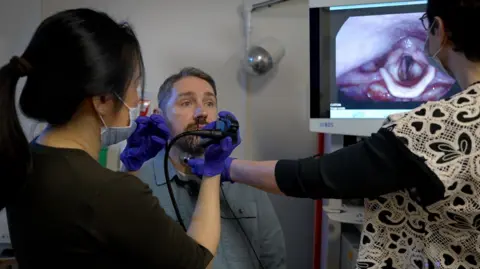
He was referred to the Ear, Nose and Throat (ENT) Clinic at Guy's Hospital where he's one of the first to receive a new trial treatment involving platelet-rich plasma - or PRP.
It involves taking the plasma from his blood and then injecting it into his vocal cords, or folds. It's a treatment that has been used for things like tendon or ligament injuries before - but not in this way.
His consultant Shiying Hey and her team have so far treated 10 patients - all reporting an improvement in their voices.
"It's incredibly exciting to be able to offer this treatment," she says. "It is also cheaper than the current treatments as we use the patient's own blood and it can be longer lasting as the PRP encourages the vocal cords to regenerate and accelerates the healing process."
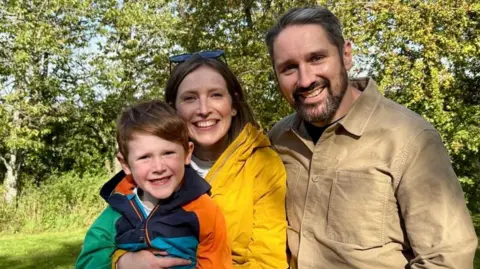 David Metherell
David has had three injections and says it has transformed his life, making him more confident to speak up in busy social or work situations.
"Being able to do that now is really liberating - really liberating - and I'll be eternally grateful for this because it's really changed my life."
It's made the bedtime ritual with his five-year-old son a whole different experience, too.
"My son knows that Daddy's got a poorly voice and Daddy's voice isn't great. But being able to read him one of his favourite stories without fatiguing, without having to clear my throat and recompose myself - just finishing a story and then singing him a little story to get him to sleep - yeah - it's what a dad should be able to do and I've never been able to do."
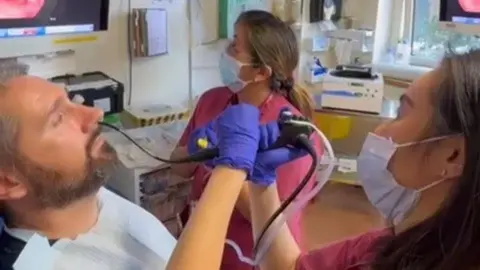 Shiying Hey
As well as the injections he has had, David also gets special exercises and training for his voice from senior speech therapist Sue Warner.
"Your voice is so important for everything - a lot of people say it's the window to the soul," she says.
"To be able to express yourself to reveal to people who you are and what you think, how you feel about something - calling out in case of danger or reading a story to your child.
"We use our voice for absolutely everything. Even just ordering a cup of coffee in a cafe. Not having a good voice often reduces people's confidence and it stops them from doing the things they want to do. It has a massive psychological impact and handicap in terms of day-to-day activities."
The ENT laryngology clinic at Guy's and St Thomas' is only accepting referrals for the treatment from GPs and health professionals.
Listen to the best of BBC Radio London on Sounds and follow BBC London on Facebook, X and Instagram. Send your story ideas to hello.bbclondon@bbc.co.uk
