'We can learn from the Battle of Cable Street'

 Topical Press
The director of a musical about a clash between a group of fascists and people living in a largely Jewish part of east London says more young people should be taught about this turbulent episode.
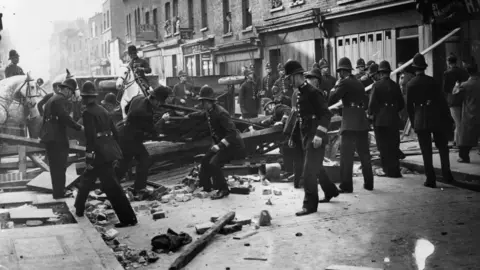
Adam Lenson is the director of Cable Street, a play that explores the fight between Oswald Mosley's British Union of Fascists (BUF) and a group of Jewish, Irish and communist Londoners who blocked Mosley's march in October 1936.
"It's an intergenerational story and a really important part of London's history. I would love schools and young people to see this show," Lenson said.
He added that it was "important the show helps begin conversations between families".
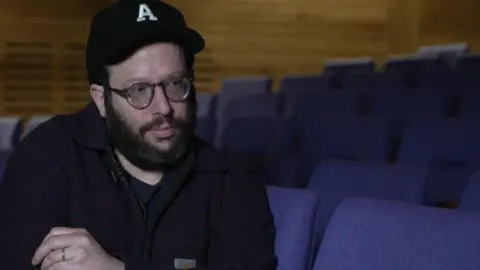
"I went to school in London and I wasn't taught that much about its history," he said.
"I think this show speaks to us about a London not all of us know enough about."
The Battle of Cable Street
The confrontation took place on 4 October 1936.
Mosley, who had previously been an MP for the Conservatives and Labour, founded the BUF in 1932. It took inspiration and funding from the Nazi Party in Germany, headed by Adolf Hitler, and the fascist movement in Italy, led by Benito Mussolini.
The BUF styled themselves similarly to a military organisation and became known as the Blackshirts due to their uniform.
On the day, Mosley had been due to give a speech at Shoreditch Town Hall to galvanise support for his far-right message.
He wanted to march his Blackshirts through a predominantly Jewish part of east London as a mark of dominance.
Thousands of Jewish and Irish people, as well as other immigrant communities, turned out to block them - and the Battle of Cable Street unfolded.
It is estimated that about 175 people were injured and some 150 demonstrators were arrested.
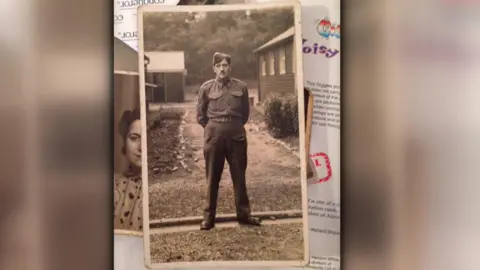
Yoav Segal, the musical's set designer, has a personal connection to the show, because his grandfather took part in the battle as a 19-year-old.
Segal said: "My grandad, Ubby Cowan, was a member of the Jewish Tailors' Union and in 1936 joined the steering committee that was organising a demonstration against Mosley.
"During the Battle of Cable Street he was a runner and went between the different outposts and helped organise the day."
Ubby Cowan died in 2016 aged 99. Segal said bringing the play to a London stage was hugely important to his family.
"My grandad totally understood the significance and importance of standing up against fascism," he said.
"Seeing this story on stage at a proper London theatre is incredible, and being involved was wonderfully emotional and very important to me and my family."
Segal said the Battle of Cable Street was still relevant for a modern audience.
"We're in a time when the far right, and potentially fascism, is on the rise globally - where hate speech is growing," he said.
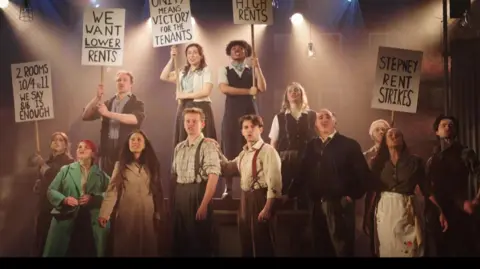
Lenson said he hoped lessons could be learned from the past.
"My hope is that people realise that as well as happening in the past, this is something that is also happening now," he told BBC London.
"I hope it allows people to see there is more similarity between us than not. I hope it makes people care more about their neighbours.
"I hope it makes people care slightly more about their communities. I hope it makes people feel brave enough to say and do the right thing when they potentially feel under pressure to stay quiet."
Cable Street is at the Marylebone Theatre until 28 February.
Listen to the best of BBC Radio London on Sounds and follow BBC London on Facebook, X and Instagram. Send your story ideas to [email protected]