Action demanded to protect dolphins and porpoises

 The Cornwall Wildlife Trust
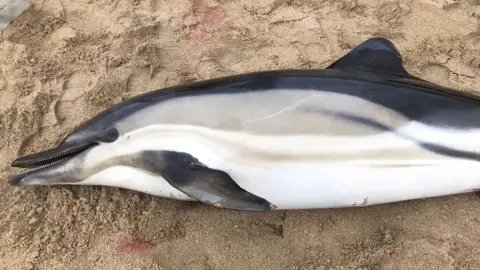
A charity wants better protection for dolphins and porpoises from fishing nets after 27 washed up dead on Cornish beaches.
Cornwall Wildlife Trust said a number of the animals were confirmed to have died in January as a result of getting caught in fishing nets, known as bycatch.
It said stronger policy was needed from the government to address the issue as the trust's figures suggested stranding incidents had doubled in the last decade to about 200 each year, with more than one in four showing signs of bycatch.
The government's Marine Management Organisation (MMO) said dolphins and porpoises were already protected under UK law and incidents should be reported to them.
The trust said three of the stranded animals found recently had been "clearly caught in monofilament nets" as they had fine linear cuts around the beaks, heads, fins and tails.
James Barnett, veterinary pathologist for the Cornwall Marine Pathology Team, added a fourth had clean cuts into its tail fluke which were were consistent with other known bycatch cases.
The trust said similar stranding levels were being reported across Europe, raising concerns about population impacts.
"Cornwall Wildlife Trust is calling on government and regulators to introduce the long-overdue management measures needed to better protect dolphins and porpoises and is urging concerned public to raise the issue with their MPs," it said.
Fishermen in Mevagissey have taken their own steps to tackle the issue, including reducing the time nets are in the water.
Nick West, chairman of Mevagissey Fisherman's Association, said: "We are fully committed to excluding the likelihood of bycatches completely."
The MMO, which regulates marine activities including licensing, protecting the environment and managing fishing, said guidelines for reducing bycatch applied throughout the year.
"Current guidance on reducing cetacean bycatch requires vessels over a certain size, using certain gear types and operating in specified areas to use acoustic deterrent devices, attached to their nets," it said.
"A reporting mechanism is in place to help us monitor and assess incidents."
Follow BBC Cornwall on X, Facebook and Instagram. Send your story ideas to spotlight@bbc.co.uk.
