Meet the guardians who look after the island defibs

 Inga Drazniece
There are more than 13,800 defibrillators registered with a guardian in the South West, and two of them have been named as the UKs "most extraordinary".
The British Heart Foundation (BHF) said the defibrillator on Lundy Island, Devon was the country's most remote, and St Agnes, Isles of Scilly was most southern.
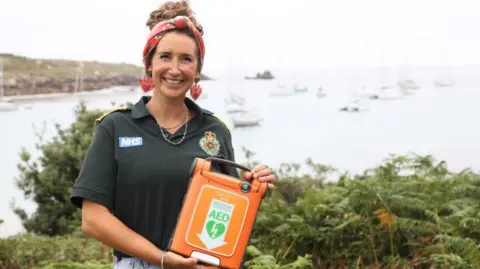
St Agnes defibrillator guardian Grace Windridge-Hicks, 35, who also volunteers for the island's ambulance service, said the device was located at the centre of the island, on top of a bin.
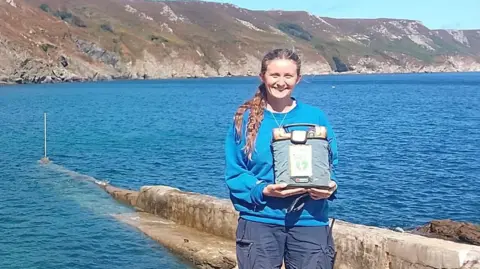
Tara McEvoy-Wilding looks after the defibrillator on Lundy which she said was a "true reflection" as the island was 12 miles from the closest point on the mainland.
 Tara McEvoy-Wilding
BHF said a defibrillator, also known as a defib, was a device that gives a jolt of energy to the heart and helps get the heart beating again when someone is in cardiac arrest and their heart has stopped.
Lundy Island is home to just 28 human residents but around 1,400 puffins and operates without cars, roads or a permanent electricity grid.
McEvoy-Wilding said: "We don't have any medical centres or anything on the island.
"We have two defibs, and then the coastguard team and a community first aid responder team... there's no professional medical help available to us easily."
 Tara McEvoy-Wilding
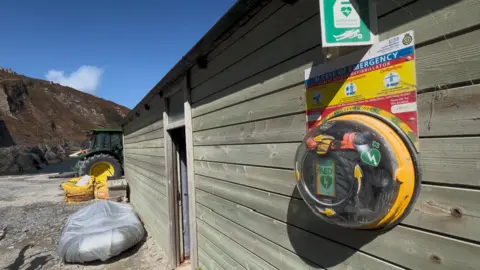
She said there were two public defibrillators, one located on the side of the boat building, near the landing bay where the ferries come in, and the other at the top of the island in the only pub.
"We also do have ones as part of our community first responder team and coastguard teams but these aren't available for public use... they're in a locked room with our other kit."
In serious emergencies, the team is most likely request a helicopter, but depending on where it was, it could take up to 40 minutes to arrive, McEvoy-Wilding said.
"It generally is quicker than that but you never know so it's good for us to have as much equipment as possible to give someone the best chance we can."
Operations manager for the circuit at the British Heart Foundation, Helen Tennant said a defibrillator guardian was the person who was responsible for the equipment and maintaining it, including changing the pads every three to five years.
She said: "They need to regularly check the defib to make sure that it's actually emergency ready, and then we ask them to record that check on the circuit so that the ambulance services can be really confident that somebody's looking after the device and that it's going to be available in an emergency."
 Inga Drazniece
Windridge-Hicks, whose husband also is a first responder, has been with the ambulance service for about 10 years and applied for funding to install a defibrillator on St Agnes five years ago because the only one on the island was locked away in the ambulance shed.
The island has 85 residents, is one mile across, has no cars and is dominated by white-sand beaches and a dramatic coastline.
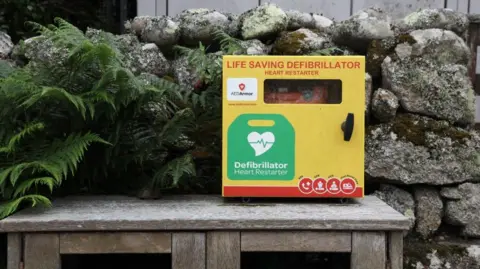
After being refused permission to put the defib on a building or inside a phone box, she eventually settled for a position on top of a double bin.
She said: "It sits on top of a bin in the middle of the island but at least it's obvious people to see it and the surrounding area is stunning.
"Having a community defib in a sort of visible place, that everyone knows where it is, is really important.
"I think it's important to give back to the community in any way that you can."
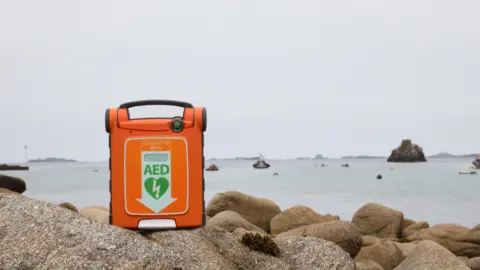 BHF/Inga Drazniece
Tennant said Lundy's BHF defibrillator was also the device furthest from any others.
She said: "It's really important we've got these defibrillators in these remote places because it takes a little bit longer for the ambulance services to get to those places.
"If there's a cardiac arrest then it's really important the community know where their closest defibrillator is and they're confident to use it.
"It's also important to have them in cities where people are living because that's the place where cardiac arrests are happening. "
Tennant said it was important for people to act as soon as possible when someone is having a cardiac arrest because "every second counts".
She encouraged anyone who had a defibrillator to register it on the website because it ensures it's visible to the ambulance service and could help save a life in the community.
In the BHF's top 10 UKs most extraordinary defibrillators list, Hermaness National Nature Reserve on Unst in Shetland was named as the most northern, the highest at a pub in Swaledale, North Yorkshire and the lowest nine metres below sea level at Broadland Great Yarmouth.
