'Slow tourism' plan aims to double tiny island population

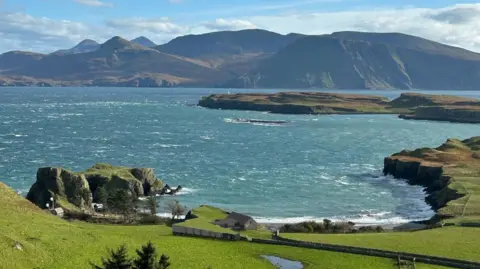 WT Achitecture
Residents of a tiny island in the Inner Hebrides have secured funding to help design a "slow tourism" visitor hub which they hope will double the island population to 40.
A £250,800 Scottish government grant will fund design work to restore and extend a derelict 18th Century barn on the Isle of Canna, south of Skye.
The planned facility, which would cost £5.6m in total, would include community facilities for islanders and accommodation, allowing more visitors to stay overnight.
With a two-and-a-half hour ferry journey to get there and no roads on the island, Canna's residents are hoping to attract determined travellers, willing to go the extra mile to learn more about island life and culture.
Canna, in the Small Isles, was once home to more than 300 people but economic pressures and the Highland Clearances in the 19th Century - which saw tenants forced out for sheep farming - resulted in a dramatic collapse in its population.
Since 1981, the island has been owned by the National Trust for Scotland (NTS) after being gifted by the previous owners, Gaelic scholar John Lorne Campbell and his wife, photographer and folklorist Margaret Fay Shaw.
The population currently stands at 20 adults and two children, with everyone contributing to island life, which includes managing renewable energy supplies.
Andrew Prendergast, development manager for Isle of Canna Community Development Trust, said: "Everybody has at least two jobs to keep the island running, on top of which they have at least one formal employment that's part of keeping the island going."
The trust is now hoping to attract a younger generation to the island, and aims to double the population in the next 10 years.
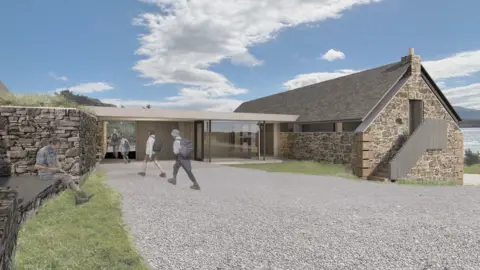 WT Achitecture
The site at Coroghon where the new tourism facility is to be developed is located above a black sand beach and within sight of an ancient Dun (or fort).
The building is currently just an unheated shearing shed which serves as the only community space on the island.
The trust would like to see it extended to provide a 20-bunk tourist hotel as well as upgraded community spaces for permanent residents.
The project would also house a newly-digitised community archive, telling the "people's story" of Canna and the adjoining island of Sanday, which is linked by a causeway.
Funding, from the 2025/26 Islands Programme, will now allow the community to draw up detailed design plans and help secure more financing for the project.
"It's a significant milestone for us," Mr Prendergast said. "Building costs on islands are extortionate."
With its lush green landscape, rich seabird population and quirky features including a post office converted from a garden shed, Canna attracts about 10,000 visitors each year.
But most of them do not stay overnight as the only accommodation options are a "higher end" guest house, rustic camping and a few holiday homes.
'We're not going to be the next Iona or Skye'
With no roads, day trippers rarely get the chance to fully explore the island, which is 4.3 miles (6.9 km) long and 1 mile (1.6 km) wide.
"The project gives the potential for income into the community and more jobs for people running services for people coming to the island," Mr Prendergast said.
"We don't get a lot of economic benefit from day visitors.
"We're very aware that Canna is not a big island so together with the other Small Isles - Eigg, Rum and Muck - we have a tourism strategy which is very much about slow tourism, people getting to know a place.
"There will be a natural limit on numbers - we're two-and-a-half hours from the ferry from Mallaig, so people need to be committed to get here.
"We're not going to be the next Iona or Skye.
"For us it's at a catalyst for a historic change in population - 300 people lived here in the 19th century. Islands are quite fragile and these projects are essential."
Community trust director Isebail MacKinnon added: "Being run as a community-owned enterprise means more of the income generated from tourism stays within the island's economy, building community wealth."
WT Architects of South Queensferry have been working with the community and NTS on design proposals which respect the site at Coroghon.
In addition to the £250,800 award from the Islands Programme, the next stage of design work on Coroghon has been funded with £30,000 from the National Trust for Scotland, and £25,000 from Highlands and Islands Enterprise.
