Officers call for police cars to be equipped with guns

 Getty Images
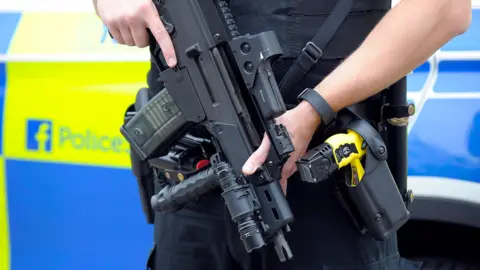
Scotland's frontline police officers should have access to guns which are securely stored in their vehicles, according to the Scottish Police Federation (SPF).
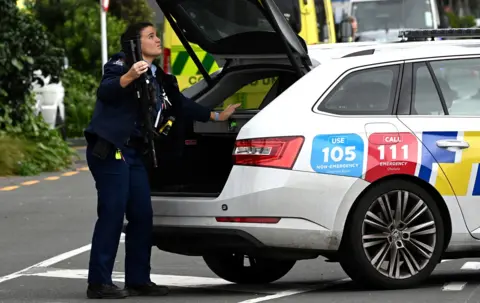
The organisation, which represents 98% of officers, is backing a model adopted in New Zealand where police are not routinely armed but do have access to weapons.
SPF general secretary David Kennedy also called for all officers to carry Taser electric shock weapons to combat rising levels of violence - and warned that anyone who brandished a knife risked being shot.
The Scottish government said Police Scotland would remain an unarmed force and that its current capability was both appropriate and proportionate.
 AFP via Getty Images
The SPF, which represents 16,500 officers up to the rank of chief inspector, made the call in a manifesto of measures it believes would improve policing as parties prepare to set out their stall for the Holyrood election.
It backs a system introduced in New Zealand in 2012 where Glock handguns and semi-automatic rifles are stored in locked cabinets in vehicles, and officers can seek permission to access them in emergencies.
Currently in Scotland guns are only issued to around 500 authorised firearms officers and the vast majority of police do not have firearms training.
Kennedy believes closures of local police stations and centralisation of specialist teams mean there could be catastrophic delays when an armed response is required.
He told BBC Scotland News: "There's not enough to cover rural areas.
"Even within towns or cities in Scotland it will be a long time before the firearms team is available."
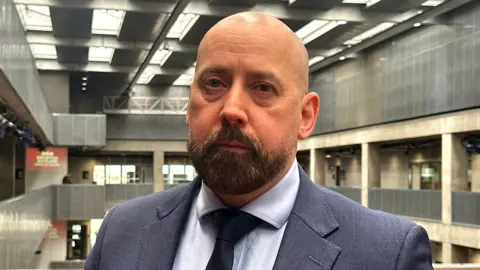
Kennedy cited a 2022 murder in the Highlands where a man shot dead his brother-in-law and stabbed his wife before driving off to attack another couple with unarmed police officers in pursuit.
The officers were ordered not to stop the gunman because an armed response unit was being despatched from Inverness, 100 miles away.
Last month a man was jailed for 10 years for chasing a police officer in Paisley while armed with a chainsaw.
Kennedy said currently about 2,000 Scottish police officers are trained in the use of Tasers but there are too few of the devices, which can incapacitate a suspect, to be issued routinely.
"It's because of finances, it's a money thing. It's nothing to do with safety," he said.
He added: "Don't carry a knife, don't produce a knife on the the streets of Scotland because of the tactics that are in place now, you can be shot."
Recent figures suggest there are more than 20 assaults on police officers a day, with about a quarter of them resulting in injury, and the trend is upwards.
The SPF "Policing Manifesto 2026" warned the service in Scotland was at a "critical inflection point" after a decade of funding pressures and centralisation.
It called for investment at least in line with inflation and more local decision-making with more officers patrolling the streets, engaging with communities.
The federation pressed for a reversal of "non-attendance policies" for incidents and warned that a shift towards non-custodial sentences, even for violent offenders, could give the appearance that there was "no meaningful deterrent".
The SPF also wants better psychological support for officers who routinely encounter traumatic situations, as a way of improving staff welfare and retention.
An 'unarmed service"
A Police Scotland spokesperson said: "All firearms officers undergo robust training which focuses on de-escalation and communication, which is always the primary objective when responding to incidents where there is a potential risk of serious harm.
"A number of statutory measures are in place to allow for independent scrutiny to ensure the use of armed policing resources is both proportionate and justified."
The Scottish government said it recognised the important role of police officers who often put themselves at risk while protecting the public.
A spokesperson added: "Police Scotland continues to be an unarmed service and our position on that will not change.
"The service has an appropriate and proportionate armed policing capability including both conventional weapons and Taser.
"Deployment of firearms officers remains an operational matter for the Chief Constable."
They said the draft budget for 2026-27 provided "record funding" of more than £1.7bn for policing.
The spokesperson added: "Scotland continues to be a safe place to live with recorded crime down by half since 1991."
