Carbon capture pipeline plan 'threatens businesses'

 BBC
BBCA fish and chip shop owner fears her business could be "massively affected" by plans to potentially build a 50m (164ft) high stack structure as part of a carbon capture pipeline scheme.
The £60m Peak Cluster project will capture carbon dioxide (CO2) produced at cement and lime plants in the Peak District and transport it via a pipeline in Wirral to be stored under the sea. The stack structure is planned for either Moreton or Meols.
Gill Antrobus, of Green Hut in Moreton Shore, said she was worried an "industrial plant right behind" her chippy could deter visitors to the area and harm the environment.
The government said safety and environmental assessments had been carried out.
Following an extraordinary general meeting on Monday, Wirral Council Leader Paula Basnett announced she was writing to Energy Secretary Ed Miliband to make it clear that all Wirral councillors objected to the plans.
The government has described the plans as the world's largest cement decarbonisation project and said it would generate and secure thousands of jobs.
However, the plans have sparked criticism from residents who live along its planned route, with almost 17,000 people signing a petition against the scheme.
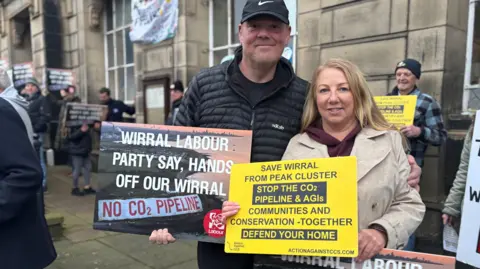
Antrobus, who was among hundreds protesting outside Wallasey Town Hall ahead of the meeting, said: "It's going to massively affect my business and my home - as it goes right past my home as well."
She also said she had concerns over the "environmental impact" of the proposed development.
"It's just not needed and there's a lot of other ways that it could be dealt with rather than this," she said.
'Ruin so much countryside'
The Green Hut chippy has been running for 60 years with her and her husband taking it over eight years ago.
"We've built it up into a really popular business," said Antrobus.
"But obviously we won't be getting any tourists, we won't be getting visitors, when it's got a massive industrial plant right behind it."
She said the decarbonisation activities should be done "at source and not just carry it somewhere else".
The business owner added: "It needs to be dealt with in a different way, a more effective way, and also there's going to be waste coming from other countries and it's just not practical and it's not viable."
Antrobus said: "It's just going to ruin so much countryside, coastline, environmental spaces.
"It's not just Wirral; it's going through a lot of places... and some beautiful parts of the world."

Sarah Ashworth is also concerned about the damage the project could do to her business.
She has owned Dogs Go, a dogs park in Willaston, Cheshire, for 10 years.
She said it would be "directly impacted" by the pipeline.
Ashworth said she was "shocked and appalled" when she heard about the plans.
She said: "It would mean my staff wouldn't be able to go to work while the work was getting done and it could be argued the land would be unsafe once this huge pipeline is running through it.
"I think there are far better ways to offset carbon."
'Tried and tested technology'
David Parkin, chairman of the Peak Cluster project, said: "We acknowledge a 200km pipeline is a very significant infrastructure project and will have a level of construction disruption.
"The main process we are going to do is called 'trenched construction' so essentially, we dig a large trench in a field, we weld up the pipe, drop it in, put the soil back and then the farmer can reuse the field as it was before."
Parkin said the project would use "tried and tested technology" and was safe.
Responding to the petition, the government said there were no plans to pause the development of UK Offshore CO2 storage projects.
"Government works with regulators and the public to ensure CO2 storage regulations support the safe deployment of Carbon Capture, Usage and Storage," a spokesperson said.
They said independent technical analysis showed very high long-term containment confidence, with a typical project expected to retain more than 99.9% of injected CO2 over a 125-year period.
"Minor leak rates have a low probability of occurring whereas major leak rates have a very low probability of occurring," the spokesperson added.
"Therefore, the likelihood of damage to the marine ecosystem is considered to be very low."
Listen to the best of BBC Radio Merseyside on Sounds and follow BBC Merseyside on Facebook, X, and Instagram. You can also send story ideas via Whatsapp to 0808 100 2230.
