What next for Bradford Council as Labour era ends?

 Aisha Iqbal/BBC
The political landscape in Bradford, like much of West Yorkshire and pockets of the wider country, has shifted following the local elections, in what some are describing as an "earthquake".
While questions continue nationally around Sir Keir Starmer's leadership and what these results mean for Labour more broadly, locally the elections have left Bradford Council facing an uncertain political future after the party lost control of the authority.
With coalition talks, leadership decisions and major questions around local services still to be resolved, here's a look at how things in Bradford changed so dramatically, what led up to it, and what we know so far about what happens next.
How did things look before?
Bradford Council had been run by Labour since 2010, initially as a minority administration before moving into overall control in 2014.
Going into these elections Labour held the minimum 46 seats needed for a majority. The Conservatives held 13 seats, Greens 10, the Bradford Independents Group nine, other Independents seven and Liberal Democrats four, with one vacancy.
Susan Hinchcliffe had led the council since 2016.
What happened in the local elections?
 Grace Wood/BBC
These elections produced one of the most fragmented political pictures Bradford has seen in years.
Out of 90 council seats, 87 were contested. Voting in Idle and Thackley was postponed following the death of Liberal Democrat councillor and former group leader Jeanette Sunderland. That by-election will now take place in June.
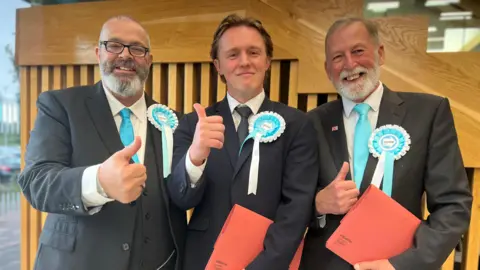
Reform UK emerged as the largest party on the council following major gains across the district, while Labour lost overall control. The Greens and Bradford Independent Group largely consolidated their vote, but saw seats flip-flopping, with losses in some places and gains in others.
Senior Labour figures, including council leader Susan Hinchcliffe, several of her cabinet and both the current Lord Mayor and his deputy, lost their seats. Brendan Stubbs, leader of the Lib Dem group, also lost his seat, with his party now having just one councillor.
 Aisha Iqbal/BBC
Who is running the council now?
At the moment, no party has overall control, meaning discussions are now beginning around possible working arrangements and coalitions.
Leadership positions and cabinet portfolios are not expected to be formally decided until Bradford Council's AGM on 19 May.
The council has confirmed Hinchcliffe technically remains leader until that meeting takes place, despite losing her seat in the election.
Meanwhile Reform is understood to be selecting its local leader ahead of the AGM, although no formal timetable has been publicly confirmed.
Although the final political picture will not technically be complete until the Idle and Thackley by-election, the current numbers mean the only realistic two-party coalition with a working majority would involve Reform and the Conservatives.
Will my bins still get collected?
For now, Bradford Council says local services, which include your bin rounds, road maintenance, street cleaning, community centres and environmental enforcement will continue operating as normal.
But whichever administration eventually takes control will inherit major financial pressures and ongoing questions around future spending and services.
The council has spent recent years trying to stabilise its finances after effectively nearing bankruptcy, borrowing heavily and agreeing exceptional financial support measures with government.
Residents have already seen a series of difficult decisions around services, including proposed cuts to street cleaning and libraries which were later watered down following public backlash, alongside tip closures and a controversial 10% council tax rise last year.
Questions also remain around councillor casework following the defeat of a number of sitting councillors.
What happens over the next few days?
For now and the next few days and weeks, Bradford City Hall will be a hub of negotiations, post-election debriefs and induction sessions for dozens of new councillors.
The day-to-day running of services is managed and carried out by council staff, and councillors are elected representatives, not employees.
Bradford Council says services "will continue to run as normal" while political negotiations continue behind the scenes.
Questions remain around who will chair the council AGM after both the Lord Mayor and Deputy Lord Mayor lost their seats, and what will happen to the casework loads of the many councillors who lost theirs.
Analysis: Why did Bradford change so dramatically?
By Aisha Iqbal, political reporter
What happened in Bradford was local, but it was also part of something much bigger.
For months, much of the political expectation had been that the Greens or Bradford Independents Group would emerge holding the balance of power, particularly after years of growing disillusionment with Labour in parts of the district.
That fragmentation had already started becoming visible two years ago, particularly in communities where anger over Gaza, poverty, inequality and wider political representation began reshaping voting patterns.
At the same time, Reform was building significant momentum among parts of Labour's traditional white working-class vote.
The result was Labour's support splintering from multiple directions at once.
In some communities, voters who had historically backed Labour shifted towards independents, Greens or other candidates they felt more closely reflected their views on international issues or local representation.
Elsewhere, particularly in parts of Bradford's white working-class communities, Reform was able to consolidate support around frustrations linked to living standards, public services and a wider sense that people and communities felt politically forgotten or overlooked.
In many ways, it echoes some of the political dynamics seen during the Brexit referendum almost a decade ago, with voters choosing to reject political systems they no longer feel connected to.
There were also very specific local factors at play in Bradford, financial pressures, council tax rises, service cuts and ongoing concerns around children's services.
But across very different communities and political viewpoints, two themes came up repeatedly during the election campaign: people wanting to feel listened to, and people feeling forgotten.
And for Labour locally and nationally, and for all the traditional parties, those are questions they will have to reflect on urgently.
Listen to highlights from West Yorkshire on BBC Sounds, catch up with the latest episode of Look North.
