Everest summit attempt for breast cancer patient

 Shaunna Burke
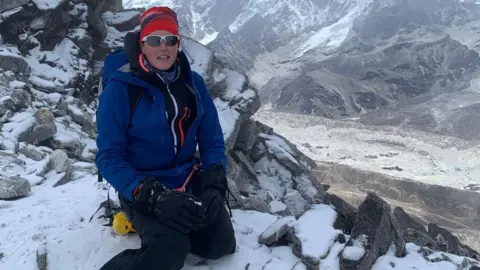
An exercise psychologist from Leeds has set her sights on becoming the first woman with incurable cancer to summit Mount Everest.
Dr Shaunna Burke, who works at the University of Leeds researching how exercise can be used in cancer treatment, sets off for Kathmandu on 13 April.
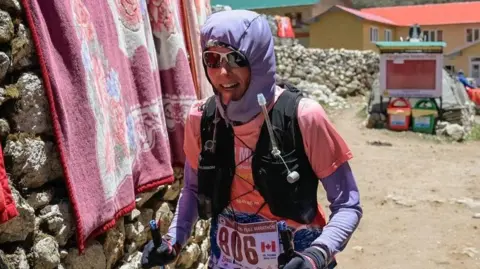
Burke, who lives in Addingham, West Yorkshire, has previously climbed four out of the seven highest peaks in the world and last year ran the Everest Marathon.
She was diagnosed with incurable stage four breast cancer in 2024 and underwent a double mastectomy, liver surgery and radiotherapy. Inspired by her own research she ran to her appointments to maintain her fitness and mental health.
The 50-year-old completed the Everest Marathon on 29 May in seven hours and 41 minutes, finishing fourth in her category.
She is also no stranger to mountaineering, having climbed Mount Everest before in 2005, as well as Mount Aconcagua in Argentina, Elbrus in Russia and Kilimanjaro in Africa.
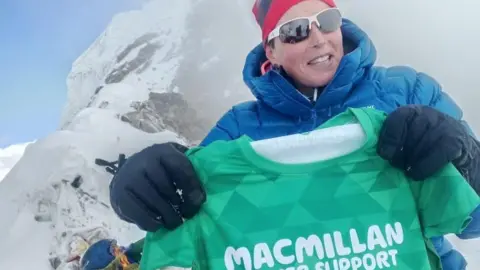
This time, her trip is also a research project, a fundraiser for Macmillan Cancer Support, and the subject of an independent film called Dying to Climb.
 Shaunna Burke
Burke said: "I'm not just climbing a mountain - I'm climbing to inspire, to support research, and to raise funds that can change lives.
"Mountaineering taught me life is fragile; cancer taught me to keep climbing — back into life, fully and with possibility."
In preparation for Everest, she has been training in the altitude chamber at Leeds Beckett's Carnegie School of Sport, walking on a treadmill with a weighted rucksack to simulate the demands of climbing above 4,000m (13,123ft).
She is being accompanied by Dr Barney Wainwright, an applied sports scientist at Leeds Beckett University, who will be monitoring the impact of the challenge on her body, including her immune function and cancer markers.
 Shaunna Burke
Anaesthetist and high-altitude expert Dr Patrycja Jonetzko will also join the expedition, along with Ben Ayers from the makers of the Dying to Climb documentary, Rainshadow Films.
The team will start on 16 April when they ascend Mera Peak, a 6,400m (20,997ft) mountain where research testing will be carried out and Burke will be monitored while she acclimatises.
On 30 April, she will carry on solo, climbng to Everest Base Camp with her team of Sherpas.
Here, she will be joined by friends for a traditional Hindu Puja ceremony of devotion and worship before she climbs to Camp 2 and Camp 3.
She will then wait for a suitable weather window for the summit push.
Everest's peak is 8,849m (29,032ft) above sea level, the highest point on earth.
Burke said: "Standing on the summit of Everest is awe-inspiring — you can see the curvature of the Earth. But it's also terrifying, because the climb isn't over.
"Most accidents happen on the way down, where you're exposed to extreme weather and even hallucinations at altitude."
She has so far raised almost £25,000 for Macmillan Cancer Support through this project, which helped her during her treatment at Airedale Hospital and St James' Hospital in Leeds.
Listen to highlights from West Yorkshire on BBC Sounds, catch up with the latest episode of Look North.
