'The pit might have gone - but there's still a community here'

 PA/BBC
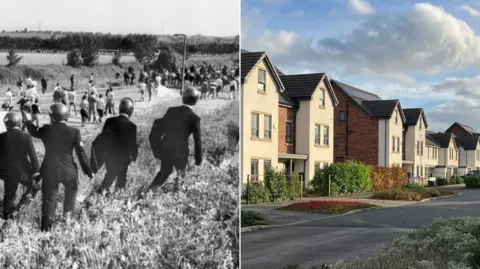
They were the images that defined the miners' strike. In June 1984, police and striking pit workers clashed in violent scenes at Orgreave in South Yorkshire.
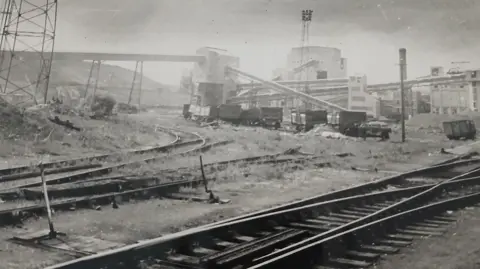
More than 40 years later, the site of the coking plant where bloodied miners were filmed by news crews is barely recognisable.
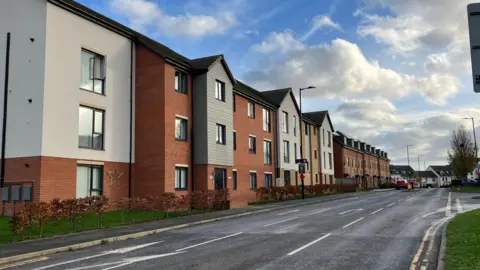
The land is now the private Waverley housing development, and the near-identical, modern properties, large cars on the driveways and outdoor Christmas decorations can be said to be a symbol of how a way of life has vanished since the 1980s.
Days no longer begin with hundreds of men heading to work at the major local employer - the pit and adjacent coking ovens. Both had closed by 1990, and residents of today's estate are commuters or home workers.
What was once a hive of industry has been transformed into a new community which will eventually have thousands of homes as well as offices, schools and retail space, while new jobs are provided by the Advanced Manufacturing Park, home to Rolls Royce, Boeing and McLaren Automotive.
The landowner is Harworth Group, formerly the property arm of UK Coal, and now a major developer of brownfield sites, including old collieries.
Yet those with deep-rooted connections to mining believe the industry's heritage has been overlooked during the regeneration work and have questioned whether "community" can truly be achieved without the unity that resulted from thousands of families working and living alongside each other.
 Chris Hockney
The Waverley vision is clear to see when the BBC visited the development. The new primary school has opened and the heart of the estate is Olive Lane, which will eventually have restaurants, cafes, a health surgery and a community centre.
So far 2,000 houses have been built and 1,000 more will be completed in the next 3-5 years.
It is difficult to imagine the peaceful streets echoing to the sounds of mounted police officers and angry picketers. The clashes left 120 people injured and 55 were arrested.
One of those detained was Kevin Horne, now 76, who shared his memories of the site's history.
"One day, I was on the front line and I looked down – I was stood on a man and I thought he were dead.
"He'd got blood coming out of his ears and his mouth. I got people to step back so we could get him out - I don't know what happened to him."
Mr Horne, who lives in Mexborough, said the developers seemed "to have cut 'Orgreave' out altogether" as Waverley has taken shape.
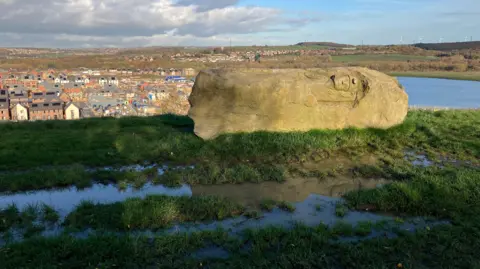
Harworth Group chose to incorporate a sculpture which commemorates the colliery and its workers, but not the Battle of Orgreave itself.
It also named the estate after the Waverley Coal Company, which operated the workings in the 1900s, as well as to "avoid any confusion" with the adjoining Orgreave parish.
Chris Hockney, who is part of the Orgreave Truth and Justice Campaign alongside Mr Horne, believes the company avoided the name "Orgreave" because of the past unrest.
 Chloe Aslett/BBC
"It was a deliberate choice to bury the name because they won't want any links to it…there's no monuments, markers, stones, anything," he said.
The 68-year-old, who was part of a support group for the striking workers, said the pit had been a "blot on the landscape" aesthetically but was a "lovely place" with a sense of community and secure, unionised jobs.
Brendan Hall, who moved to the estate in 2013, grew up in a family of miners and said he felt an "affinity" to the area's past, including the 1984 conflict.
He said residents should be proud to live on a "really historic site" despite the "negative connotations".
"If there's anything we could do to mark the site, that would be really positive," he added.
 Brendan Hall
The 42-year-old runs Wave Magazine, an "open forum" for residents and businesses to share local events and groups which is delivered to all homes and the businesses on the Advanced Manufacturing Park.
"A lot of businesses that advertise in the magazine are based here – it's quite an innovative place for entrepreneurs and businesspeople," Mr Hall said.
"It's a really big, growing community and there's just so much going on. The more we can bring everybody together, the better it'll be."
Jamie Baggaley, councillor for Rother Vale, said many people had young children on the estate which had created communities of parents.
"A lot of people laugh that everyone comes to Waverley to have kids - it's quite a high birth rate in the area," the father-of-three said.
"There are several 'new mums' WhatsApp groups, and people who have had a baby around the same time have clubbed together to help each other out."
 Jamie Baggaley
In terms of infrastructure, he said he had been working to resolve issues with bus services, permanent stops and road markings on some streets.
The fact that most of the estate had not yet been adopted by Rotherham Council proved a "challenge", he said, as it was "extremely tricky" to get private developers to do work usually expected of councils.
"I think with these large-scale developments, there's a lot of housing, not necessarily a lot of infrastructure," he added.
A nursery, veterinary surgery and restaurants have now opened on the Olive Lane "high street" and the community centre is being fitted out.
Mr Hockney, however, said he was sceptical and compared it unfavourably with the old miners' welfare clubs, which were funded by subscriptions from workers' wages rather than grants.
"They're trying to run a whole range of activities but they're really struggling because the funding from the housebuilder doesn't come back into the communities," he added.
"The community and social aspect is totally lost when you privatise everything."
 BBC/Chloe Aslett
Yet many of the Waverley families of today, who often have no links to mining, have found that the amenities suit their lifestyles.
Ugo Opera, a radiographer, moved onto the estate in 2022 with his wife, a nurse, to raise their two children.
He said: "It's a bit self-sustaining, when you come in it's a different world altogether.
"It is the best decision I've taken. I think I love it."
Buyers are able to start families in part because house prices are fairly affordable, hovering at around £300,000 as a development-wide average, though there is considerable variation depending on property type and size.
Mr Opera said that prices were rising, however, and that he and many of his neighbours hoped public transport could improve and that a railway station could open.
Orgreave was served by the Woodhouse Mill station on the Rotherham to Chesterfield line, which closed in 1953 - though the route, now freight-only, remains operational. The Sheffield to Lincoln passenger line also passes nearby.
 Chloe Aslett/BBC
Mr Hall, whose children are aged 10, 14 and 16, said it could take a while for a sense of community to form in some areas since "there's probably people moving in every day of the week".
"Now that we've got a lot of places like the pubs, and we've got restaurants and we've actually got that high street now, it makes it a lot easier," he added.
"It feels like there's always something happening.
"When we moved it was just a building site with a few houses - the fact we're still here 12 years on says a lot."
Listen to highlights from South Yorkshire on BBC Sounds, catch up with the latest episode of Look North
