'No data gathered' on taxis in bus lanes, despite Stormont plan

 Getty Images
No data has been gathered on the impact of allowing more taxis in some Belfast bus lanes, despite Stormont saying it would collect the information.
The city centre scheme began in December 2024 with the Department for Infrastructure (DfI) saying it would be "taking the opportunity to gather data".
It recently extended the scheme until September, but has confirmed that "no data has been collected to date".
Cycling campaigners accused Stormont of "superficial engagement", but DfI said a monitoring exercise "will proceed once the necessary arrangements are in place".
The scheme extended the use of some city centre bus lanes to Class A and Class C taxis - categories that include private-hire taxis and Ubers.
Previously only Class B and Class D taxis - mostly London-style black cabs and wheelchair-accessible vehicles - were permitted to use the bus lanes.
The move came amid complaints in 2024 over traffic problems during roadworks associated with the development of Grand Central Station.
In December 2024, DfI said it was "taking the opportunity to gather data and information on the impacts of this type of scheme which will be used to inform future policy decisions in terms of bus lane usage".
When asked by BBC News NI for a copy of this data, a DfI official said: "I can confirm that no data has been collected to date."
"The department's consultant is currently preparing the monitoring exercise, which will proceed once the necessary arrangements are in place," they added in response to a Freedom of Information (FOI) request.

A public consultation on the scheme was launched in March, when it was also extended by a further six months.
"We encourage full participation and welcome any feedback, comments, or insights from those affected by, or with an interest in, the scheme."
Alliance Party assembly member Peter McReynolds, who sits on Stormont's infrastructure committee, said it was "baffling" that DfI had extended the scheme "without producing any evidence to justify the decision".
"This is particularly concerning given its 2024 commitment to gather data on the policy's impact - a commitment that now appears to have been ignored," he said.
McReynolds said allowing taxis into bus lanes "slows buses, discourages public transport use and undermines sustainable transport options".
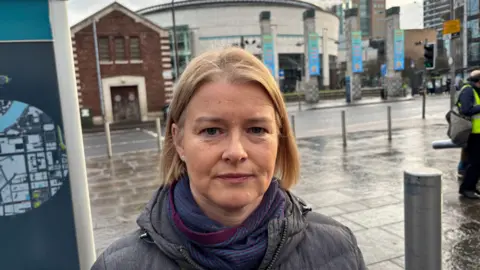
Anne Madden, from the Walk Wheel Cycle Trust, said it was "very concerning" as the "experimental scheme is meant to be assessing the impact of taxis on the operation of bus lanes".
"We have and remain opposed to all taxis sharing bus lanes, primarily due to the safety of people cycling," she added.
Meg Hoyt, chair of the Belfast Cycle Campaign group, said that cyclists had "come to expect this type of superficial engagement from the department".
She said that more taxis in bus lanes was a "step backwards" on addressing traffic congestion and "adds another element of risk" for cyclists.
Belfast black taxi driver Robert McAllister said that "all taxis should be in the bus lanes" except for Ubers.
"That's my honest opinion, because we're all part of the transport system," he said.
On the concerns of some cyclists, he said that taxi drivers are "professional drivers" and "highly experienced".
DfI was approached for further comment.
On its consultation webpage, the department said that during the latest extension of the scheme it would be "assessing the impact of the taxis on the operation of the bus lanes".
"This will include seeking data on the safety of bus lane users, as well as any impact on journey times, vehicle speeds and volumes," it added.
In January 2025, the head of Northern Ireland's public transport operator, Translink, told a Stormont committee he had "concerns" about more taxis being allowed in some bus lanes.
But Chris Conway said he could "understand why" the decision was made, which followed concerns over roadworks near Grand Central Station.
