The revival of centuries-old festive tradition

 Culture Vannin
A long-forgotten festive tradition is making a comeback, thanks to a short-film produced by the body that promotes the Isle of Man's culture.
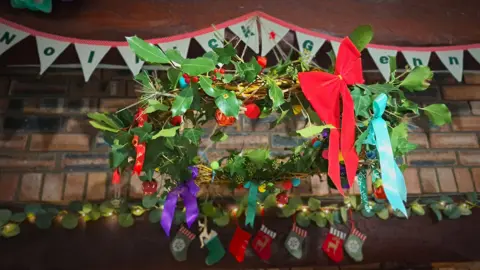
The Kissing Bush, a wreath-shaped ornament hung from the ceiling and decorated with ivy and holly, was a feature of the traditional Manx Christmas for centuries.
But the tradition became an item in the footnotes of history, after being phased out as the Christmas tree became more popular in people's homes about 150 years ago.
The bush came into prominence during the Kegeesh Ommidjagh - or Foolish Fortnight - which allowed for a festive degree of eating, drinking, partying and enjoying the pleasure of life with impunity.
'Sense of place'
James Franklin, online and educational resources officer at Culture Vannin, said the Kegeesh Ommidjagh was in opposition to the Victorian ideals of Christmas being a time of "family, goodness and charity", with a decorated tree standing to promote these values.
"All non-essential work was put aside and people instead dedicated themselves to having fun, drinking too much, having a feast, dancing and foolish activities, that's where the Kissing Bush comes in," he said.
"It's a part of the home which allows people to act differently and have fun - such as kissing people."
Whilst mistletoe never caught on in Manx households, the Kissing Bush took different forms throughout the British Isles.
Its English equivalent was more "a chopped off bit of bush" whereas its Manx counterpart was a ceiling-hung wreath decorated with holly and ivy.
Mr Franklin said the Isle of Man was unique in its keeping of traditions, such as the Kissing Bush.
"We're in the middle of everything," he said, "we have this melting pot."
"A lot of our traditions were ones once shared but died out elsewhere, and we've stayed true to these older ways of doing things which are inevitably more connected to the seasons and the landscape.
"[Our traditions] give us a sense of place, which is something Manx people have done for generations."
 Jo Callister
Jo Callister, who teaches at the Bunscoill Ghaelgagh in St John's - the only Manx-speaking school in the world - said bringing the outside in was and important part of the season for her.
"[The Kissing Bush] is definitely part of our Christmas tradition," she said.
It was a conversation starter for when she had guests arrive into her home, she said, adding that she would keep and collect sentimental items throughout the year to hang on her Kissing Bush.
She said: "I've used my sister-in-law's wedding bouquets, ribbons from Christmas wrappings and the ribbons my nieces used to wear.
"It's great to go out and forage for the things we weave into our bush, we're lucky to live on such a beautiful island."
Centuries old
The Kissing Bush has a long history, and mention of it has cropped up in publications and correspondence dating back more than a century and a half.
In 1860, a Manx woman who emigrated to the state of Kansas wrote a letter detailing Christmas on the island.
She said the day was full of "tantalising social and festive remembrances of mirth and jollity and unalloyed happiness... with romping under kissing bushes and other delicious exercises".
Three years later, the Manx Sun claimed "no orthodox Manx matron would consider her decorations complete without the evergreens and to the maidens, the kissing bush is indispensable".
The Kissing Bush was eventually phased out yet one was displayed in Douglas in the 1950s.
"Lots of people came to see it as a bit of a novelty," Mr Franklin said.
Read more stories from the Isle of Man on the BBC, watch BBC North West Tonight on BBC iPlayer and follow BBC Isle of Man on Facebook and X.
