'Revolutionary' new cancer jab not yet available for NI patients

 Getty Images
A leading cancer researcher has said that Northern Ireland patients should not be left behind in a "postcode lottery" as a new injectable cancer drug is rolled out across other parts of the UK.
The treatment, a new injectable form of the immunotherapy drug pembrolizumab (Keytruda), is expected to significantly reduce the time thousands of NHS patients spend in hospital.
Prof Mark Lawler, from Queen's University Belfast, said the scientific community will be "calling out" for patients to have rapid access to the drug.
The Department of Health (DoH) said it is "aware" of the jab and is "exploring" how it can be made available to patients in Northern Ireland "as soon as possible".
Following approval from the UK's medicines regulator, NHS hospitals in all four UK nations can make orders for subcutaneous pembrolizumab.
It is up to local trusts and hospitals to implement rollout on their timelines, a firm representing the drug's manufacture, Merck Sharp & Dohme, told BBC News NI.
Keytruda, which is already used to treat multiple cancers, is a type of immunotherapy that helps the body's own immune system attack cancer cells.
The injectable version is being rolled out for patients in England and Wales from Monday.
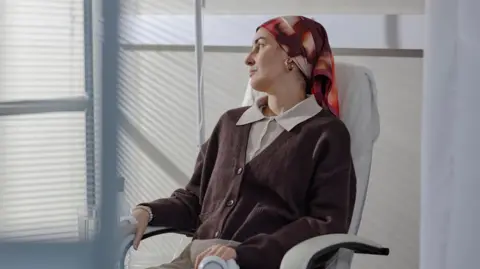
Since 2015, NHS patients have received the world's best-selling drug through a drip – or intravenous infusion – which can take more than an hour to administer in hospital.
In its new form, the treatment will be given every three weeks as a one-minute injection or every six weeks as a two-minute injection, depending on an individual's cancer diagnosis.
NHS England says the new injection should save patients and staff valuable time.
'Revolutionary'
Lawler has more than 30 years experience in cancer research.
He told BBC Radio Ulster's Good Morning Ulster programme the new form of the drug is "such an important development".
"It's something that's revolutionary in a way.
"A really novel approach to treating cancer which is probably the biggest development in the last 25 years in terms of immunotherapy."
He added that it is "good news" for patients but also "good news for the health system, because the health system can then do things much more quickly".
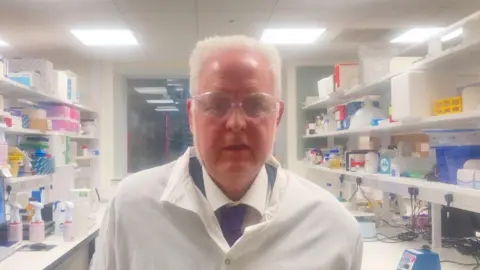
Lawler said that it is "not good" that the drug is not yet available in Northern Ireland.
"The first thing we need to do is get it for Northern Ireland… we don't want yet another postcode lottery.
"We really need to set the scene so that if we're in the UK we get the same treatment whether we're in Belfast, Birmingham, Bradford or Burton-on-Trent," he added.
"I've spoken to my colleagues in Scotland and they're equally as annoyed as I am that we're not getting this to our patients.
"I'm delighted that the DoH are looking for ways to get the [drug] approach to patients in Northern Ireland, and we're certainly happy to help in anyway that way we can."
'Win-win situation'
Lawler said he cannot "specifically comment" on whether the reason Northern Ireland does not have it yet is due to departmental finances, but that would be his "sense of the issue".
"I'm guessing part of the thing is in relation to funding, but it's also important to recognise - sometimes you have to actually look at something and say 'this is something that is going to help save money for both the health system, and also deliver the best possible care for cancer patients' - surely that's a win-win situation?
"I understand there are issues but we are giving out about waiting times, this is one approach that would actually save us some time," he added.
"Certainly the capacity isn't an issue because it saves time… it's not a logistical problem, it must be a financial problem."
What is immunotherapy?
Cancer can hide from the body's own immune system by producing proteins that send a "stop signal" telling our immune cells not to attack.
Some scientists describe this as the disease hiding behind an "invisibility cloak".
Immunotherapy works by blocking the signal allowing those cancer cells to be more easily recognised and destroyed.
That discovery won two scientists - James Allison and Tasuku Honjo - the Nobel Prize for medicine in 2018.
Keytruda was one of the earliest immunotherapy drugs to be approved, first for skin cancer and later for other forms of the disease.
By most measures it is now the biggest-selling prescription medicine in the world, with global sales of $30bn (£22bn) in 2025.
Until now, hospital pharmacy teams have had to prepare a bag of the drug under sterile conditions which is then given as an infusion into the vein through a cannula.
