'We've seen huge benefits since banning mobiles'

 Debbie Tubby/BBC
A secondary school which banned smartphones has seen "huge benefits" for students both academically and socially, according to its head teacher.
Pupils at The Netherhall School in Cambridge have been unable to access their mobiles during school hours since the beginning of the academic year.
Principal Chris Tooley said their absence meant students could "concentrate fully on their learning".
The government has been under pressure to bring in a statutory ban of smartphones in schools, although recent research suggested strict bans were not a "silver bullet".
 DJ McLaren/BBC
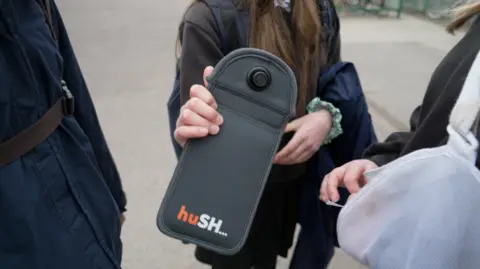
The pouches cost £20 each, which was a big chunk out of the school's budget but was "money well spent", according to Tooley.
"Safeguarding is of paramount importance and it does come at a cost," he said.
"And we've seen huge benefits in terms of students speaking with each other and attending clubs; it's made it all worthwhile."
In January, the Department for Education strengthened its existing non-statutory guidance, advising schools that they should be phone-free during school hours.
 Debbie Tubby/BBC
Netherhall's 1,300 pupils queue up each morning to put their phones into lockable pouches and are unable to retrieve them until the school day is over.
"I do think it can help with distractions, but then sometimes it feels a lot in the morning when we're coming in and everyone has to line up in the morning when we put them in the pouch," said Megan, 16.
She admitted she has been caught with her phone in her bag and as a result had to "fill out a work booklet about why phones can be distracting during the day".
"There's no distractions anymore, so it's nice not having that distraction in the background," she said.
 Debbie Tubby/BBC
Before the ban, pupils were supposed to put their phones on silent mode while in the classroom, although student Nico, 16, reckoned "no one was really following the rule".
The new system "stops people who are addicted to their phones, which is a lot of people nowadays", he added.
Tooley agreed, saying: "Some students have struggled with the transition to placing the phone in the hush pouch because developers are trying to make mobile phone apps which are addictive.
"Even with with phones turned on to silent, the vibrations saying notifications kept arriving and the absence of that allows students to concentrate fully on their learning."
Maths teacher Janay Fehr said levels of concentration had improved.
"We definitely noticed a difference with some of those students who were distracted, shall we say, from notifications," she said.
"[Now] the students come in to lesson and they're not trying to sneak a peek at those notifications and they are just focused in on the learning."
 Debbie Tubby/BBC
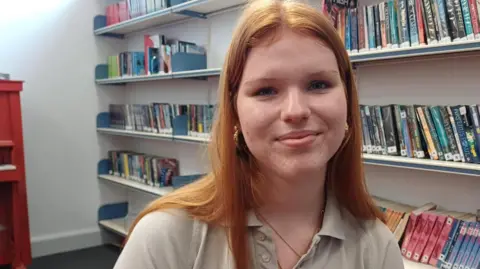
Evie, 16, welcomed the ban, saying: "I definitely used to see a lot more people just on their phones in the middle of lessons and I think now it is more social and everyone's listening to the teachers and people concentrating."
However, when the phones were retrieved at the end of the school day, "everyone's on their phones and they're just walking, not really talking to their friends".
She suspects she uses her phone more at home as a result.
This was similar to findings from the University of Birmingham published last week, which suggested restrictive policies boosted face‑to‑face interaction at school, but could also contribute to some pupils using their phones more at home, affecting sleep and physical activity.
 Debbie Tubby/BBC
Fifteen-year-old Phoebe said she found break times had become more enjoyable since the ban.
"Now people are contributing or being social and playing with their friends," she said.
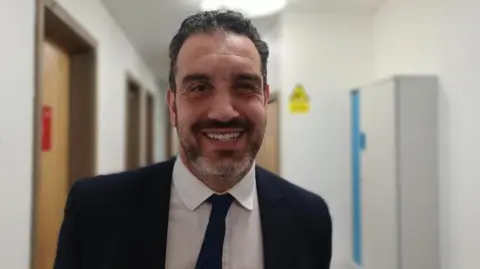
The ban was suggested by Karim Marsaoui, Netherhall's deputy principal and safeguarding lead, who said children were "facing different challenges" to those he faced at school.
"It's about keeping some of the positives from the past and also adapting and appreciating future technologies - and having a fine balance between the two," he said.
The school had communicated its plans to parents throughout, he added.
 Debbie Tubby/BBC
Pepe Di'Asio, general secretary of the Association of School and College Leaders, believes most teachers will "welcome the principles of confiscating phones".
"There's no doubt that the government have left the policing of mobile phones on the heads of head teachers in schools," he said.
"And we're happy to do that because we think it's appropriate, but we need the resources to make that policing a reality to help us help the young people navigate the school day and take them away from their phones."
Last month, the House of Lords backed an amendment to the Children's Wellbeing and Schools Bill to ban smartphones in schools.
The government is also currently consulting on banning social media for under-16s in the UK as a part of a series of measures which it says are intended to "protect young people's wellbeing."
Follow Cambridgeshire news on BBC Sounds, Facebook, Instagram and X.
