The SQA has been scrapped. Why and what now?
 Getty Images
Scotland's exams body - the SQA - has been scrapped and a new organisation called Qualifications Scotland is taking its place from Tuesday.
Critics have called the change a "superficial rebrand", especially as the new body will have many of the same staff as the old one, but its stated aim is to "reset relationships with learners and teachers" in order to "win back trust".
According to Andrea Bradley, the head of Scotland's largest teaching union the EIS, the new body will need to do that. She says teachers have lost confidence in the SQA.
She told the BBC the exams body had not acted in a way that would win friends and influence people in the education system.
The final straw was the 2020 exams fiasco when pupils were unable to sit exams due to Covid, Ms Bradley said.
"Teachers were asked to provide an assessment grade for young people based on professional judgement," she said.
"Rather than accept this, the SQA applied an algorithm that resulted in some young people from the poorest backgrounds having their awards downgraded."
John Swinney, who was education secretary at the time, had to intervene and tell the SQA to restore the grades of 125,000 students.
"That was the proverbial nail in the coffin," Ms Bradley said.
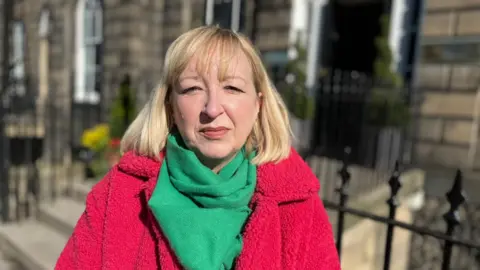
The union leader said that while the staff within the SQA who had worked with schools were spoken very highly of, the organisation overall did not have many voices speaking up for it because of the manner in which it had engaged with the teaching profession over the years before.
In 2021, an OECD report, commissioned by the Scottish government, found a "misalignment" between the aims of the school curriculum and the narrow focus on exams in the later years of high school.
The report said the "visionary ideals" of the "curriculum for excellence" had not fully succeeded, with the qualifications system run by the SQA called a "barrier" to its aims in secondary education.
The announcement that the SQA would be scrapped came in June 2021 but it has taken more than four years for the new body to be put in its place.
A review of Scotland's education bodies in 2022 by Prof Ken Muir called for reform and highlighted a growing disconnect between the SQA and teachers - with a reluctance to listen on the part of the exams body.
It called for a "significant cultural and mindset change" at all levels as well as a "redistribution of power, influence and resource within Scottish education".
Ms Bradley said: "Simply rebranding and changing the title and logos is not going to cut it for EIS members.
"There has to be demonstrable willingness from Qualifications Scotland to engage with teachers as professionals now."
One of the key aims of the changes is to involve teachers and learners in decision-making, with new committees set up to include both.
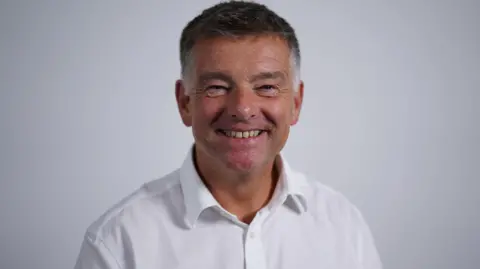
Nick Page, chief executive of the new Qualifications Scotland, admitted there was a "clear and compelling need for change".
"The arrival of Qualifications Scotland represents not just a fundamental reset but the critically important opportunity to transform what and how we assess learning in Scotland," he said.
Mr Page said it would be an organisation that listens, learns and evolves.
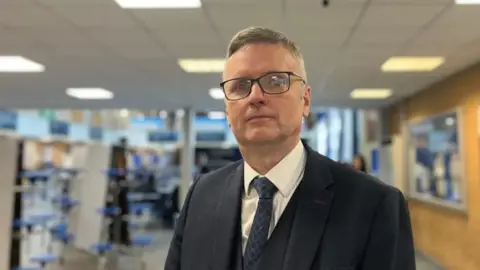
The new organisation will have to work at pace on education reform as new qualifications at National 4 and National 5 level will be launched in 2031 with changes to Higher and Advanced Higher level brought in by 2032.
It's likely changes to assessment will happen before then, with revisions to curriculum guidance due in 2027.
John McGhee, interim executive director of education at Glasgow City Council, was a classroom teacher for several decades before entering management.
He believes that skills which are aligned to work need to be at the heart of the new organisation.
"My hope is that Qualifications Scotland and Education Scotland will talk to each other about vocational qualifications, which have to be provided at scale," he said.
"There is a real opportunity for Qualifications Scotland to get involved in a re-evaluation of the Scottish curriculum at the senior phase to try to marry it to opportunities in terms of the changing employment scene, particularly growth areas such as renewables and defence."
Newly-released research carried out by the SQA itself in 2024 showed that only one in five learners, parents and educators thought the exams body had successfully earned back trust.
In contrast, SQA qualifications themselves had high levels of credibility among the education community.
Feedback from those within the school community who felt the SQA had low credibility gave a range of reasons from perceived inaccurate marking of exams to a lack of overall consistency.
Others cited last year's Higher History exam where a slump in grades was blamed on poor responses from students.
Teachers had accused the SQA of "moving the goalposts" and said there had been stricter marking and greater detail required.
Gavin Yates, the executive director Scottish parents' organisation Connect, said he was not surprised by the research.
He said the SQA sometimes appeared remote and not in tune with the needs of all learners, despite having some very committed staff.
"The demise of the SQA was caused by a lack of confidence in the organisation by the Scottish public," he said.
"The issues that came to a head post-Covid very publicly were not particularly new and the Holyrood education committee had warned back in 2017 that the body needed to rebuild trust.
"All large organisations have issues from time to time and it is understandable that mistakes are sometimes made.
"However, the establishment of Qualifications Scotland offers a chance to turn a page but they now need to ensure that the needs of learners, the views of educators and parents are right at the heart of what they do going forward."
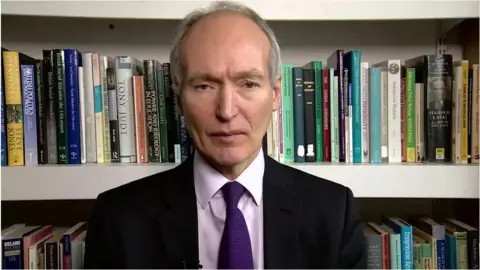
Lindsay Paterson, professor emeritus of education policy at the University of Edinburgh, said one of the criticisms of the SQA was that it both set the exams and oversaw the standard of the qualifications.
It became its own policeman, he said.
Others have likened it to "marking its own homework".
Prof Paterson said: "What should have happened was that they set up a completely separate accreditation body to introduce a degree of distance between accrediting qualifications and the awarding of them."
He said he thought the reorganisation was "a great missed opportunity".
"It could have been a moment in which we started to think differently about assessment in Scotland, reform exams and tackle AI," he said.
"It's not at all clear why these changes are happening, the government thinks reforming the management structure is going to bring about change and there is no evidence that will happen."
Prof Paterson said imaginative thinking would be needed to change the system.
"If you want to address the fundamental weakness of our assessment system, you need to bring in people from the outside," he said.
"Why aren't we learning from around the world? We need critical external perspective."
A Scottish government spokesman said: "The creation of Qualifications Scotland is a pivotal moment in the education reform programme."
Education Scotland
Qualifications Scotland will becomes fully operational in February 2026, officially taking over all statutory qualification awarding and accreditation functions from the SQA.
New certificates will be issued from this point and the new brand will also be launched.
The education inspectorate is also experiencing a process of transformation as a result of recent education reforms.
A new office – His Majesty's Chief Inspector of Education in Scotland – was created in November in order to separate school inspection responsibilities from Education Scotland, who will now focus on curriculum development.
It is expected to be fully operational by the end of the year, after an order is passed by the UK parliament.
