Doctors could go to Australia over specialty training shortages

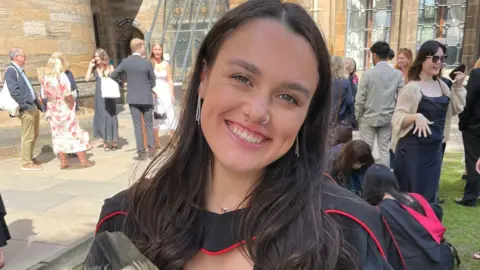 Alex Easson
Resident doctors have told the BBC there is a shortage of the specialist training places they need to take their careers forward, with some thinking about moving overseas as a result.
After five years of medical school, doctors complete two years of foundation training before applying for specialisms such as surgery, anaesthetics or general practice.
However, the competition for these places is intense, leaving some young doctors anxious about their future prospects.
Alex Easson is in the middle of her first foundation year, rotating around different specialities, but she wants to get into orthopaedic surgery.
"Last year for the west of Scotland there were six training positions and almost 300 people applied," she told Radio Scotland Breakfast.
The 24-year-old, from the Glasgow area, said she was studying for postgraduate exams, attending conferences and completing research alongside her full-time job to strengthen her application.
But there are no guarantees.
"My concern is all of this hard work that I'm doing now still doesn't guarantee me a place in a training programme," she says.
Alex said if she does not get a speciality training place she'd have to take a year working as a resident doctor but not progressing towards becoming a consultant, although these "fellow" years are also difficult to get.
"I'll be honest, I am looking into moving to Australia because if I do need to do a year where I'm working but I'm not necessarily progressing in my training, it is very appealing to move to a country where you are paid more and the working conditions are better," she said.
Resident doctors who wanted to highlight the issue got in touch with the BBC through Your Voice.
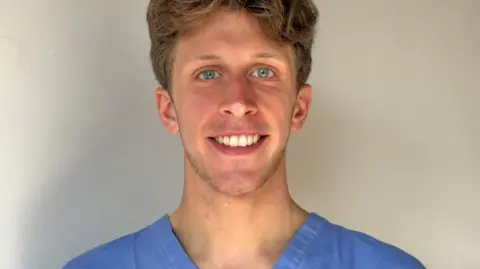 Sam Gurling
The Scottish government said it had increased the number of places available and that most doctors eventually secure a training post.
But Sam Gurling, who is also in his first foundation year, says many resident doctors feel anxious about their prospects.
"Training ratios are still massively high and generally I feel worried about not getting a job," he said.
"Even locum jobs are few and far between. I honestly don't know what I will do if I can't secure a job."
Sam, from Glasgow, says he wants to specialise in anaesthetics which had more than 6,700 applicants for 539 posts across the UK last year - about 12 applicants per place.
"I know plenty of brilliant doctors that are a few years ahead of me that would make fantastic anaesthetists who have been trying very hard to get posts yet are reapplying year after year," he said.
"Three or four years in and they still haven't got a post."
He said there was a growing "bottleneck" in the pipeline from medical student to becoming a consultant or GP.
"We are increasing the medical students places but not increasing the training posts in accordance with that," he said.
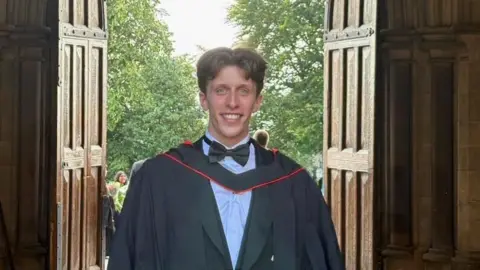 Sam Gurling
After graduating from medical school, doctors complete two years of foundation training, known as FY1 and FY2.
After that they apply for specialist training programmes, such as surgery, anaesthetics or general practice.
There are no separate statistics available for Scotland, but recruitment figures for 2025 have been published for the whole of the UK.
Those figures show that while the number of applicants per vacancy can be quite low for some specialities, that contrasts with areas like community sexual and reproductive health, where there were 1,379 applicants for 14 jobs
A combined general practice and public health programme had 2,173 applicants for 13 places, while cardiothoracic surgery had 737 applicants for 10 posts.
The competition can also be intense in larger programmes such as anaesthetics or clinical radiology, which had more than 4,000 applicants for 356 places.
Data shows the number of doctors coming through training in Scotland has been increasing.
The number completing medical degrees has risen steadily in recent years, from 1,315 in 2010/21 to 1,565 in 2024/25.
Scottish Health Secretary Neil Gray told Radio Scotland Breakfast he wanted to avoid doctors like Alex going abroad.
He said: "I would say to Alex you are wanted here, we need you here."
He said many who do go to Australia come back to Scotland and they are very welcome to rejoin the NHS.
The health secretary said measures were in place to address concerns over pay and conditions.
"We are also investing 10% more this year in funding those specialty places to increase availability," he said.
Gray also said he was working with the UK government on UK graduates being prioritised for specialty training places.
But the health secretary said the system needed to be competitive to ensure that the best graduates were moving into these speciality roles.
"I also recognise that we need to get the balance right," he said, which was why places were being increased.
Gray said, based on data from the General Medical Council, about 90% of doctors secure a training post within three years of completing foundation training.
Many spend time in temporary clinical roles or take time out before entering specialist programmes.
However, resident doctors say the period immediately after foundation training can still involve significant uncertainty.
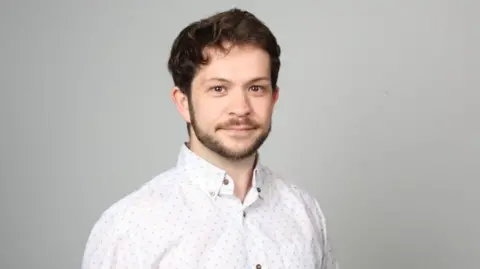 BMA
BMADr Chris Smith, chair of the British Medical Association (BMA) Scotland's resident doctor committee, graduated five years ago and has had three attempts at securing his own specialism training.
He said many resident doctors across the country were in a similar position and it was leading them to consider options that ideally they would not want to.
"At a time when patients are already worried about access to health care, it beggars belief that a new cohort of medical graduates are already considering moving country, taking a career break or even exploring a different career path," he said.
"Quite simply, there are not enough training places or jobs to allow them to continue to practise medicine in Scotland."
"We are at risk of losing people," he said.
"We are investing in highly qualified professionals who want to live, work and care for people in Scotland but are just not able to do so.
"We need a big increase in specialty training posts and bring down some of those competition ratios."

