Iran judiciary denies plan to execute detained protester Erfan Soltani
 Facebook via Reuters
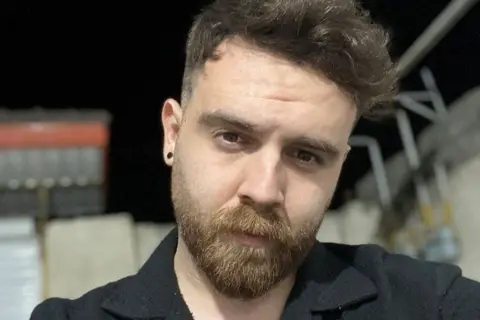
Iran's judiciary has denied it scheduled the execution of a man arrested in connection with the country's recent protests.
Norway-based Kurdish human rights organisation Hengaw said earlier this week that the family of Erfan Soltani, 26, had been told he faced execution on Wednesday, only days after he was detained.
On Wednesday, Hengaw cited them as saying Soltani's execution had been "postponed" but warned that "serious and ongoing concerns" regarding his life remained.
"This is good news. Hopefully, it will continue!" said US President Donald Trump, who had warned Iran not to execute protesters.
The Iranian judiciary said Soltani faced charges of "colluding against national security" and "propaganda activities against the establishment", which are not punishable by the death penalty, state broadcaster IRIB reported.
It called reports by foreign media organisations that Soltani faced execution a "blatant act of news fabrication".
Iranian Foreign Minister Abbas Araghchi also said in an interview with US television that there was "no plan" to hang people.
It came after Trump threatened to take "very strong action" if executions were carried out, amid mounting speculation of possible US military strikes.
On Wednesday, he told reporters that "very important sources on the other side" had informed him "the killing in Iran is stopping, and there's no plan for executions".
Soltani, a clothes shop owner, was arrested at his home last Thursday in connection with the protests in the northern city of Fardis, west of Tehran, according to the group and his family.
However, the judiciary said he was arrested during "riots" on Saturday and was being held in a prison in the neighbouring city of Karaj, according to IRIB.
Speaking to the BBC from Europe, a relative called Somayeh said Soltani was still in jail and she remained concerned about him, although she had heard very little news because of the internet blackout in Iran.
However she said a message sent via the Starlink satellite internet service had said he had not had a defence lawyer and his family were under a lot of pressure from the authorities.
"Erfan is the heart of that family. He's a very calm, very kind person," she said, adding that he loved photography, sport and animals and had just wanted "basic rights" for himself and the people of Iran.
"He had thousands of hopes for himself and other young people."
Somayeh said the Iranian government had hoped that executing Erfan would "scare people into stopping the protests".
"They didn't have any reason to arrest Erfan. There are many Erfans. The only strategy of the government is to end the protests this way," she said.
Later on Thursday, the US Treasury department said Trump had directed it to impose new sanctions on five senior Iranian officials whom it accused of being "the architects of the Iranian regime's brutal crackdown on peaceful demonstrators".
They included the secretary of the Supreme Council for National Security, Ali Larijani, who the Treasury said co-ordinated the response to the protests, as well as the commanders of the Revolutionary Guards and police forces in the western province of Lorestan and southern province of Fars, where the Treasury said security personnel had shot dead many civilians.
Responding to the judiciary's statement, the director of the Norway-based group Iran Human Rights said threats of the death penalty against detainees and their families were not uncommon.
The chief justice, Gholamhossein Mohseni-Ejei, has advocated for the swift trial and punishment of arrested "rioters".
"Those elements who beheaded people in the streets or burned people alive must be tried and punished as quickly as possible," he said in a video on Wednesday. "If we don't do it fast, it won't have the same impact."
Justice Minister Amin Hossein Rahimi meanwhile said that any individual arrested during the protests that took place between last Thursday and Saturday was "definitely a criminal".
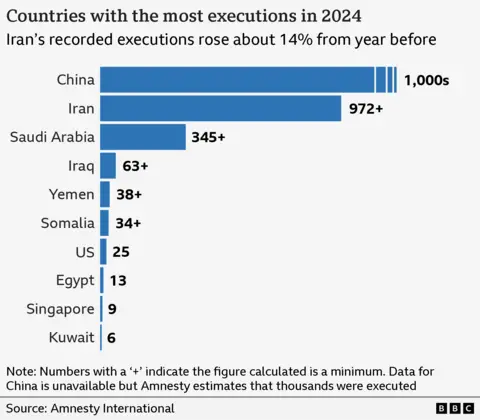
Over the past three years, Iran has hanged at least 12 men who were sentenced to death in connection with the 2022 "Woman, Life, Freedom" protests. Human rights groups said their convictions came after torture-tainted "confessions" and grossly unfair trials.
The current wave of protests began after shopkeepers in Tehran went on strike over the rising cost of living and the depreciating value of the currency.
They quickly spread across the country and turned against Iran's clerical establishment, particularly the Supreme Leader, Ayatollah Ali Khamenei. The slogans chanted by demonstrators have included "Death to the dictator" and "Seyyed Ali [Khamenei] will be toppled this year".
The protests escalated significantly last Thursday and were met with deadly force by authorities, masked by a near total shutdown of the internet and communication services.
According to the US-based Human Rights Activists News Agency (HRANA), at least 2,453 protesters have been killed since the unrest began, as well as 14 children, 156 people affiliated with the security forces or government, and 14 uninvolved civilians.
It reports that another 18,470 protesters have been arrested.
Iran Human Rights says it has so far verified the killing of at least 3,428 protesters by security forces and estimates that around 20,000 people have been arrested.
Canada's Foreign Minister, Anita Anand, said on Thursday that a Canadian citizen had "died in Iran at the hands of Iranian authorities", without identifying them.
"Peaceful protests by the Iranian people - asking that their voices be heard in the face of the Iranian regime's repression and ongoing human rights violations - have led the regime to flagrantly disregard human life," she added.
The International Federation of Red Cross and Red Crescent Societies also said a staff member of the Iranian Red Crescent, Amir Ali Latifi, had been killed and five of his colleagues wounded "in the line of duty in Gilan province" on 10 January.
