Sanctioned oil tanker enters UK waters day after government crackdown threat

 BBC
BBCAn oil tanker sanctioned by the government has sailed through the English Channel - entering UK waters - a day after a threat from ministers that such vessels can be boarded by UK armed forces.
At one point, the VAYU 1, which has been sanctioned for carrying oil from Russia, was around six nautical miles off Dover, according to ship-tracking data.
It was tracked to this location on 26 March, the day after the government announced that UK forces had been given permission to board sanctioned ships transiting UK waters.
When asked why it had not been stopped, the Ministry of Defence (MoD) told BBC Verify "any enforcement action is considered on a case‑by‑case basis".
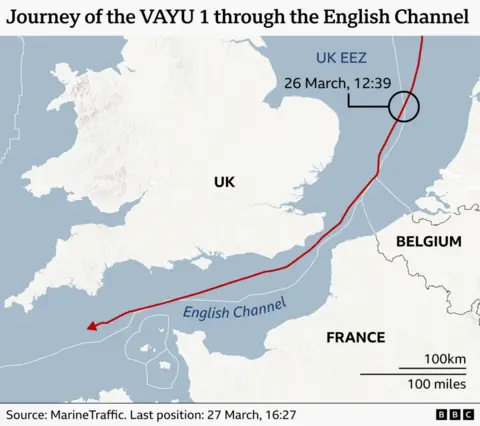
The Cameroon-flagged VAYU 1 began its journey from the Russian city of Murmansk on 10 March 2026, according to MarineTraffic. Data suggests it is carrying a full cargo.
It first entered UK waters on 26 March at 12:39 GMT and its presence was spotted by a user on X.
Its final destination is not listed on the ship-tracking website.
The UK government added the VAYU 1 to its sanctions list in May 2025 due to suspected involvement in carrying Russian oil.
The sanctions notice said the ship "is involved in activity whose object or effect is to destabilise Ukraine… or to obtain a benefit from or support the government of Russia. Namely, VAYU 1 is involved in carrying oil or oil products that originated in Russia from Russia to a third country".
Russia has been accused of operating a so-called "shadow fleet" of tankers with opaque ownership structures in an attempt to get round international sanctions on its oil exports.
The tanker's journey
On 25 March, the government announced that it had given permission for its forces to board sanctioned ships transiting UK waters.
It is unclear what the government defines as "UK waters" and we have asked it to clarify this.
It could either refer to the UK's territorial waters, which extend up to 12 nautical miles from the coast, or the UK's Exclusive Ecomomic Zone (EEZ) - which reaches up to 200 nautical miles from the coastline.
BBC Verify analysed the journey of the VAYU 1, revealing it spent at least 5 hours and 30 minutes in the UK's territorial waters and 29 hours in the UK's EEZ.
Its last location was around 40 nautical miles south of Plymouth and still in the UK's EEZ.
The BBC revealed that ministers had identified a legal basis in January to board sanctioned vessels, but the announcement that approval for the measure had been given by the prime minister was announced on Wednesday.
Sir Keir Starmer said the move would increase pressure on Russia, which uses oil sales to help fund its invasion of Ukraine.
"Putin is rubbing his hands at the war in the Middle East because he thinks higher oil prices will let him line his pockets.
"That's why we're going after his shadow fleet even harder."
BBC Verify asked the MoD if it was aware that the VAYU 1 had entered UK waters and whether it planned to intervene.
In a statement, it replied that "any enforcement action is considered on a case‑by‑case basis, in accordance with international law and domestic legislation".
However, it also added that it would "not provide a running commentary... as this could compromise our ability to successfully take action against sanctioned ships".
How could a seizure be carried out?
There are a number of ways the Royal Navy can detain ships, says Prof Kevin Rowlands from the Royal United Services Institute (RUSI) and a former Navy captain.
"First, identifying and tracking the vessels is reasonably straight forward. The list of shadow fleet ships is well known and surveillance in UK waters is pretty comprehensive.
"Boarding will depend on the type of ship, its location, and local sea and weather conditions at the time. It could be by boat or, more likely, by helicopter."
"The navy has boarding teams consisting of sailors and Royal Marines. They are trained to safely embark on the ship, liaise with the crew, search the vessel, check paperwork and, if necessary, divert it under escort to a UK port."
Additional reporting by Daniele Palumbo

