Ancient wolf stomach reveals final secrets of extinct woolly rhino

 Cardiff University
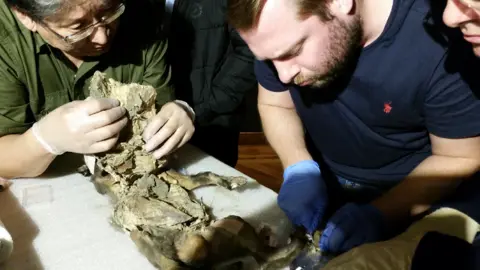
Scientists have made a world-first discovery after extracting woolly rhinoceros DNA from the stomach of a wolf dating back to the Ice Age.
The 14,400-year-old find offers rare insight into the final days of woolly rhinos, finding that they likely became extinct due to a rapid population collapse.
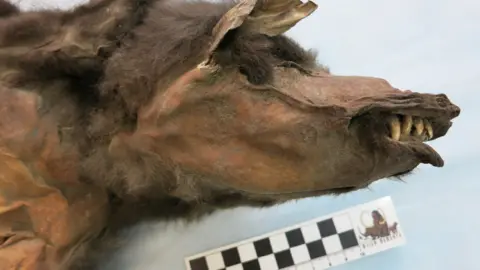
The DNA was found in the stomach of a wolf discovered near the village of Tumat, Siberia, with academics from Cardiff University involved in the study.
"Woolly rhinos had a viable population for 15,000 years after the first humans arrived in northeastern Siberia, which suggests that climate warming rather than human hunting caused the extinction," said Love Dalén, who was involved in the study.
The genetic material came from a fragment of preserved tissue found during the autopsy of the wolf, which lived around 14,400 years ago.
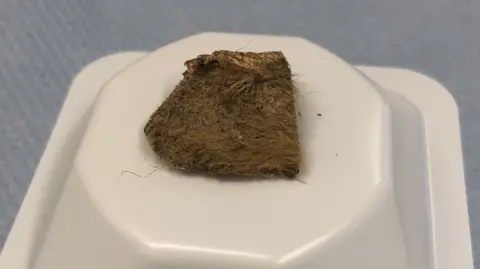
DNA testing later confirmed the tissue belonged to a woolly rhinoceros - one of the youngest specimens of the species ever identified - and the sample initially caused confusion in the laboratory.
Dr David Stanton, a researcher at Cardiff University's School of Biosciences, said: "It was a very unusual specimen to work on in the lab.
"It was initially identified as a piece of cave lion tissue, so it was quite a surprise when the genetic analysis showed that it was actually a woolly rhinoceros."
He added it was then researchers realised "how unique the specimen was".
"The date estimate, very close to when woolly rhinos went extinct, made it incredibly valuable for understanding how and why so many species went extinct at the time."
 Cardiff University
The international research team included scientists from Cardiff University, Stockholm University, the Swedish Museum of Natural History, the Greenland Institute of Natural Resources and North Eastern Federal University.
Their finding suggests woolly rhinos remained genetically healthy until shortly before they disappeared, pointing to a rapid population collapse rather than a slow decline.
"Sequencing the entire genome of an Ice Age animal found in the stomach of another animal has never been done before," said Camilo Chacón-Duque,from the Centre for Paleoegenetics.
He added that the research could help inform modern conservation efforts.
 Cardiff University
Researchers compared the new DNA with two older woolly rhinoceros DNAs dating back 18,000 to 49,000 years, which showed no increase in inbreeding or harmful mutations over time.
"This indicates that the woolly rhinoceros probably maintained a stable and relatively large population until just before the species disappeared," the researchers said.
